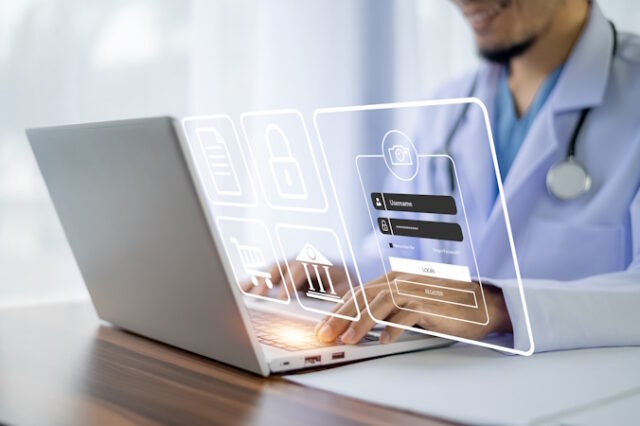
Protecting data in the healthcare industry is a complex task that requires careful consideration. Healthcare providers and their business associates face the challenge of safeguarding patient privacy while delivering high-quality care and complying with strict regulatory HIPAA compliance and the EU’s General Data Protection Regulation (GDPR).
Given that protected health information (PHI) is one of the most sensitive and valuable types of personal data, healthcare organizations and other entities involved in handling patient information must adhere to rigorous data protection guidelines. These guidelines aim to ensure the confidentiality and security of patient privacy, mitigating the risk of unauthorized access or misuse.
Cybersecurity in the Healthcare Industry
Restrict Access to Data
Implementing access controls strengthens healthcare data protection by limiting access to patient information and specific applications to only authorized personnel necessary to perform their duties, ensuring data privacy. Access restrictions necessitate user authentication, verifying that only authorized individuals have access to protected data. Multi-factor authentication is a recommended approach, as it requires users to verify their identity using two or more validation methods, guaranteeing secure access to sensitive data and applications.
Encrypt Data
Encryption is widely regarded as a highly effective method for safeguarding sensitive data within the healthcare sector. By applying encryption techniques to data both at rest and in transit, healthcare organizations strive to render patient information indecipherable to unauthorized individuals, even in the event of a security breach.

While HIPAA offers suggestions pertaining to encryption, it does not explicitly mandate its implementation, thereby allowing healthcare providers and business associates to exercise their discretion in selecting encryption methods and additional security measures.
To transfer electronic health records and at the same time guarantee medical data security, you need a VPN. One of the high-level VPNs that about 7% of healthcare companies use is VeePN. It is suitable for various areas of healthcare cybersecurity and personal use. For example, using VPN to access BBC iPlayer, you can unlock the entire library. This may be useful for the TV in the waiting room.
Vulnerability Management
A vulnerability management program plays a crucial role in healthcare organizations. By constantly monitoring systems, applying security patches, and staying up-to-date, vulnerabilities can be identified and addressed before they are exploited by attackers. This proactive approach significantly reduces the risk of exploitation and helps ensure the security and integrity of sensitive data.
Educate Healthcare Staff
The human element continues to pose a significant security risk across industries, particularly in healthcare. Simple human errors or negligence can lead to costly and devastating consequences for healthcare organizations. Security awareness training ensures that healthcare employees possess the necessary knowledge to make informed decisions and handle patient data with utmost care and caution.
Employees should also be trained to use the VeePN VPN proxy, which creates a secure data tunnel. Encrypted data using VeePN, even if intercepted, will not reveal important patient data.
Incident Response Planning
Effective incident response planning is a vital component in enhancing cybersecurity within the healthcare industry. This approach entails detecting, containing, and mitigating the impacts of an attack. Additionally, it should encompass well-defined communication protocols to promptly notify stakeholders such as patients, partners, and regulatory authorities.
Implement Data Usage Controls
Protective data controls offer advanced security measures that go beyond access controls and monitoring. These controls are designed to identify and block risky or malicious data activity in real-time.
In the healthcare sector, organizations can utilize data controls to prevent specific actions involving sensitive data, such as web uploads, unauthorized email sends, copying to external drives, or printing. Data discovery and classification play a critical role in this process by identifying and tagging sensitive data to ensure it is adequately protected.
Backup Data
Cyberattacks possess the capability to expose exceedingly sensitive patient information, thereby presenting risks to both the integrity and availability of data. An exemplary instance of the impact of such incidents can be observed through the rise of ransomware. Furthermore, the consequences arising from a natural disaster affecting a healthcare organization’s data center can result in catastrophic outcomes if appropriate measures for data backup are not established.
To mitigate these risks, it is of utmost importance to implement regular offsite data backups while concurrently enforcing stringent controls for data encryption, access, and adherence to other industry-recognized best practices. The inclusion of offsite data backup serves as a vital component in safeguarding against potential data breaches and ensuring the continuity of healthcare operations.
Conduct Regular Risk Assessments
Conducting regular risk assessments can help identify vulnerabilities or weak points in a healthcare organization’s security. It can also highlight shortcomings in employee education, deficiencies in the security posture of vendors and business associates, and other areas of concern. If your organization has a periodic risk assessment in place, you will be more likely to avoid leaks. You and your partners will learn to avoid potential problems before they even appear.
By implementing a multi-layered defense approach and adopting proactive policies and practices, healthcare organizations can greatly diminish the likelihood of a breach or unauthorized access to delicate patient data.
However, simply following best practices is no longer sufficient; it’s imperative for healthcare organizations to stay abreast of emerging technologies and stay in compliance with new requirements.
Disclaimer
Artificial Intelligence Disclosure & Legal Disclaimer
AI Content Policy.
To provide our readers with timely and comprehensive coverage, South Florida Reporter uses artificial intelligence (AI) to assist in producing certain articles and visual content.
Articles: AI may be used to assist in research, structural drafting, or data analysis. All AI-assisted text is reviewed and edited by our team to ensure accuracy and adherence to our editorial standards.
Images: Any imagery generated or significantly altered by AI is clearly marked with a disclaimer or watermark to distinguish it from traditional photography or editorial illustrations.
General Disclaimer
The information contained in South Florida Reporter is for general information purposes only.
South Florida Reporter assumes no responsibility for errors or omissions in the contents of the Service. In no event shall South Florida Reporter be liable for any special, direct, indirect, consequential, or incidental damages or any damages whatsoever, whether in an action of contract, negligence or other tort, arising out of or in connection with the use of the Service or the contents of the Service.
The Company reserves the right to make additions, deletions, or modifications to the contents of the Service at any time without prior notice. The Company does not warrant that the Service is free of viruses or other harmful components.