The arrival of spring is often celebrated as a season of rebirth, marked by blooming flora and rising temperatures. However, for the millions of Americans who suffer from seasonal allergic rhinitis, it also signals the start of a grueling battle against invisible aerial irritants. According to the 2026 AccuWeather Allergy Forecast, this year’s pollen season will be defined by dramatic volatility, with specific regions bracing for “intense bursts” of allergens fueled by a complex interplay of winter leftovers, spring rainfall, and fluctuating temperatures.
The Science of the Sneeze: How Weather Dictates the Sneeze
The severity of any given allergy season is rarely a fluke; it is the direct result of meteorological conditions months in the making. For 2026, the primary drivers are soil temperature, moisture levels, and the timing of the final spring frosts.
Warm ground temperatures act as a catalyst, allowing trees and plants to initiate their reproductive cycles earlier than usual. While heavy rainfall is often viewed as a “cleanser” that washes pollen out of the atmosphere, it serves a dual purpose. In the short term, a downpour provides relief by grounding airborne particles. In the long term, however, that same moisture nourishes the soil, leading to more robust plant growth and a subsequent, often more aggressive, spike in pollen production once the sun returns.

Wind also plays a critical role in the 2026 outlook. With active storm tracks projected across the central and eastern U.S., pollen can be transported hundreds of miles from its source, meaning even urban dwellers far from dense forests may find themselves struggling with “imported” allergens.
Tree Pollen: An Early Start and Regional Extremes
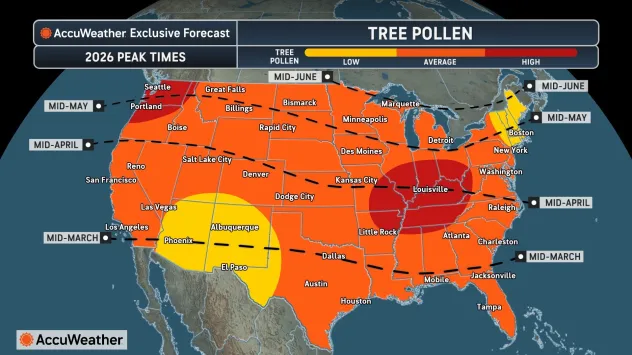
Tree pollen is the first major hurdle of the year, and in 2026, it is already making its presence felt. In the South and West—specifically Southern California, southern Arizona, and the Gulf Coast—the season has already begun in earnest.
One of the most significant “danger zones” identified for 2026 is the Ohio Valley. Residents in this region should prepare for exceptionally high tree pollen levels. AccuWeather notes that the combination of ample spring rain and subsequent warm spells will create “intense bursts” of pollen that could overwhelm standard over-the-counter treatments.
Interestingly, the forecast highlights a “frost dynamic” that could complicate the season. In areas like the Pacific Northwest, an early start is expected, but a late-season frost could briefly suppress counts. While this sounds like good news, AccuWeather Senior Meteorologist Alan Reppert notes that such frosts often lead to a rebound effect, where the pollen returns with even greater intensity later in the spring. In cities like Seattle and Portland, tree pollen levels are expected to remain elevated for several weeks, potentially reaching record highs.
Conversely, the Northeast and parts of New England may see a slightly more manageable tree pollen season. A colder start to the year and lower-than-average rainfall projections suggest that the “pollen explosion” may be more of a “slow burn” in these regions, though brief spikes remain possible.
Grass Pollen: The Mid-Season Shift
As tree pollen wanes in late May and June, grass pollen typically takes over. For 2026, the northern Plains and the Great Lakes are squarely in the crosshairs.
“A combination of above-average rainfall and some warmer weather will bring much higher grass pollen levels,” Reppert explained to AccuWeather. Major metropolitan hubs, including Chicago, St. Louis, and Minneapolis, are expected to see significant grass pollen activity. Because grass responds almost instantly to moisture, a single soaking rain followed by two days of sunshine can cause pollen counts to skyrocket.
In the South, the grass season is expected to be uneven. Texas may face a few weeks of very high levels, but the season is projected to be shorter than those in the North. Along the Gulf Coast, a drier start to the summer may actually keep grass pollen levels below historical averages, providing a rare bit of relief for residents in that corridor.
In the Western U.S., particularly the Northwest, hot and dry conditions are expected to dominate the summer months. This aridity is likely to keep grass pollen in check for much of the season, though any sporadic rainfall could trigger short-lived, 48-to-72-hour spikes.
Weed Pollen: The Late-Season Heavy Hitter
The final phase of the allergy year involves weed pollen—most notably ragweed, but also thistle, sagebrush, and mugwort. This season usually peaks in late summer and continues until the first hard freeze of autumn.
For 2026, the Rocky Mountains are bracing for an intense weed pollen season. Increased rainfall in the high elevations, combined with a projected delay in the first cold snap of autumn, means that weeds will have a longer, more productive window to release pollen.
In the Eastern U.S., the outlook is more varied. A swath of territory from eastern Texas through Kentucky and Alabama is expected to see lower-than-average weed pollen levels due to cooler-than-normal late-summer temperatures. In the Northeast, a lack of early-season rainfall may limit ragweed growth, potentially leading to a milder finish to the year, provided the region avoids a rainy late August.
The Health Impact: More Than Just a Runny Nose
For the nearly 60 million Americans living with seasonal allergies, these forecasts represent more than just a daily inconvenience. High pollen counts are linked to increased fatigue, decreased productivity, and a higher risk of asthma exacerbations.
Medical experts advise that because the 2026 season is starting early in many regions, patients should not wait for symptoms to appear before beginning their regimens. Starting intranasal corticosteroids or antihistamines two weeks before the predicted local spike can help “prime” the body and reduce the overall inflammatory response.
Mitigating the Risk: Strategies for 2026
While the weather cannot be controlled, exposure can be managed. Meteorologists and health professionals recommend several key strategies for navigating the high-pollen days of 2026:
- Monitor the “Morning Peak”: Pollen production typically peaks between 5:00 AM and 10:00 AM. High-risk individuals should move their outdoor exercise or gardening to the late afternoon or evening when counts often subside.
- The “Home Sanctuary” Approach: Keep windows closed, even on beautiful spring days. Use high-efficiency particulate air (HEPA) filters in HVAC systems to trap microscopic allergens that hitch a ride inside on clothes or pets.
- Decontaminate After Entry: After spending time outdoors, changing clothes and showering is essential. Pollen is notoriously “sticky” and can cling to hair and fabric, continuing to trigger symptoms long after you’ve come inside.
- Watch the Wind: On dry, gusty days, pollen counts can be high even if local vegetation isn’t blooming, as wind carries particles from neighboring regions.
Looking Ahead
As climate patterns continue to shift, allergy seasons are becoming longer and more robust. The 2026 forecast underscores this trend, showing that while some areas like the Northeast might catch a break, much of the country is entering a period of prolonged allergen exposure.
From the “pollen-filled air” expected under the blooming trees of the Ohio Valley to the late-summer ragweed surge in the Rockies, the 2026 season will require a proactive approach. By staying informed through localized forecasts and preparing medical interventions early, allergy sufferers can hope to enjoy the beauty of the season without the burden of its biological side effects.
The message for 2026 is clear: the pollen is coming, and in many places, it’s already here. Preparation today will be the key to breathing easy tomorrow.
Source: AccuWeather
Disclaimer
Artificial Intelligence Disclosure & Legal Disclaimer
AI Content Policy.
To provide our readers with timely and comprehensive coverage, South Florida Reporter uses artificial intelligence (AI) to assist in producing certain articles and visual content.
Articles: AI may be used to assist in research, structural drafting, or data analysis. All AI-assisted text is reviewed and edited by our team to ensure accuracy and adherence to our editorial standards.
Images: Any imagery generated or significantly altered by AI is clearly marked with a disclaimer or watermark to distinguish it from traditional photography or editorial illustrations.
General Disclaimer
The information contained in South Florida Reporter is for general information purposes only.
South Florida Reporter assumes no responsibility for errors or omissions in the contents of the Service. In no event shall South Florida Reporter be liable for any special, direct, indirect, consequential, or incidental damages or any damages whatsoever, whether in an action of contract, negligence or other tort, arising out of or in connection with the use of the Service or the contents of the Service.
The Company reserves the right to make additions, deletions, or modifications to the contents of the Service at any time without prior notice. The Company does not warrant that the Service is free of viruses or other harmful components.