WASHINGTON — New bombshell allegations that Secretary of Defense Pete Hegseth ordered U.S. forces to “kill everybody” aboard a suspected drug‑smuggling boat in the Caribbean have sparked outrage, legal warnings, and bipartisan congressional inquiries — threatening to upend his tenure at the Pentagon.
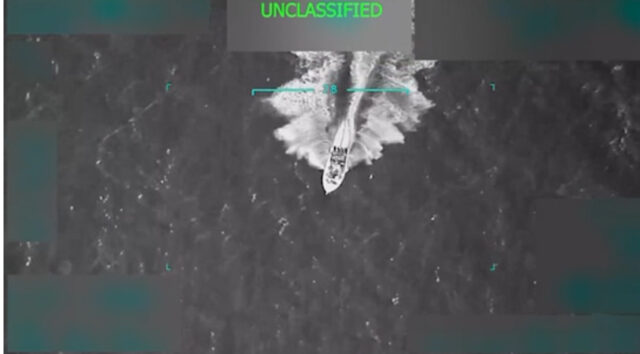
According to a recent report by The Washington Post, the September 2 strike initially wounded two suspected traffickers who were found clinging to their wrecked boat. A second missile strike reportedly killed them — allegedly to comply with Hegseth’s verbal “no survivors” directive.
Within days, the White House confirmed that Hegseth had authorized multiple strikes on the Venezuelan‑linked vessel — carried out by forces under US Navy Vice Admiral Frank Bradley. Thousands of miles later, the fallout continues. Press Secretary Karoline Leavitt insisted the missions were lawful, carried out in international waters, and justified under the law of armed conflict.
Late Update from the Associated Press: U.S. Navy Vice Admiral Frank Bradley will provide a classified briefing to key lawmakers overseeing the military on Thursday as they investigate a U.S. military attack on a boat allegedly carrying drugs that included a second strike that killed any survivors.

Still, experts in international law warn the reported order may constitute a war crime. As TIME noted, instructions to kill individuals no longer fighting — especially survivors at sea — violate the rules against targeting persons hors de combat.
Congressional backlash and calls for accountability
The alleged strike has triggered a rare bipartisan investigation by both the House and Senate Armed Services Committees. Among those demanding answers is Shri Thanedar (D‑Mich.), who is reportedly considering introducing articles of impeachment against Hegseth.
Senators from both parties — including Roger Wicker (R‑Miss.) and Jack Reed (D‑R.I.) — have pledged “vigorous oversight” to determine whether the Defense Department violated U.S. or international law.
Some lawmakers, including Mark Kelly (D‑Ariz.), called the second strike — targeted at survivors — unmistakably unlawful.
Even members of Hegseth’s own party have expressed concern; one senator publicly called for his resignation.
Hegseth’s defense and public reaction
Hegseth vehemently denies giving a kill‑all order, dismissing the Post’s reporting as “fabricated, inflammatory, and derogatory.” On X (formerly Twitter), he defended the Caribbean operations as “lethal, kinetic strikes” aimed at “narco‑terrorists” and insisted they complied with all legal standards.

But the controversy has only escalated. In one provocative move, Hegseth shared an AI‑generated image — depicting a familiar children’s book turtle as a warfighter firing a missile at a drug boat — which critics say mocks the gravity of the deaths.
Online outrage has been swift. One public critic posted on social media: “You’re a sick man”—a stark illustration of the growing public backlash.
Strategic shifts overshadowed by scandal
Only weeks earlier, Hegseth had unveiled sweeping reforms to Pentagon acquisition processes, arguing that the military needed faster procurement and more modernized systems — a pivot toward speed, innovation, and increased Indo‑Pacific readiness. But the damage to his credibility may now derail those ambitions.
As the investigations proceed, pressure is mounting not only for clarity and accountability — but for structural change. Legal experts, bipartisan lawmakers, and international observers argue that if the allegations are validated, Hegseth’s conduct could irreparably damage the U.S.’s moral standing and raise serious questions about military command oversight.
Whether the Biden‑era norms Hegseth criticized — including humane treatment of noncombatants — will be restored under scrutiny remains uncertain. Until then, the Pentagon’s aggressive anti‑narcotics campaign under his watch hangs in the balance.
Sources
- The Washington Post
- Reuters
- TIME
- Newsweek
- The Independent
- Axios
- KRNV
- The Washington Post
- Breaking Defense
- Yahoo
- AP News
Disclaimer
Artificial Intelligence Disclosure & Legal Disclaimer
AI Content Policy.
To provide our readers with timely and comprehensive coverage, South Florida Reporter uses artificial intelligence (AI) to assist in producing certain articles and visual content.
Articles: AI may be used to assist in research, structural drafting, or data analysis. All AI-assisted text is reviewed and edited by our team to ensure accuracy and adherence to our editorial standards.
Images: Any imagery generated or significantly altered by AI is clearly marked with a disclaimer or watermark to distinguish it from traditional photography or editorial illustrations.
General Disclaimer
The information contained in South Florida Reporter is for general information purposes only.
South Florida Reporter assumes no responsibility for errors or omissions in the contents of the Service. In no event shall South Florida Reporter be liable for any special, direct, indirect, consequential, or incidental damages or any damages whatsoever, whether in an action of contract, negligence or other tort, arising out of or in connection with the use of the Service or the contents of the Service.
The Company reserves the right to make additions, deletions, or modifications to the contents of the Service at any time without prior notice. The Company does not warrant that the Service is free of viruses or other harmful components.