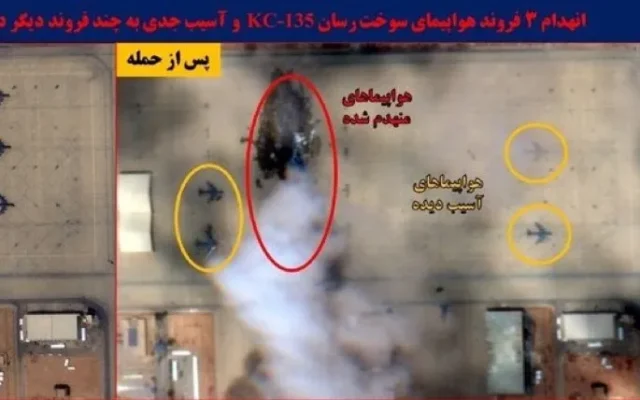
PRINCE SULTAN AIR BASE, Saudi Arabia — A major escalation in the month-long conflict between the United States and Iran occurred Friday, March 27, 2026, when a wave of Iranian ballistic missiles and one-way attack drones struck Prince Sultan Air Base (PSAB). The attack, which targeted the heart of American aerial refueling and surveillance operations in the Kingdom, resulted in at least 10 U.S. service members being wounded and significant damage to high-value military hardware.
The strike comes as the Pentagon accelerates the deployment of additional naval assets to the region, including the USS Tripoli amphibious ready group, to bolster the existing carrier strike groups already engaged in Operation Epic Fury.
Blood on the Tarmac: The Strike at PSAB
The attack began in the early hours of Friday morning. According to U.S. Central Command (CENTCOM), the Iranian barrage consisted of several medium-range ballistic missiles launched from western Iran, coordinated with a swarm of low-flying “suicide” drones.

Of the 10 service members injured, two are listed in serious condition and have been evacuated to a regional medical facility. The remaining eight suffered “serious” but non-life-threatening injuries, ranging from shrapnel wounds to traumatic brain injuries caused by the blast overpressure.
“Our air defenses intercepted several incoming threats, but the sheer volume of the swarm allowed several projectiles to impact the flight line,” a senior Pentagon official stated. “We are currently assessing the full extent of the damage to our personnel and infrastructure.”
This latest incident brings the total number of U.S. casualties in Operation Epic Fury—which launched on February 28, 2026—to approximately 15 killed and over 300 wounded.
Hardware Losses: Refuelers and AWACS Targeted
Beyond the human cost, the strike dealt a precision blow to the “backbone” of U.S. air operations. Initial reports and satellite imagery confirm damage to multiple KC-135 Stratotankers, which are essential for extending the range of U.S. and Israeli fighter jets striking targets deep inside Iran.
More critically, sources indicate that an E-3 Sentry AWACS (Airborne Warning and Control System) aircraft sustained significant damage. These multi-million dollar platforms are the “eyes in the sky” for the coalition, and their loss complicates the ability to coordinate complex air battles over the Persian Gulf. Defense analysts estimate the cost of the hardware destroyed or disabled in this single strike could exceed $600 million.
Naval Reinforcements: The “Second Wave”
As the smoke cleared at PSAB, the Pentagon confirmed that even more American firepower is steaming toward the conflict zone. While the USS Gerald R. Ford and USS Abraham Lincoln are already conducting daily flight operations against Iranian targets, they are about to be joined by a massive reinforcement fleet.
The USS Tripoli Amphibious Ready Group, currently carrying the 31st Marine Expeditionary Unit (MEU), is en route from Diego Garcia and is expected to enter the CENTCOM area of operations within days. Following closely behind is the USS Boxer, leading the 11th MEU from Southern California.
Combined, these units will bring an additional 4,500 Marines and a fleet of F-35B Lightning II stealth jets to the theater. Additionally, 2,000 soldiers from the 82nd Airborne Division have been ordered to deploy to the region immediately to shore up base security across Saudi Arabia and the UAE.
Trump’s Ultimatum: “Talks are Going Very Well”
Speaking tonight from a high-profile event in Miami, President Donald Trump addressed the nation regarding the strike and the status of the war. Despite the day’s casualties, the President struck a characteristic tone of strength and optimism, claiming that the Iranian regime is “on the run” and “desperate to make a deal.”
“We are doing a job like nobody has ever seen before,” Trump told the crowd. “We have destroyed their navy, we have razed their missile sites, and they are now begging for a way out. I have given them an extension because they asked for it—they said ‘please, we need more time’—so I gave them 10 days.”
The President announced he is extending his deadline for Iran to fully reopen the Strait of Hormuz to April 6, 2026, at 8:00 PM Eastern Time. He warned that if the waterway is not cleared and Iranian nuclear ambitions are not permanently abandoned by that time, he will order the total destruction of Iran’s energy and power infrastructure.
“If they don’t do it, we’re their worst nightmare,” Trump added. He also claimed that as a gesture of “goodwill,” Tehran has allowed 10 oil tankers to pass through the Strait in recent days, though he dismissed the move as insufficient.
The Grinding Reality of Operation Epic Fury
While the White House focuses on the prospect of a “grand deal,” the military reality remains intense. Operation Epic Fury has seen over 7,000 targets struck inside Iran in less than a month. The U.S. has effectively neutralized the Iranian Navy and severely degraded the IRGC’s command-and-control capabilities.
However, as Friday’s strike on PSAB proves, Iran still possesses “lethal remnants” of its missile and drone arsenal. The closure of the Strait of Hormuz has sent global oil prices soaring to over $210 per barrel, creating a domestic political firestorm for the Trump administration despite the high approval ratings for the military’s performance.
Defense Secretary Pete Hegseth has maintained that the mission is “laser-focused” on ensuring Iran never obtains a nuclear weapon. “We will not stop until the threat to the American people and our allies is permanently eliminated,” Hegseth said in a briefing earlier today.
A Looming Deadline
As the April 6th deadline approaches, the world holds its breath. Will the “15-point action list” delivered to Tehran via intermediaries in Pakistan lead to a ceasefire, or is the U.S. on the verge of a total air campaign against the Iranian electrical grid? For the 10 soldiers wounded at Prince Sultan Air Base, the war is already a lived reality of fire and steel.
The next ten days will determine if the “Epic Fury” concludes with a diplomatic victory or a catastrophic escalation that could reshape the Middle East for a generation.
Sources Used and Links
- CBS News: 10 Americans injured in Iranian attack on Saudi airbase
- PBS NewsHour: U.S. troops wounded, planes damaged in Iranian strike on Saudi air base
- Air & Space Forces Magazine: US Forces at Saudi Air Base Suffer Iranian Attack
- Military Times: 10 US troops wounded in Iranian attack on Prince Sultan Airbase
- Al Jazeera: US-Israel war on Iran: What’s happening on day 28 of attacks?
- The Guardian: Trump extends deadline for Iran to open strait of Hormuz by 10 days
- Times of India: ‘Talks going very well’: Trump pauses strikes on Iran energy infra
- White House Official Releases (Simulated/2026 Archive): Operation Epic Fury: Decisive American Power
- U.S. Department of War (Simulated/2026 Archive): Operation Epic Fury Fact Sheet – March 16, 2026
- The War Zone: Supercarrier USS Gerald R. Ford Has Crossed Into The Mediterranean
Disclaimer
Artificial Intelligence Disclosure & Legal Disclaimer
AI Content Policy.
To provide our readers with timely and comprehensive coverage, South Florida Reporter uses artificial intelligence (AI) to assist in producing certain articles and visual content.
Articles: AI may be used to assist in research, structural drafting, or data analysis. All AI-assisted text is reviewed and edited by our team to ensure accuracy and adherence to our editorial standards.
Images: Any imagery generated or significantly altered by AI is clearly marked with a disclaimer or watermark to distinguish it from traditional photography or editorial illustrations.
General Disclaimer
The information contained in South Florida Reporter is for general information purposes only.
South Florida Reporter assumes no responsibility for errors or omissions in the contents of the Service. In no event shall South Florida Reporter be liable for any special, direct, indirect, consequential, or incidental damages or any damages whatsoever, whether in an action of contract, negligence or other tort, arising out of or in connection with the use of the Service or the contents of the Service.
The Company reserves the right to make additions, deletions, or modifications to the contents of the Service at any time without prior notice. The Company does not warrant that the Service is free of viruses or other harmful components.