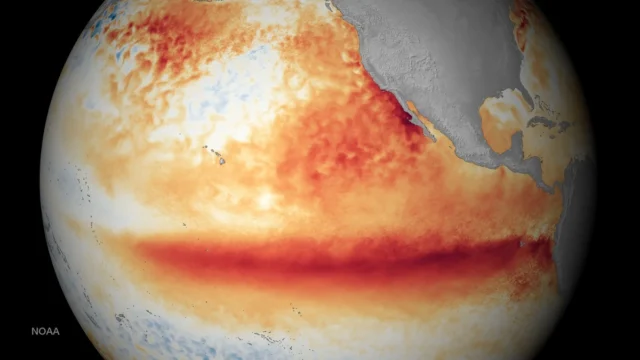
The global climate pulse is quickening as scientists monitor a rapidly warming patch of water in the equatorial Pacific Ocean. According to new climate data released by the European Centre for Medium-Range Weather Forecasts (ECMWF) and echoed by the World Meteorological Organization (WMO), the world may be on the precipice of a “super” or “Godzilla” El Niño—a rare and formidable weather event that occurs only once every decade or two, leaving a permanent mark on the global record books.
As reported by The Washington Post, this developing phenomenon is already sending ripples through the scientific community. “All signs are increasingly pointing to a significant, if not strong to very strong, El Niño event,” climate scientist Daniel Swain noted in a recent assessment. If these projections hold true, the coming year could see a dramatic shift in global weather patterns, ranging from devastating droughts in tropical regions to torrential flooding across the southern United States.
The Mechanics of a “Super” Event
El Niño is a natural climate cycle characterized by the weakening of trade winds, which allows warm water to slosh eastward toward the Americas. While standard El Niño events happen every few years, a “super” event involves a much more intense surge of heat. This year’s development is being fueled by record-breaking westerly wind bursts that are pushing vast reservoirs of warm water across the Pacific.
The stakes are higher than in previous decades. As The Washington Post highlights, the current event is unfolding against a backdrop of unprecedented planetary warming. Defense Department meteorologist Eric Webb explained that greenhouse gas concentrations have reached a point where the Earth can no longer “exhaust the heat released in a major El Niño event before the next El Niño comes along and pushes the baseline upward again.”

This suggests that the 2026–27 event could be even more impactful than the historic “super” iterations of 1982–83, 1997–98, and 2015–16.
A Forecast of Extremes
The implications for the United States are profound. In the short term, a marine heatwave building near the West Coast—partially linked to this El Niño—is expected to fuel a hotter-than-average summer. This raises the specter of increased wildfire risk, particularly in regions already struggling with persistent drought.
As the system matures into the winter of 2026, the southern branch of the jet stream is expected to strengthen. This often acts as a conveyor belt for moisture, potentially bringing heavy downpours and flooding to southern states like Florida and California. Conversely, the northern U.S. might see a more “moderate” winter, as the northern jet stream is pushed further toward the pole, keeping the most frigid Arctic air at bay.
On a global scale, the consequences are equally stark:
- Southeast Asia and Australia: Typically face severe droughts, which can lead to crop failures and water shortages.
- The Horn of Africa: Often experiences enhanced rainfall, which can trigger flooding in vulnerable regions.
- Atlantic Basin: In a rare silver lining, the harsh winds in the upper atmosphere typical of a strong El Niño can inhibit the formation of hurricanes, potentially leading to a quieter storm season.
The Race Toward New Records
Perhaps the most alarming prospect is the impact on global temperatures. El Niño acts as a mechanism for the ocean to release stored heat into the atmosphere. While 2024 currently holds the title for the warmest year on record, scientists believe this new cycle will challenge that peak.
Climate scientist Zeke Hausfather told The Washington Post that while 2026 will see a significant temperature spike, the true peak may come a year later. “This would push up our estimate for 2026 global temperatures… and make 2027 very likely to be the warmest year on record,” Hausfather said, noting that atmospheric temperatures typically lag behind the ocean’s initial warming.
The “Wild Card” of Climate Change
While no two El Niño events are identical, the current trend is following a path similar to the most major events in history. However, the influence of man-made climate change makes the outcome harder to predict with absolute certainty. The baseline temperature of the ocean is higher than it was during the last super El Niño in 2015, meaning the starting point for this “heat jump” is already at a record level.
The “spring predictability barrier”—a period in March and April where climate models traditionally struggle to accurately forecast the year ahead—is still a factor. However, the sheer consistency of current data has many experts on high alert. The ECMWF ensemble output currently suggests an 80% chance of a strong El Niño by August 2026, with a striking 22% chance of it reaching “super” status.
Preparing for the Shift
Governments and emergency management agencies are already beginning to factor these projections into their long-term planning. For California and the Gulf Coast, the focus is on flood preparedness and infrastructure resilience. For the Western U.S., the priority remains wildfire mitigation and water conservation in anticipation of a blistering summer.
As the equatorial Pacific continues to simmer, the world watches the thermometers. Whether this event officially reaches “super” status or remains a “strong” El Niño, its footprint will be felt in every corner of the globe. As The Washington Post analysis suggests, the arrival of this system isn’t just a weather story—it’s a preview of the “new normal” in a rapidly changing climate.
The “El Niño cometh,” and with it comes a reminder of the ocean’s immense power to dictate the rhythm of life on land. The coming months will determine if 2027 becomes the new benchmark for a planet under heat stress, or if humanity can find ways to adapt to the strengthening cycles of a warming world.
Sources and Links
- The Washington Post: Super El Niño Explained (March 9, 2026)
- NOAA Climate Prediction Center: ENSO Diagnostic Discussion
- World Meteorological Organization (WMO): ENSO Update March 2026
- International Research Institute for Climate and Society (IRI): February 2026 ENSO Quick Look
- San Francisco Today: Odds of Strong El Niño Surge
Disclaimer
Artificial Intelligence Disclosure & Legal Disclaimer
AI Content Policy.
To provide our readers with timely and comprehensive coverage, South Florida Reporter uses artificial intelligence (AI) to assist in producing certain articles and visual content.
Articles: AI may be used to assist in research, structural drafting, or data analysis. All AI-assisted text is reviewed and edited by our team to ensure accuracy and adherence to our editorial standards.
Images: Any imagery generated or significantly altered by AI is clearly marked with a disclaimer or watermark to distinguish it from traditional photography or editorial illustrations.
General Disclaimer
The information contained in South Florida Reporter is for general information purposes only.
South Florida Reporter assumes no responsibility for errors or omissions in the contents of the Service. In no event shall South Florida Reporter be liable for any special, direct, indirect, consequential, or incidental damages or any damages whatsoever, whether in an action of contract, negligence or other tort, arising out of or in connection with the use of the Service or the contents of the Service.
The Company reserves the right to make additions, deletions, or modifications to the contents of the Service at any time without prior notice. The Company does not warrant that the Service is free of viruses or other harmful components.