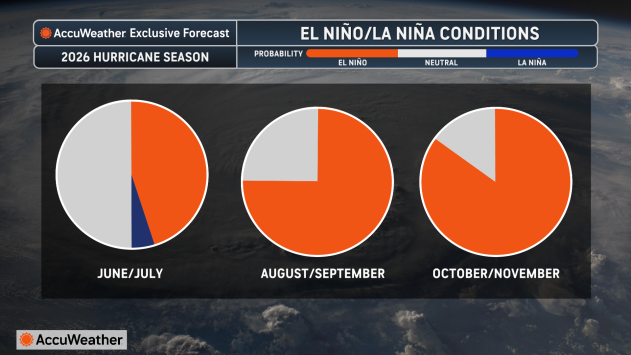
As the calendar turns through 2026, the global climate is standing at a significant crossroads. After a period defined by the cooling influence of La Niña, meteorologists are sounding the alarm on a rapid transition toward its warmer counterpart. According to a recent deep-dive report from AccuWeather, an El Niño event is officially brewing in the tropical Pacific, a development that promises to reshape weather patterns across the United States, influence the 2026 Atlantic hurricane season, and potentially set the stage for record-breaking global temperatures.
The Return of the Warm Phase
El Niño is the warm phase of the El Niño-Southern Oscillation (ENSO), a naturally occurring climate cycle driven by fluctuations in ocean temperatures and atmospheric pressure across the eastern tropical Pacific. When these waters warm by at least 0.5 degrees Celsius above historical averages for an extended period, the ripple effects are felt thousands of miles away.
“The trends support El Niño developing late this spring to early this summer,” says AccuWeather Senior Meteorologist Chat Merrill. This timeline suggests that by the second half of 2026, the United States will be firmly under the influence of this atmospheric giant.
The transition is particularly noteworthy because of how quickly it is occurring. Much of the early 2020s was dominated by a “triple-dip” La Niña, which brought persistent drought to the American West and fueled hyperactive hurricane seasons. The flip to El Niño represents a 180-degree turn in the atmospheric “engine” that drives North American weather.

Navigating the “Spring Predictability Barrier”
While the signals for warming are strong, forecasting the exact intensity of an emerging El Niño during the early months of the year is notoriously difficult. Meteorologists refer to this period as the “spring predictability barrier.” During this window, the atmosphere and ocean are in such a state of flux that long-range models can struggle to pinpoint whether the event will be a “moderate” warming or a “historically strong” one similar to the powerhouse events of 1997-98 or 2015-16.
Despite these hurdles, AccuWeather experts remain confident in the overall trajectory. “Typically, the stronger the signal, the more confidence on impacts for a typical El Niño season,” notes AccuWeather Senior Meteorologist Jason Nicholls. Nicholls points out that while the change is currently slow, the early signs in the Pacific are unmistakable, and the phenomenon has several months to gather strength before reaching its peak influence.
Implications for the 2026 Hurricane Season
One of the most immediate concerns for emergency managers and coastal residents is how El Niño will interact with the 2026 Atlantic hurricane season, which begins June 1. Historically, El Niño acts as a “buffer” for the Atlantic basin.
As the Pacific warms, it alters the upper-level winds across the Caribbean and Atlantic. “El Niño tends to increase the mid- to upper-level wind shear on a more frequent basis across portions of the Atlantic Basin,” explains AccuWeather Long-range Expert Paul Pastelok. This wind shear acts as a mechanical deterrent for developing storms, effectively ripping the tops off of budding tropical depressions before they can organize into major hurricanes.
Pastelok describes this phenomenon as a “roadblock to a hyperactive hurricane season.” While this may sound like good news, experts warn that it only takes one storm to cause a disaster. Furthermore, while the Atlantic may see fewer storms, the Eastern Pacific often sees an uptick in tropical activity during El Niño years, potentially threatening the West Coast of Mexico and occasionally sending moisture into the Southwestern U.S.
A Shift in Precipitation: Floods and Droughts
For the continental United States, El Niño’s primary calling card is a redirected jet stream. Typically, a strong El Niño pulls the subtropical jet stream further south, bringing a parade of storms across the Southern Tier of the country.
This could provide a much-needed lifeline for regions struggling with water scarcity. “El Niño patterns could bring more rain than normal to the Colorado Basin,” says Merrill. While he cautions that a single season of rain won’t be enough to quench decades-long droughts, it represents a “step in the right direction” for vital reservoirs like Lake Mead and Lake Powell.
However, the increase in moisture isn’t limited to the West. Jason Nicholls adds that “the early start to the El Niño can lead to an increase in moisture from the southern Plains to the East Coast during summer and fall.” This could mean a muggier summer for the Deep South and an increased risk of flash flooding in the Mid-Atlantic as the year progresses.
Conversely, the Northern Tier of the U.S.—including the Pacific Northwest, the Northern Plains, and the Great Lakes—often experiences drier and milder conditions during El Niño. This “North-South” split is a classic hallmark of the phenomenon, often leading to lower heating bills in the North during winter but to higher wildfire risks in late summer due to a lack of rainfall.
Looking Toward the 2026-27 Winter
While the immediate focus is on the summer and autumn transition, AccuWeather is already looking ahead to how this brewing event will dictate the 2026-27 winter season. If the El Niño continues to strengthen through the end of the year, the U.S. could see a “split” winter.
Southern California and the Gulf Coast might brace for a relentlessly wet winter, while the “Snow Belt” in the Midwest might see a significant reduction in total accumulation. For major metropolitan areas like New York, Philadelphia, and Boston, El Niño winters are often a wild card—sometimes producing massive “blockbuster” coastal storms fueled by the southern jet, and other times resulting in rainy, mild stretches that leave ski resorts struggling.
The Global Context
Beyond the borders of the United States, the brewing El Niño of 2026 carries global stakes. El Niño events typically release vast amounts of heat from the ocean into the atmosphere, often making the years in which they occur the warmest in recorded history. With global temperatures already at record highs, the addition of an El Niño “boost” could make 2026 or 2027 a milestone year for climate extremes.
As the Pacific continues to warm, the message from AccuWeather is clear: the era of La Niña is over, and a new, warmer chapter of weather is about to begin. Residents from the coast of California to the shores of the Carolinas should prepare for a year where the ocean, thousands of miles away, will decide the forecast at their front door.
Sources: AccuWeather
Disclaimer
Artificial Intelligence Disclosure & Legal Disclaimer
AI Content Policy.
To provide our readers with timely and comprehensive coverage, South Florida Reporter uses artificial intelligence (AI) to assist in producing certain articles and visual content.
Articles: AI may be used to assist in research, structural drafting, or data analysis. All AI-assisted text is reviewed and edited by our team to ensure accuracy and adherence to our editorial standards.
Images: Any imagery generated or significantly altered by AI is clearly marked with a disclaimer or watermark to distinguish it from traditional photography or editorial illustrations.
General Disclaimer
The information contained in South Florida Reporter is for general information purposes only.
South Florida Reporter assumes no responsibility for errors or omissions in the contents of the Service. In no event shall South Florida Reporter be liable for any special, direct, indirect, consequential, or incidental damages or any damages whatsoever, whether in an action of contract, negligence or other tort, arising out of or in connection with the use of the Service or the contents of the Service.
The Company reserves the right to make additions, deletions, or modifications to the contents of the Service at any time without prior notice. The Company does not warrant that the Service is free of viruses or other harmful components.