The Post-Splashdown Briefing: Analyzing a Masterclass in Exploration
As the Orion spacecraft, designated Integrity, bobbed in the gentle swells of the Pacific Ocean on the evening of April 10, 2026, the focus shifted rapidly from the recovery ships to the briefing rooms of the Johnson Space Center in Houston. Within hours of the 8:07 p.m. EDT splashdown, NASA leadership convened a high-stakes news conference to detail the technical health of the mission and, more importantly, to outline the revised future of the Artemis program.
NASA Associate Administrator Amit Kshatriya opened the conference with a sense of profound relief and clinical precision. “Tonight, we didn’t just recover four astronauts; we recovered the certainty that humanity belongs among the stars,” Kshatriya stated. He confirmed that the initial telemetry from the Orion capsule indicated that the vehicle performed “within or above expected parameters” throughout the most violent phases of re-entry.
The heat shield, a critical component that had been the subject of intense scrutiny following the uncrewed Artemis I mission, appeared to withstand 5,000-degree Fahrenheit temperatures with remarkable resilience. Orion Program Manager Howard Hu noted that the “skip-entry” maneuver—a technique where the capsule dips into the atmosphere, skips back out briefly to shed velocity, and then dives back in—was executed with “mathematical perfection.” This maneuver allowed the recovery teams aboard the USS John P. Murtha to anticipate the splashdown point within a few hundred meters of the predicted “bullseye.”
Navigating Technical Hurdles and Future Timelines
Despite the celebratory tone, the conference was not without its technical caveats. Hu acknowledged that engineers are investigating “telemetry gaps” and minor communication flickers that occurred while the crew was in the lunar shadow. Additionally, a brief mention of a “power management anomaly” in the European Service Module (ESM) required the crew to manually reset certain non-critical systems early in the flight.

The most significant takeaway from the briefing involved the strategic “pivot” for the upcoming Artemis III and IV missions. Kshatriya revealed that while the Artemis II crew was still orbiting the moon on April 7, NASA’s senior leadership held a pivotal meeting to finalize mission design changes. Due to the complexities of orbital refueling for the Human Landing System (HLS), Artemis III has been officially redesignated. It will no longer attempt a lunar landing but will instead serve as a high-Earth orbit docking demonstration with SpaceX’s Starship. This ensures that the intricate “ballet” of fuel transfer and docking is mastered before lives are put on the surface. Consequently, the historic return of humans to the lunar dust is now slated for Artemis IV in late 2028.
A Voyage for the Ages: The History of Artemis II
The success of the news conference is grounded in the historic ten-day journey that preceded it. Artemis II represents the first time humans have ventured beyond Low Earth Orbit (LEO) since the conclusion of the Apollo program in 1972. The mission was not merely a repeat of history but a modernization of it, utilizing the most powerful rocket ever built: the Space Launch System (SLS).
The Pioneers of the Deep
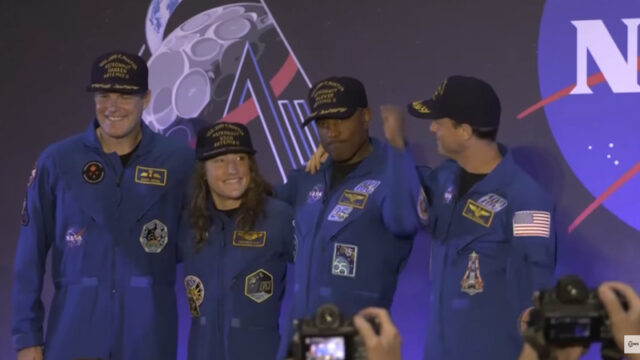
The four-person crew carried the weight of global expectations. Commander Reid Wiseman, Pilot Victor Glover, and Mission Specialist Christina Koch of NASA, alongside Canadian Space Agency Mission Specialist Jeremy Hansen, became symbols of a new era of inclusivity in exploration.
- Christina Koch became the first woman to venture into deep space, having already held the record for the longest single spaceflight by a woman.
- Victor Glover made history as the first person of color to leave Earth’s immediate orbit.
- Jeremy Hansen represented the strength of international partnerships, marking the first time a non-American has traveled to the moon’s vicinity.
During their 700,000-mile round trip, the crew reached a maximum distance of 252,756 miles from Earth, further than any human has ever traveled. From this vantage point, they captured high-definition imagery of the lunar far side and shared a “total solar eclipse” experience that was only visible from their unique trajectory behind the moon.
The Final Descent: 13 Minutes of Fire
The mission’s conclusion was as dramatic as its launch. Approaching Earth at nearly 25,000 miles per hour, the Orion capsule was subjected to the extreme physics of atmospheric friction. The resulting plasma sheath caused a tense six-minute radio blackout—a period known to flight controllers as the “void.”
When Commander Wiseman’s voice finally crackled over the radio, confirming that the drogue parachutes had deployed at 22,000 feet, the atmosphere in Mission Control shifted from stony silence to jubilant cheers. The deployment of the three massive main parachutes at 6,000 feet transformed the capsule from a falling projectile into a drifting vessel.
The recovery operation off the coast of San Diego was a choreographed display of naval and aerospace cooperation. Navy divers and NASA recovery specialists secured the capsule and assisted the astronauts into waiting helicopters. Within an hour of splashdown, the crew was on the deck of the USS John P. Murtha, undergoing initial medical evaluations and speaking with their families via satellite link.
The Legacy of Integrity
The Artemis II mission, and the capsule named Integrity, has proven that the architecture of the SLS and Orion is sound. While the roadmap to the lunar surface has been adjusted to ensure maximum safety and technical readiness, the momentum is undeniable. The “Earthset” photos captured by Koch and Glover have already become the defining images of the decade, reminding a new generation that the moon is not just a light in the sky, but a destination within reach.
As the news conference concluded, the message from Houston was clear: The mission did not end with a splashdown. It ended with a handoff to the engineers, scientists, and future moonwalkers who will turn the data from Artemis II into the footprints of Artemis IV.
Sources and Links:
- NASA Blogs: Artemis II Flight Day 10: Live Re-Entry Updates
- Space.com: Artemis 3 and beyond: What’s next for NASA after Artemis 2 moon success
- GeekWire: Artemis 2 crew makes triumphant splashdown at the end of humanity’s first trip around the moon since 1972
- Al Jazeera: NASA’s Artemis II astronauts splash down on Earth after lunar mission
- Live Science: ‘Welcome home, Integrity’: Artemis II crew safely returned to Earth after ‘bullseye landing’ to cap historic moon mission
- WRAL News: Crews now work to recover the four Artemis II crew members
Disclaimer
Artificial Intelligence Disclosure & Legal Disclaimer
AI Content Policy.
To provide our readers with timely and comprehensive coverage, South Florida Reporter uses artificial intelligence (AI) to assist in producing certain articles and visual content.
Articles: AI may be used to assist in research, structural drafting, or data analysis. All AI-assisted text is reviewed and edited by our team to ensure accuracy and adherence to our editorial standards.
Images: Any imagery generated or significantly altered by AI is clearly marked with a disclaimer or watermark to distinguish it from traditional photography or editorial illustrations.
General Disclaimer
The information contained in South Florida Reporter is for general information purposes only.
South Florida Reporter assumes no responsibility for errors or omissions in the contents of the Service. In no event shall South Florida Reporter be liable for any special, direct, indirect, consequential, or incidental damages or any damages whatsoever, whether in an action of contract, negligence or other tort, arising out of or in connection with the use of the Service or the contents of the Service.
The Company reserves the right to make additions, deletions, or modifications to the contents of the Service at any time without prior notice. The Company does not warrant that the Service is free of viruses or other harmful components.