TEHRAN / WASHINGTON — In a dramatic expansion of “Operation Epic Fury,” a United States fast-attack submarine sank the Iranian Navy’s Moudge-class frigate IRIS Dena in the Indian Ocean early Wednesday. The strike, characterized by the Pentagon as a “quiet death,” marks the first time an American submarine has destroyed an enemy vessel with a torpedo since the end of World War II.
https://t.co/PiqQpVIrMu pic.twitter.com/Wc1e0B0um7
— Department of War 🇺🇸 (@DeptofWar) March 4, 2026
As the conflict between the U.S.-Israeli coalition and the Islamic Republic enters its fifth day, the maritime engagement off the coast of Sri Lanka signals that nowhere is safe for Iranian assets. Defense Secretary Pete Hegseth, speaking from the Pentagon, declared the Iranian Navy “combat ineffective” and “decimated,” emphasizing that the global reach of the U.S. military is being fully leveraged to dismantle the regime’s power.
A “Quiet Death” in International Waters
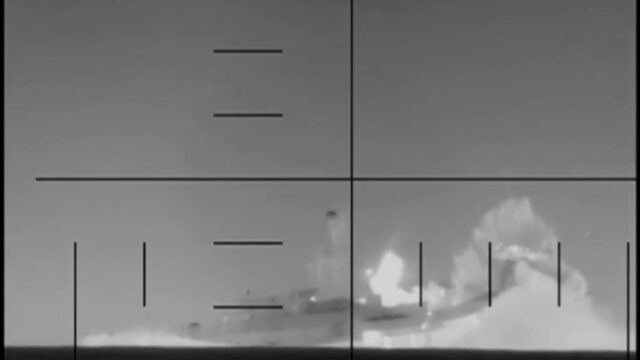
The sinking of the IRIS Dena occurred approximately 20 nautical miles south of Galle, Sri Lanka. The frigate was reportedly returning from the 2026 International Fleet Review in India when it was intercepted. According to General Dan Caine, Chairman of the Joint Chiefs of Staff, a single Mark 48 heavyweight torpedo was used to achieve “immediate effect,” splitting the vessel and sending it to the bottom of the sea in minutes.

Sri Lankan authorities have confirmed the recovery of 87 bodies, while 32 wounded sailors were rescued by local coast guard units. Approximately 100 crew members remain missing. The Pentagon released infrared periscope footage of the explosion, a move intended to serve as a stark warning to the remaining Iranian leadership.
“An American submarine sank an Iranian warship that thought it was safe in international waters,” Hegseth stated. “We are fighting to win.”
Uncontested Skies Over Tehran
While the naval war expands, the air campaign over the Iranian heartland has reached a state of near-total dominance. The Israeli Air Force (IAF) and U.S. B-52 bombers carried out massive overnight strikes across Tehran, targeting the Revolutionary Guard’s (IRGC) command centers, Basij militia sites, and missile production facilities.
In a historic milestone for aviation, an Israeli F-35 “Adir” reportedly achieved the first-ever air-to-air kill by an F-35 against a manned aircraft, downing an Iranian YAK-130 fighter jet over the capital. Israeli officials also confirmed the elimination of several high-ranking IRGC figures, including Daoud Alizadeh, a key commander in the Quds Force.
Military analysts from the Institute for the Study of War (ISW) report that Iran’s ability to retaliate is fading rapidly. Ballistic missile launches from Iranian territory have dropped by an estimated 86% since the opening day of the war on February 28. U.S. Central Command (CENTCOM) noted that over 20 Iranian naval vessels have been neutralized in the last 96 hours.
The Human Toll and Regional Fallout
Despite the military successes claimed by Washington and Jerusalem, the humanitarian situation within Iran is deteriorating. The Iranian Red Crescent estimates the death toll has exceeded 780, with thousands more injured as strikes hit urban centers. UN experts have raised alarms over the destruction of civilian infrastructure, including a report of a strike on a girls’ school in Hormozgan Province.
Domestically, the Iranian regime is facing a collapse of legitimacy. Internet connectivity has been throttled to roughly 1% of normal levels as authorities attempt to suppress renewed student protests and civil unrest. The death of Supreme Leader Ali Khamenei, reported earlier in the week, has left a power vacuum that the coalition is actively exploiting, with President Trump calling on the Iranian people to “take over your government.”
The conflict has also sent shockwaves through global markets. Oil prices have surged following the effective closure of the Strait of Hormuz by Iranian mines and scuttled vessels. In response, President Trump has ordered the U.S. Navy to begin escorting commercial tankers through the Persian Gulf to ensure the “free flow of energy.”
Political Friction in Washington
On Capitol Hill, the rapid escalation has sparked a fierce debate over executive power. A bipartisan group of lawmakers has introduced a War Powers Resolution intended to halt military action within 30 days unless a formal declaration of war is issued.
“Regardless of how anyone feels about the war, Congress needs to stand up to its constitutional obligation,” said Representative Sam Liccardo. However, with the Republican majority largely supporting the administration’s “Operation Epic Fury,” the resolution faces a difficult path to passage, and a certain veto from the White House.
As the U.S. and Israel prepare for what they describe as “deeper” strikes into Iranian territory, the world watches to see if this five-day blitz will lead to the promised regime change or ignite a protracted regional insurgency.
Sources and Links
- War.gov: Four Days In, Hegseth, Caine Say U.S. Making Decisive Progress in Iran
- The Guardian: US submarine sinks Iranian warship as conflict spreads beyond Middle East
- Military.com: ‘Quiet Death’: US Sub Sinks Iranian Frigate, First Torpedo Kill Since WWII
- Institute for the Study of War (ISW): Iran Update Morning Special Report, March 4, 2026
- House of Commons Library: US-Israel strikes on Iran: February/March 2026 Briefing
- OHCHR: Iran: UN experts call for de-escalation and accountability
- Washington Examiner: Hegseth confirms US submarine sunk Iranian warship off Sri Lanka coast
- Times of India: US submarine sinks Iranian warship; 87 bodies found
Disclaimer
Artificial Intelligence Disclosure & Legal Disclaimer
AI Content Policy.
To provide our readers with timely and comprehensive coverage, South Florida Reporter uses artificial intelligence (AI) to assist in producing certain articles and visual content.
Articles: AI may be used to assist in research, structural drafting, or data analysis. All AI-assisted text is reviewed and edited by our team to ensure accuracy and adherence to our editorial standards.
Images: Any imagery generated or significantly altered by AI is clearly marked with a disclaimer or watermark to distinguish it from traditional photography or editorial illustrations.
General Disclaimer
The information contained in South Florida Reporter is for general information purposes only.
South Florida Reporter assumes no responsibility for errors or omissions in the contents of the Service. In no event shall South Florida Reporter be liable for any special, direct, indirect, consequential, or incidental damages or any damages whatsoever, whether in an action of contract, negligence or other tort, arising out of or in connection with the use of the Service or the contents of the Service.
The Company reserves the right to make additions, deletions, or modifications to the contents of the Service at any time without prior notice. The Company does not warrant that the Service is free of viruses or other harmful components.