ST. PETERSBURG, Fla. (AP) — Moments before the deadly crash of a charter jet on a Florida highway, three warnings about oil pressure problems in its two engines sounded, the National Transportation Safety Board said in a preliminary report Tuesday.
The Bombardier aircraft flying from Ohio with five people aboard was cleared to land at Naples Municipal Airport at 3:08 p.m. on Feb. 9, the report says. It was about 6.5 miles (10.5 kilometers) north of the airport when what the NTSB called a “master warning” about oil pressure issues in the left engine took place.
Seconds later, another oil warning sounded for the right engine, followed by a third that simply said “ENGINE.” These warnings include lights and a voice advisory including chimes in the cockpit, according to the report.
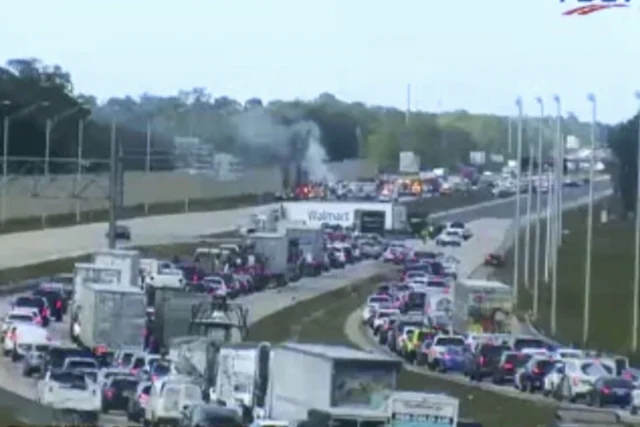
At 3:10 p.m., the pilots announced they had “lost both engines” and were attempting to make an emergency landing on busy Interstate 75 in Naples, Florida. The control tower repeated the aircraft was cleared to land and one of the pilots responded, “We are cleared to land but we are not going to make the runway” because of the engine failures.

The aircraft did manage to crash-land along the highway but slammed into a concrete sound barrier and burst into flames, killing both pilots. The flight attendant scrambled to open a rear door and led the two passengers to safety with only minor injuries, the report says. No one was seriously injured on the ground.
Watch WINK News VIDEOS of the crash
Although there was some damage to the two engines, most of the components were recovered and no obvious problems that might have caused their failure were noted by NTSB investigators. A final report will be released in the coming months.
The aircraft was built in 2004 and had its most recent airworthiness inspection on Jan. 5. It had more than 9,700 total hours of flight operation, according to the NTSB.
The plane was operated by Hop-a-Jet Worldwide Charter based in Fort Lauderdale, Florida. It had flown from there to the Ohio State University airport in Columbus, picked up its two passengers and then headed to Naples.
The dead pilots were identified as Edward Daniel Murphy, 50, and Ian Frederick Hofmann, 65, who each had thousands of hours of flight experience, including time on the Bombardier-type of airplane. The survivors were crew member Sydney Ann Bosmans, 23, and passengers Aaron Baker, 35, and Audra Green, 23, both of Columbus.
Disclaimer
Artificial Intelligence Disclosure & Legal Disclaimer
AI Content Policy.
To provide our readers with timely and comprehensive coverage, South Florida Reporter uses artificial intelligence (AI) to assist in producing certain articles and visual content.
Articles: AI may be used to assist in research, structural drafting, or data analysis. All AI-assisted text is reviewed and edited by our team to ensure accuracy and adherence to our editorial standards.
Images: Any imagery generated or significantly altered by AI is clearly marked with a disclaimer or watermark to distinguish it from traditional photography or editorial illustrations.
General Disclaimer
The information contained in South Florida Reporter is for general information purposes only.
South Florida Reporter assumes no responsibility for errors or omissions in the contents of the Service. In no event shall South Florida Reporter be liable for any special, direct, indirect, consequential, or incidental damages or any damages whatsoever, whether in an action of contract, negligence or other tort, arising out of or in connection with the use of the Service or the contents of the Service.
The Company reserves the right to make additions, deletions, or modifications to the contents of the Service at any time without prior notice. The Company does not warrant that the Service is free of viruses or other harmful components.