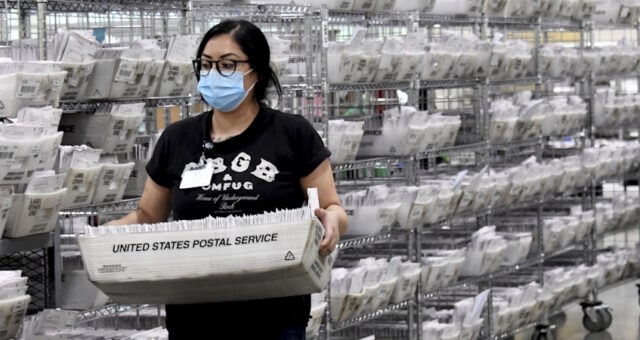
A quiet but consequential change to the United States Postal Service (USPS) Domestic Mail Manual took effect on December 24, 2025, fundamentally altering how the agency dates outgoing mail. Under the new rule, Section 608.11, a postmark no longer represents the day a customer drops an envelope into a mailbox. Instead, it reflects the date the mailpiece is first processed by automated equipment at a regional facility—a shift that experts warn could lead to rejected ballots and IRS late fees.
The End of Same-Day Postmarking
For decades, Americans have operated under the “mailbox rule,” assuming that dropping a tax return or ballot into a blue collection box on deadline day secured a timely postmark. However, the USPS is now codifying the reality of its “Delivering for America” modernization plan. As processing is consolidated into fewer regional hubs—some hundreds of miles away from local post offices—mail often sits in transit or in storage before reaching a sorting machine.
The new policy clarifies that the postmark date “does not necessarily align” with the date the USPS took possession of the item. For residents in rural areas or towns more than 50 miles from a regional hub, the delay between mailing and postmarking is expected to become the norm.
Impact on Taxes and Voting
The change creates immediate legal hurdles for two of the most time-sensitive types of mail:

- Tax Filings: The IRS follows the “timely mailing treated as timely filing” rule ($IRC \text{ } \S7502$), which relies almost exclusively on the postmark. If a taxpayer mails their return on April 15, but it isn’t processed until April 16, they could face significant late-filing penalties.
- Mail-in Ballots: Over a dozen states and the District of Columbia count ballots that arrive after Election Day as long as they are postmarked by the close of polls. Under this new rule, a ballot mailed on Election Day might receive a next-day postmark, leading to its disqualification.
How to Protect Your Deadlines
To mitigate these risks, the USPS and tax professionals recommend three specific actions:
- Request a Manual Postmark: Visit a post office counter and ask a clerk to hand-stamp your envelope. This ensures the postmark reflects the actual date of mailing.
- Use Certified Mail: Purchasing Certified or Registered mail provides a receipt that serves as legal proof of the mailing date, regardless of the postmark.
- Mail Early: Officials suggest mailing sensitive documents at least one week before the deadline.
Sources
- Federal Register: Postmarks and Postal Possession (Final Rule)
- Brookings Institution: When a postmark no longer tracks mailing
- AARP: How USPS Postmark Change Could Affect Mail Deadlines
- USPS: Election Mail Official Guidelines
Disclaimer
Artificial Intelligence Disclosure & Legal Disclaimer
AI Content Policy.
To provide our readers with timely and comprehensive coverage, South Florida Reporter uses artificial intelligence (AI) to assist in producing certain articles and visual content.
Articles: AI may be used to assist in research, structural drafting, or data analysis. All AI-assisted text is reviewed and edited by our team to ensure accuracy and adherence to our editorial standards.
Images: Any imagery generated or significantly altered by AI is clearly marked with a disclaimer or watermark to distinguish it from traditional photography or editorial illustrations.
General Disclaimer
The information contained in South Florida Reporter is for general information purposes only.
South Florida Reporter assumes no responsibility for errors or omissions in the contents of the Service. In no event shall South Florida Reporter be liable for any special, direct, indirect, consequential, or incidental damages or any damages whatsoever, whether in an action of contract, negligence or other tort, arising out of or in connection with the use of the Service or the contents of the Service.
The Company reserves the right to make additions, deletions, or modifications to the contents of the Service at any time without prior notice. The Company does not warrant that the Service is free of viruses or other harmful components.