The Milestone Consumers Feared
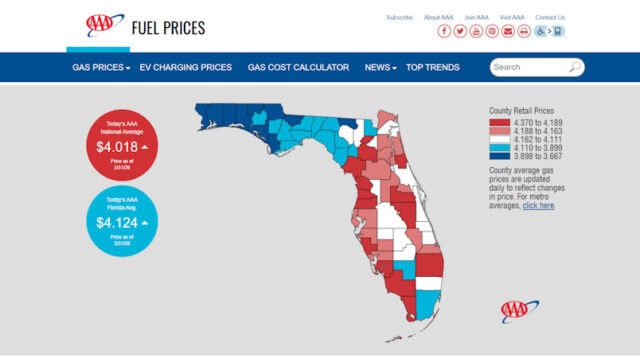
On this Tuesday, March 31, 2026, the American motorist is facing a grim reality at the pump. For the first time since the summer of 2022, the national average for a gallon of regular unleaded gasoline has officially crossed the $4.00 mark. Data released this morning by AAA and the Energy Information Administration (EIA) confirms that the rapid ascent, which began in early February, has culminated in a price point that threatens to stall economic momentum and reignite inflationary pressures across the country.
Get upto the minute gas prices HERE
Only six weeks ago, the outlook for 2026 was remarkably different. Analysts had predicted a “year of relief,” with average prices expected to hover around $2.90 per gallon. However, a “perfect storm” of geopolitical warfare, seasonal refinery transitions, and localized supply bottlenecks has shattered those optimistic forecasts. Today, drivers in states like California and Washington are seeing prices closer to $5.50, while even traditionally low-cost regions in the Gulf Coast are witnessing surges toward the $3.75 level.
The Catalyst: War in the Middle East
The primary driver of this sudden spike is the escalation of military conflict in the Middle East. The onset of the US-Israel-Iran war in early March 2026 has sent shockwaves through global crude markets. Brent crude, the international benchmark, has surged more than 40% in less than thirty days, currently trading at approximately $107.56 per barrel.

The strategic “pain point” remains the Strait of Hormuz. Recent reports indicate that Iran has established what military analysts describe as a “toll booth” or “chokehold” on the waterway, through which roughly one-fifth of the world’s daily oil supply passes. The recent attack on a Kuwaiti oil tanker and subsequent US retaliatory strikes on Iranian nuclear and military infrastructure have created a risk premium that traders say is “unprecedented” in the post-pandemic era.
When the Strait of Hormuz is threatened, the market does not just react to lost barrels; it reacts to the fear of a total halt in maritime traffic. This fear has added an estimated $25 to $30 to the price of every barrel of oil produced globally, directly translating to a $0.75 to $1.00 increase at the domestic pump in just four weeks.
Seasonal Pressure and Refinery Realities
While the war is the headline-grabber, domestic factors are compounding the crisis. Every March, the US gasoline market undergoes a “seasonal transition.” Refineries begin the process of switching from winter-blend gasoline to summer-blend gasoline.
Summer-blend gasoline is more expensive to produce because it requires additional processing to reduce volatility and prevent smog during warmer months. This transition typically adds between $0.10 and $0.15 to the cost per gallon. Furthermore, this is the time of year when refineries schedule “turnarounds” or maintenance periods, temporarily reducing the total volume of gasoline being pumped into the national pipeline system.
Compounding this is the permanent loss of domestic refining capacity. The closure of the Phillips 66 refinery in Los Angeles at the end of 2025 and the previous shuttering of the LyondellBasell refinery in Houston have left the US with a thinner margin of error. When demand spikes—as it has during the current 2026 Spring Break season—there is less “spare” capacity to absorb the shock, leading to localized price spikes that pull the national average higher.
The Economic Ripple Effect
The impact of $4 gas extends far beyond the individual consumer’s wallet. The logistics and transportation sectors are already signaling that surcharges will be passed on to retailers. Diesel prices, which often track or lead gasoline trends, have also surged, meaning the cost of moving food, consumer electronics, and construction materials is rising simultaneously.
Economists at the University of Houston note that Americans are uniquely sensitive to gas prices because they are “highly visible” costs. Unlike a monthly utility bill that might be autopaid, the gas station sign is a constant reminder of inflation. Current projections suggest that if prices remain above $4 through the summer, consumer discretionary spending could drop by as much as 2.5%, as households divert funds from travel and dining to basic commuting costs.
Analyst Predictions: What Happens Next?
Predicting the ceiling for gas prices in 2026 has become a polarizing task for energy experts.
The Bearish Case (Short-Term Pain, Long-Term Correction)
Some analysts, including those from the EIA, believe the current spike is a “geopolitical bubble.” They point to the fact that non-OPEC production—specifically from the United States, Guyana, and Brazil—is at record highs. Before the conflict, the world was actually on track for a supply surplus. If a diplomatic “de-escalation” occurs in the Middle East, these analysts predict a “crash” in oil prices back toward the $70 range, which could see gas prices plummet back toward $3.00 by autumn.
The Bullish Case (The $5 Per Gallon Threat)
Other firms, such as Enerdata, warn that the “fundamental transformation” of the market is underway. If the Strait of Hormuz remains contested or if Qatar further restricts LNG and oil production in response to the war, Brent crude could easily breach $130 per barrel. In this scenario, the US national average would likely hit $5.00 per gallon by July 4th, matching the record highs seen in 2022.
What Has to Happen to Lower Prices?
For the national average to retreat below the $4.00 threshold, several critical conditions must be met:
- Resolution of the Strait of Hormuz Crisis: The single most effective way to lower prices is to ensure the “free flow of commerce” through the Persian Gulf. Whether through a diplomatic ceasefire or a decisive military stabilization that removes the “toll booth” threat, the removal of the geopolitical risk premium would immediately shave $0.50 off the price at the pump.
- Impact of the Strategic Petroleum Reserve (SPR) Release: The White House recently announced the release of 172 million barrels of oil from the SPR over the next four months. For this to lower prices, the oil must not only be released but successfully refined into gasoline. Markets are currently waiting to see if this infusion of supply can offset the loss of Iranian and Middle Eastern barrels.
- OPEC+ Production Reversal: While OPEC+ recently agreed to a modest increase of 200,000 barrels per day for April, analysts say this is “anecdotal” compared to the current deficit. A more significant output increase from Saudi Arabia and the UAE would be required to provide a meaningful cushion.
- Completion of Refinery Maintenance: Once the spring maintenance season concludes in May and refineries are running at 92-95% capacity with the summer blend, the “supply squeeze” should ease slightly, even if crude prices remain elevated.
- Demand Destruction: Historically, when gas hits $4.00, consumers begin to “self-regulate.” This means fewer road trips, more carpooling, and a faster transition to electric vehicles (EVs). A noticeable drop in demand during the upcoming summer driving season would force retailers to lower margins to attract customers.
Conclusion: A Precarious Summer Ahead
As we move into April 2026, the American energy landscape is at a crossroads. The transition to a “green economy” continues in the background, with the EIA noting that increased fleet efficiency and EV adoption are slowly lowering long-term demand. However, in the immediate term, the internal combustion engine remains the backbone of American life, and that backbone is currently under immense financial strain.
Whether $4.00 per gallon is the new “floor” or a temporary peak depends entirely on the stability of the Middle East and the resilience of the global supply chain. For now, motorists are advised to brace for a summer of volatility, where the price on the sign remains as unpredictable as the headlines driving it.
Sources Used
- AAA Gas Prices: March 2026 National Averages and Trends
- AP News: Oil prices hold above $100 and Wall Street rebounds as US exchanges strikes with Iran
- CBS News: Gas in U.S. hits $4 a gallon for first time since August 2022
- U.S. Energy Information Administration (EIA): Short-Term Energy Outlook – 2026 Gasoline Forecast
- Enerdata: Future of Fossil Fuel Prices: Oil & Gas Outlook Post-2026 Conflict
- Marketplace: Motorists should expect lower gas prices in 2026 (Pre-Conflict Analysis)
- Stout Financial: 2026 Gasoline Price Forecast: What to Expect?
Disclaimer
Artificial Intelligence Disclosure & Legal Disclaimer
AI Content Policy.
To provide our readers with timely and comprehensive coverage, South Florida Reporter uses artificial intelligence (AI) to assist in producing certain articles and visual content.
Articles: AI may be used to assist in research, structural drafting, or data analysis. All AI-assisted text is reviewed and edited by our team to ensure accuracy and adherence to our editorial standards.
Images: Any imagery generated or significantly altered by AI is clearly marked with a disclaimer or watermark to distinguish it from traditional photography or editorial illustrations.
General Disclaimer
The information contained in South Florida Reporter is for general information purposes only.
South Florida Reporter assumes no responsibility for errors or omissions in the contents of the Service. In no event shall South Florida Reporter be liable for any special, direct, indirect, consequential, or incidental damages or any damages whatsoever, whether in an action of contract, negligence or other tort, arising out of or in connection with the use of the Service or the contents of the Service.
The Company reserves the right to make additions, deletions, or modifications to the contents of the Service at any time without prior notice. The Company does not warrant that the Service is free of viruses or other harmful components.