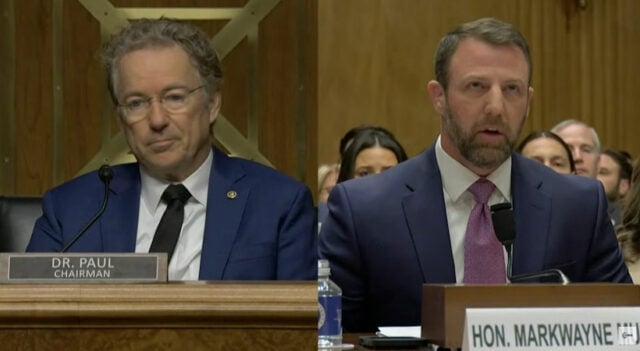
WASHINGTON, D.C. — In a room thick with personal animosity and high-stakes constitutional debate, the Senate Homeland Security and Governmental Affairs Committee convened on Wednesday, March 18, 2026, to consider the nomination of Senator Markwayne Mullin (R-Okla.) to lead the Department of Homeland Security (DHS). What was expected to be a standard vetting of President Trump’s latest cabinet pick quickly devolved into a visceral showdown between Mullin and Committee Chair Rand Paul (R-Ky.), laying bare a widening rift within the Republican Party over the limits of federal police power and the future of the nation’s most controversial agencies.
While the user’s query referenced the elder statesman of the libertarian movement, Ron Paul, the confrontation in the Senate today was led by his son, Rand Paul, who carries the family’s signature skepticism of federal overreach. However, the ghost of Ron Paul’s “End the DHS” philosophy haunted the chamber as the two men sparred over the role of Immigration and Customs Enforcement (ICE) and the fatal consequences of recent federal surges in American cities.
A Personal Feud Takes Center Stage
The hearing began not with policy, but with a stinging personal rebuke. Senator Paul opened the proceedings by recounting the 2017 assault by his neighbor that left him with six broken ribs and a partially removed lung. He then confronted Mullin over comments the Oklahoma Senator allegedly made to constituents in February, where he reportedly called Paul a “freaking snake” and suggested he “understood” why the neighbor had attacked him.

“Explain to the American public why they should trust a man with anger issues to set the proper example for ICE and border agents,” Paul demanded, his voice trembling with indignation.
Mullin, known for his confrontational style and previous near-physical altercation with Teamsters President Sean O’Brien, refused to apologize. While he admitted he “spoke too fast” regarding some issues, he doubled down on his personal assessment of the Chairman. “I’ll say it to your face, and I’ll say it privately, but I’ll never say it behind your back,” Mullin retorted. “We just don’t get along, sir, but that doesn’t keep me from doing my job.”
The Shadow of the “Metro Surge”
Beyond the personal vitriol, the hearing centered on the disastrous “Metro Surge” in Minnesota—a massive ICE and Border Patrol operation launched in early 2026 that has become the focal point of a national outcry. The operation, designed to sweep up “criminal illegal aliens,” resulted in the January shooting deaths of two U.S. citizens: Alex Pretti, a nurse, and Renee Good, a mother of three.
Mullin, who had initially labeled Pretti a “deranged individual” following the shooting, was forced into a rare moment of retreat. “Those words probably should have been retracted,” Mullin admitted under questioning. “I was responding immediately without the facts. That’s my fault.”
Senator Paul used the hearing to display video footage of the Pretti shooting, arguing that the victim showed no signs of aggression before federal agents opened fire. This specific incident has fueled a month-long partial shutdown of the DHS, as Democrats and libertarian-leaning Republicans like Paul demand immediate reforms, including the mandatory use of body-worn cameras and a prohibition on agents wearing masks during domestic operations.
The DHS Shutdown and the “One Big Beautiful Bill”
The backdrop of Mullin’s nomination is a Department of Homeland Security in crisis. The agency has been partially shut down for over 30 days due to a funding impasse. Paradoxically, while FEMA, the Coast Guard, and the TSA are currently operating without a budget, ICE remains fully funded through 2028. This is thanks to the “One Big Beautiful Bill,” a massive $75 billion reconciliation package passed in 2025 that secured long-term funding for 10,000 new ICE agents and expanded detention facilities.
Mullin defended the continued funding of enforcement while warning that the shutdown was “bleeding” the department of its institutional knowledge. “We’re losing people we’ve already trained,” Mullin warned. “Every time we quit funding them, we expect them to keep working, and it puts the mission at risk.”
However, Paul and other critics argued that the “mission” itself is what requires scrutiny. They pointed to the increasing use of “administrative warrants”—documents signed by ICE officials rather than independent judges—to enter private homes. Paul characterized these tactics as a direct violation of the Fourth Amendment, a cornerstone of the libertarian critique of the DHS since its inception.
A Department at a Crossroads
As the hearing progressed, the ideological divide became clear. Mullin represents the “law and order” wing of the GOP that views the DHS and ICE as essential shields against “migrant crime” and “foreign threats.” He touted the administration’s claims of recovering over 160,000 trafficked children—a figure PolitiFact and other monitors have noted includes data spanning multiple administrations and distorts the reality of unaccompanied minors in the system.
On the other side, the “Pauline” wing of the party, increasingly joined by civil-rights-conscious Democrats like Andy Kim (D-N.J.) and Gary Peters (D-Mich.), views the 2026 version of the DHS as a bloated, unaccountable paramilitary force.
“You are asking to lead the third-largest federal department,” Paul noted toward the end of the first session. “But you support tactics that would have made the Founders of this country recoil in horror.”
The Path Forward
Despite the fireworks, Mullin’s path to confirmation remains likely. He has garnered unexpected support from Senator John Fetterman (D-Pa.), who praised Mullin’s “straight-talk” approach, and most Senate Republicans appear ready to fall in line to ensure the Trump administration has its chosen “Border Czar” at the helm of the department.
A committee vote is scheduled for Thursday morning, with a full Senate vote expected by the end of next week. If confirmed, Mullin will inherit a department that is not only financially fractured but deeply divided over its own identity. Whether he can “bring confidence back to the agency,” as he promised today, or if his “anger issues” will further inflame a nation already on edge, remains the defining question of his looming tenure.
Sources Used and Links
- GPB News (March 18, 2026): Sen. Paul confronts Sen. Mullin over violent rhetoric at his DHS confirmation hearing
- Politico Pro (March 9, 2026): Rand Paul eyes next week for Mullin DHS confirmation hearing
- PBS News (February 12, 2026): Minnesota officials, federal immigration leaders testify before Senate Homeland panel
- PolitiFact (March 18, 2026): Fact-check: What Markwayne Mullin said about Rand Paul, Alex Pretti at DHS confirmation hearing
- Punchbowl News (March 18, 2026): The Senate’s big day of hearings
- Government Executive (March 18, 2026): Trump’s new DHS nominee promises some changes, adequate staffing amid shutdown-induced departures
- Union of Concerned Scientists (March 17, 2026): If Confirmed, Will Senator Markwayne Mullin Be DHS’s Next Disaster?
- CBS News (March 18, 2026): Sen. Markwayne Mullin says he regrets calling Alex Pretti a “deranged individual”
Disclaimer
Artificial Intelligence Disclosure & Legal Disclaimer
AI Content Policy.
To provide our readers with timely and comprehensive coverage, South Florida Reporter uses artificial intelligence (AI) to assist in producing certain articles and visual content.
Articles: AI may be used to assist in research, structural drafting, or data analysis. All AI-assisted text is reviewed and edited by our team to ensure accuracy and adherence to our editorial standards.
Images: Any imagery generated or significantly altered by AI is clearly marked with a disclaimer or watermark to distinguish it from traditional photography or editorial illustrations.
General Disclaimer
The information contained in South Florida Reporter is for general information purposes only.
South Florida Reporter assumes no responsibility for errors or omissions in the contents of the Service. In no event shall South Florida Reporter be liable for any special, direct, indirect, consequential, or incidental damages or any damages whatsoever, whether in an action of contract, negligence or other tort, arising out of or in connection with the use of the Service or the contents of the Service.
The Company reserves the right to make additions, deletions, or modifications to the contents of the Service at any time without prior notice. The Company does not warrant that the Service is free of viruses or other harmful components.