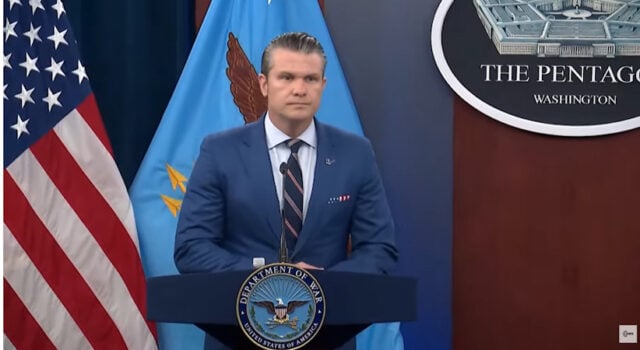
WASHINGTON — In a Tuesday morning briefing from the Pentagon that signaled a massive escalation in the ten-day-old conflict, Secretary of War Pete Hegseth announced that U.S. and allied forces are launching their “most intense day of strikes” yet against the Islamic Republic of Iran. Speaking alongside General Dan Caine, Chairman of the Joint Chiefs of Staff, Hegseth painted a picture of a collapsing regime, declaring that the Iranian military is “evaporating by the hour” under the weight of Operation Epic Fury.
The briefing, delivered as sirens continued to wail in Tel Aviv and smoke rose over Tehran, served as both a status report and a stern warning to the newly consolidated leadership in Iran. Hegseth, who has embraced the title “Secretary of War” during the Trump administration’s military campaign, emphasized that the United States is no longer merely degrading Iranian capabilities but is now moving toward “uncontested control” of the region’s airspace.
The “Most Intense Day” Begins
“Today marks a pivot point,” Hegseth told reporters. “Until now, we have been dismantling the shield. Today, we are shattering the sword. Our pilots and missile crews are executing the most high-volume, high-precision kinetic engagement in the history of modern warfare. We are flying all day and all night, finding, fixing, and finishing the remnants of the Iranian military industrial base.”

According to Department of War data, more than 3,000 targets have been struck since the commencement of hostilities on February 28. Hegseth confirmed that the U.S. is transitioning from expensive, long-range standoff munitions to “cheaper, more plentiful” GPS and laser-guided gravity bombs, dropped from B-52 and B-1 bombers that now operate with near-total impunity over Iranian territory.
“The Iranian Air Force is no more—built for 1996, destroyed in 2026,” Hegseth added with a characteristic touch of bluntness. “Their navy is currently resting at the bottom of the Persian Gulf. Combat ineffective. Decimated. Defeated. Pick your adjective.”
A Regime in Disarray
The tactical updates come amid political chaos in Iran. Following the killing of Supreme Leader Ayatollah Ali Khamenei in the opening days of the war, the regime has scrambled to project stability. Hegseth addressed the selection of Mojtaba Khamenei as the new Supreme Leader, a move many analysts view as a desperate attempt to preserve the dynasty.
“The younger Khamenei has stepped into the highest-risk job on the planet,” Hegseth remarked. “But a change in figurehead does not change the mission. Our objectives remain clear: the total elimination of Iran’s ballistic missile threat, the destruction of their naval capacity to threaten global trade, and the absolute guarantee that no nuclear weapon will ever be produced by this regime.”
Reports from inside Iran suggest that the strikes have not only targeted military sites but also the Law Enforcement Command (LEC) and internal security apparatuses used by the regime to suppress dissent. In Esfahan and Lorestan provinces, combined U.S. and Israeli strikes have reportedly leveled several IRGC Ground Forces headquarters, leading to reports of jailbreaks and localized uprisings against the clerical leadership.
The Human Cost and the “Minab Investigation”
The intensity of the campaign has brought significant international scrutiny regarding civilian casualties. Human rights monitors estimate that over 1,000 civilians have been killed in Iran, including a devastating strike on a primary school in Minab that resulted in the deaths of scores of children.
When pressed by reporters on the Minab incident, Hegseth remained guarded. “We are investigating,” he said, echoing previous statements. “The United States does not target civilians. However, the Iranian regime has a long history of using human shields and placing military assets in residential areas. We will have more information when the forensic data is complete, but make no mistake: the responsibility for this entire conflict lies with the aggressors in Tehran.”
On the American side, the cost of the war is also mounting. Hegseth confirmed that the U.S. death toll has risen to seven service members, following a retaliatory drone strike on a base in Kuwait last week. “There will be more casualties,” Hegseth admitted in an earlier interview with 60 Minutes that he referenced during the briefing. “This generation knows the cost of war. It doesn’t weaken our resolve; it stiffens our spine.”
Economic Shockwaves and the Strait of Hormuz
Global markets have reacted violently to the conflict. Brent crude oil prices briefly surged past $100 a barrel earlier this week as fears grew that the Strait of Hormuz would remain closed. However, prices saw a sharp correction today following comments from President Trump, who suggested the war is “very complete, pretty much” and “ahead of schedule.”
Hegseth clarified the President’s stance, noting that while the major military infrastructure of Iran has been neutralized, the “mop-up” phase requires continued intensity. “The President is right—the backbone of the IRGC is broken,” Hegseth said. “But as long as they attempt to block the lifeblood of the global economy in the Strait, we will hit them harder. We are considering all options, including a permanent U.S. presence to secure the shipping lanes.”
In a notable move to stabilize the domestic economy, the Trump administration has indicated it will waive certain oil sanctions to ensure supply remains steady while the Middle East infrastructure recovers.
A Coalition of “Unity of Resistance”
Hegseth also highlighted the role of regional allies, describing a “unity of resistance” that includes Israel, Saudi Arabia, the UAE, and Jordan. These nations have actively used their own air defense systems to intercept Iranian missiles and drones, creating what the Pentagon calls the most sophisticated missile defense network ever fielded in a combat zone.
Israeli Prime Minister Benjamin Netanyahu, in a statement released simultaneously with Hegseth’s briefing, warned that his forces are “not done yet.” The Israeli military has begun a new wave of strikes on Tehran, focusing on the “degrading of the clerical leadership” and the IRGC’s internal command structure.
Conclusion: No Timeline for Exit
As the briefing concluded, Hegseth was asked for a timeline on the end of Operation Epic Fury. Refusing to provide a specific date, he insisted that the United States would set the tempo.
“We could say four weeks, or six, or eight,” Hegseth said. “But we don’t tell the enemy our limits. We are winning decisively, and we will stay until the job is done. America fights to win, and in this operation, we are doing exactly that.”
For now, the skies over Iran remain filled with the sound of coalition aircraft, as the “most intense day” of the war continues to unfold.
Sources and Links
- The Guardian: Middle East crisis live: Hegseth says today will be the ‘most intense day of strikes’ in war against Iran
- The Hindu: Israel-Iran war LIVE: Hegseth says ‘we are winning’ as U.S. ramps up to ‘most intense day’
- U.S. Department of War: Secretary of War Pete Hegseth and Gen. Dan Caine Hold a Press Briefing
- CBS News: As U.S.-Israeli war with Iran intensifies, Trump says it is “very far ahead of schedule”
- Institute for the Study of War (ISW): Iran Update Morning Special Report, March 9, 2026
- PBS NewsHour: WATCH: U.S. sank Iranian warship, Hegseth announces
Disclaimer
Artificial Intelligence Disclosure & Legal Disclaimer
AI Content Policy.
To provide our readers with timely and comprehensive coverage, South Florida Reporter uses artificial intelligence (AI) to assist in producing certain articles and visual content.
Articles: AI may be used to assist in research, structural drafting, or data analysis. All AI-assisted text is reviewed and edited by our team to ensure accuracy and adherence to our editorial standards.
Images: Any imagery generated or significantly altered by AI is clearly marked with a disclaimer or watermark to distinguish it from traditional photography or editorial illustrations.
General Disclaimer
The information contained in South Florida Reporter is for general information purposes only.
South Florida Reporter assumes no responsibility for errors or omissions in the contents of the Service. In no event shall South Florida Reporter be liable for any special, direct, indirect, consequential, or incidental damages or any damages whatsoever, whether in an action of contract, negligence or other tort, arising out of or in connection with the use of the Service or the contents of the Service.
The Company reserves the right to make additions, deletions, or modifications to the contents of the Service at any time without prior notice. The Company does not warrant that the Service is free of viruses or other harmful components.