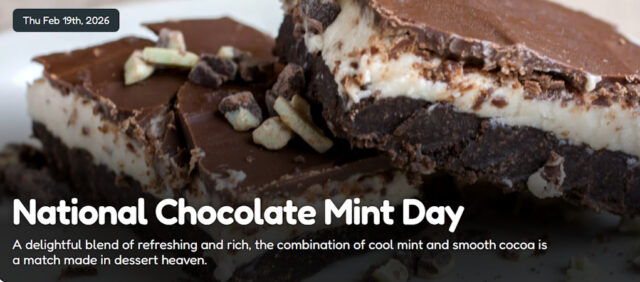
Recognized by the US National Confectioners Association, National Chocolate Mint Day is observed annually across the nation on February 19th. This holiday has been set aside for all the chocolate mint lovers to eat their favorite treats all day long.
- 1000 BC – Mint has been found in Egyptian tombs from as far back as 1000 BC!
- 16th-17th Century – After cacao is brought from the Americas, European elites sweeten and flavor hot chocolate with sugar and spices; over time, mint joins cinnamon and vanilla as a common complementary flavor.
- 1800s – In the mid-1800s, inventions and process improvements made it possible for confectioners to begin mass-producing chocolate.
- 1874 – One of the earliest mass producers of chocolate mints was Huyler’s (1874 to 1964) in New York. Their chain of stores spread across the country.
- 1900s – In tea houses and dining halls of the early 1900s mint sprigs and dark chocolates were served after desserts for patrons to ‘chew for good breath and aid digestion.
- 1918 – Frango Mints, perhaps the first chocolate mints, were patented. They were sold in teahouses and frozen to emphasize the sharp mint flavor.
- 1921 – Andes chocolate mints, created in 1921, have little to do with the Andes mountains. Once called “Andy’s Candies” the owner ‘found that men did not like giving boxes of candies with another man’s name on them to their wives and girlfriends’ so he changed the name.
- 1940 – This aromatic herb, combined with chocolate, didn’t become popular until York Peppermint Patties were introduced.
- 1951 – Girl Scouts of the USA add a “Chocolate Mint” cookie (later known as Thin Mints) to their lineup, and it grows into their best‑selling variety, cementing mint chocolate as a mainstream household flavor.
- 1973 – Culinary student, Marilyn Ricketts, invents mint chocolate chip ice cream at South Devon College in the UK.
- 2019 Tenants of Hudson Valley find it hard to track down ‘‘After Eight’’ in time for the holidays.
- Thin Mints account for over 25% of the annual Girl Scout cookie sales.
- In fact, according to Google Trends, in the U.S. overall, Thin Mints are the most searched Girl Scout cookie of all time
- Mint chocolate is also the name of an herb with edible leaves that tastes like chocolate and mint.
- The ancient Greeks and Romans valued mint for its ability to aid digestion and freshen the breath, and it was used in many kinds of food.
- The ancient Greeks believed that mint could cure hiccups.
- Peppermint is the number 1 selling flavor among non-chocolate hard candies.
- The most common mint flavors are peppermint and spearmint, but there are more than 20 types of mints growing around the world.
- Mint’s essential oils are used in perfume, cosmetics, air fresheners, drink flavorings, candies, and medications.
- The US produces 70% of the world’s peppermint and spearmint,
- Mint gets its name from Menthe, a Greek mythical character
- Ancient Hebrews used to scatter mint over the synagogue floor for its scent
- Mexicans call mint Yerba Bueno or good herb
- The health benefits of mint include improved digestion, weight loss, relief from nausea, depression, fatigue, and headache. It is also used to treat asthma, memory loss, and skin problems.
- The International Dairy Foods Association reports that mint chocolate chip is the 10th most popular ice cream flavor.
- Junior Mints are a popular choice with movie theater patrons.
- Advertisements for mint chocolates, or chocolate mints, did not appear in newspapers until the turn of the century.
- Spearmint is the most commonly used mint in chocolate recipes. However, peppermint is also used.
- Popular chocolate mints, ‘‘Andies mountains’’ were once called ‘‘Andies Candies.’’
Sources:

Disclaimer
Artificial Intelligence Disclosure & Legal Disclaimer
AI Content Policy.
To provide our readers with timely and comprehensive coverage, South Florida Reporter uses artificial intelligence (AI) to assist in producing certain articles and visual content.
Articles: AI may be used to assist in research, structural drafting, or data analysis. All AI-assisted text is reviewed and edited by our team to ensure accuracy and adherence to our editorial standards.
Images: Any imagery generated or significantly altered by AI is clearly marked with a disclaimer or watermark to distinguish it from traditional photography or editorial illustrations.
General Disclaimer
The information contained in South Florida Reporter is for general information purposes only.
South Florida Reporter assumes no responsibility for errors or omissions in the contents of the Service. In no event shall South Florida Reporter be liable for any special, direct, indirect, consequential, or incidental damages or any damages whatsoever, whether in an action of contract, negligence or other tort, arising out of or in connection with the use of the Service or the contents of the Service.
The Company reserves the right to make additions, deletions, or modifications to the contents of the Service at any time without prior notice. The Company does not warrant that the Service is free of viruses or other harmful components.