The Midnight Extraction
In the moonless early hours of Sunday, April 5, 2026, the silence of the Kohgiluyeh and Boyer-Ahmad province in southwestern Iran was shattered by the rhythmic thrum of low-flying rotors and the sharp crackle of suppression fire. Deep within a jagged mountain crevice, roughly 7,000 feet above sea level, a highly respected U.S. Air Force Colonel and Weapons Systems Officer (WSO) waited. For forty-eight hours, he had been the subject of an intense, high-stakes manhunt—not just by the Iranian Revolutionary Guard Corps (IRGC), but by an entire nation galvanized by promises of a bounty.
The rescue, described by President Donald Trump as “one of the most daring search-and-rescue operations in U.S. history,” involved a massive 200-strong special forces team. It was the culmination of a two-day drama that began when a U.S. F-15E Strike Eagle was downed over Iranian territory, marking a significant escalation in the five-week-long conflict currently gripping the Middle East.
The Fateful Strike
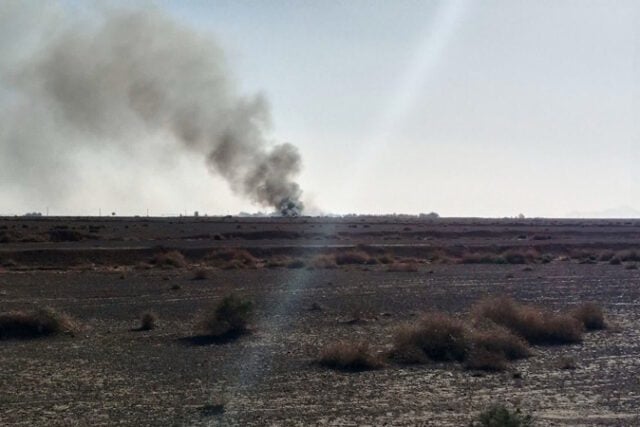
The ordeal began on Friday, April 3, 2025. The F-15E Strike Eagle, a cornerstone of American air superiority, was conducting a mission over southwestern Iran when it was struck by enemy fire. While the exact weapon remains a point of contention—with Iranian state media claiming a sophisticated surface-to-air missile hit and U.S. officials remaining tight-lipped—the result was immediate. The aircraft, a dual-role fighter designed for long-range interdiction, plummeted toward the rugged terrain near the city of Dehdasht, approximately 30 miles from the coast.
Both crew members successfully ejected, but their paths diverged the moment their parachutes deployed. The pilot was located and extracted within seven hours in a daring “broad daylight” mission. However, the Colonel, serving as the WSO, was not so lucky. Wounded during the ejection or the landing, and facing a rapidly closing net of Iranian security forces, he disappeared into the rocky verticality of the Zagros Mountains.

Forty-Eight Hours of Evasion
The “hunt” for the Colonel was as much a psychological battle as a physical one. As the Iranian government called upon its citizens to help capture the “enemy pilot,” the Colonel was forced to employ every facet of his SERE (Survival, Evasion, Resistance, and Escape) training.
He moved primarily under the cover of darkness, navigating the treacherous 7,000-foot ridges of the province. By day, he hunkered down in a mountain crevice, a natural hideout that offered some protection from the thermal imaging of Iranian drones and the prying eyes of local search parties. According to senior administration officials, the Colonel was “seriously wounded” during this period but maintained a disciplined silence, using what the President later termed “beeping information”—likely a sophisticated, low-probability-of-intercept (LPI) survival beacon—to signal his position to U.S. intelligence.
The environment was hostile in every sense. The terrain in Kohgiluyeh and Boyer-Ahmad is notoriously difficult, characterized by steep limestone cliffs and sparse vegetation. The Colonel had to contend with extreme temperature fluctuations and the constant threat of discovery. At one point, Iranian military-aged males, spurred by the bounty, reportedly moved within three kilometers of his position. They were kept at bay by uncrewed Reaper drones, which executed precision strikes on those deemed a direct threat to the downed airman.
The CIA’s Deception Campaign
While the Colonel hid, a different kind of war was being waged in the digital and intelligence spheres. To buy the Pentagon time to organize a massive rescue force, the CIA launched a sophisticated disinformation campaign.
Intelligence operatives spread rumors within Iran and on social media that the U.S. had already located the Colonel and was moving him by ground toward the border. This “deception campaign” was designed to throw off the IRGC’s focus, forcing them to divert resources to checkpoints and road patrols rather than concentrating their search on the mountain hideouts. The confusion was successful; while the IRGC searched vehicles and mountain passes miles away, the Pentagon was able to pinpoint the Colonel’s exact coordinates in his mountain crevice.
The Rescue Force: 200 Strong
When the order finally came from the White House, it was for an operation of unprecedented scale. Unlike the 1995 rescue of Scott O’Grady, which utilized a 57-man Marine TRAP (Tactical Recovery of Aircraft and Personnel) team, this mission deployed a 200-strong special forces team.
The rescue fleet included:
- Pave Hawk Helicopters: Specialized for combat search and rescue (CSAR), these aircraft flew low, utilizing the terrain to mask their approach from Iranian radar.
- C-130 Hercules: These provided logistical support and served as communication hubs.
- A-10 Warthogs: Providing “sand” (close air support), these planes circled the extraction zone to suppress any ground-based threats.
- Drones: Reaper drones provided constant overwatch and tactical strikes.
The 200 commandos were tasked with securing a wide perimeter around the extraction site to ensure that the Colonel, who was unable to move quickly due to his injuries, could be safely reached and loaded.
The Zero-Hour Extraction
The operation reached its climax overnight between Saturday and Sunday. Under a “hail of heavy covering fire,” the commandos descended upon the mountain crevice. Night-time clashes erupted in the province as U.S. forces engaged IRGC units that had eventually closed in on the signal.
Iranian sources reported that three Revolutionary Guards were killed in the firefight. Despite the intensity of the engagement, the U.S. military reported no American casualties or injuries during the extraction. The Colonel was successfully hoisted from his mountain hideout and brought aboard a Pave Hawk.
Footage that emerged later on social media showed the chaotic night-time clashes near Dehdasht, with tracers lighting up the sky as the U.S. aircraft exited Iranian airspace. By the time the sun rose on Sunday, April 5, the Colonel was safely in U.S. custody and receiving medical treatment for his wounds.
Aftermath and Global Reaction
The success of the mission brought an immediate wave of international reactions. President Trump took to Truth Social to celebrate the “American warfighter,” emphasizing that the U.S. would never leave a service member behind. He praised the Colonel as “brave” and the special forces team for executing a raid “seldom attempted because of the danger.”
In Israel, Prime Minister Benjamin Netanyahu—who has his own history with daring rescues—offered his congratulations, noting the bravery required for such a decision. The successful recovery of both crew members is being hailed as a historic first: the separate rescue of two aviators from deep inside enemy territory during an active conflict.
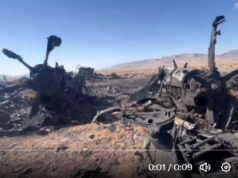
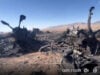
However, the event has also heightened tensions. Iranian state media released photos of the F-15E’s wreckage, including its distinctive tail fin, as a symbol of their resistance. The conflict, now entering its sixth week, shows no signs of abating, but for one U.S. family, the “hunt” has finally ended in a miracle.
Sources and Links
- PBS News: What to know about the daring rescue of two U.S. aviators shot down in Iran
- The Guardian: US rescues second crew member of downed F-15E fighter jet from Iran
- 33rd Fighter Wing (AF.mil): The Perfect Edge: Training teaches Airmen how to survive, evade, resist and escape
- Wikipedia: Scott O’Grady (Referenced for historical comparison of search and rescue tactics).
Disclaimer
Artificial Intelligence Disclosure & Legal Disclaimer
AI Content Policy.
To provide our readers with timely and comprehensive coverage, South Florida Reporter uses artificial intelligence (AI) to assist in producing certain articles and visual content.
Articles: AI may be used to assist in research, structural drafting, or data analysis. All AI-assisted text is reviewed and edited by our team to ensure accuracy and adherence to our editorial standards.
Images: Any imagery generated or significantly altered by AI is clearly marked with a disclaimer or watermark to distinguish it from traditional photography or editorial illustrations.
General Disclaimer
The information contained in South Florida Reporter is for general information purposes only.
South Florida Reporter assumes no responsibility for errors or omissions in the contents of the Service. In no event shall South Florida Reporter be liable for any special, direct, indirect, consequential, or incidental damages or any damages whatsoever, whether in an action of contract, negligence or other tort, arising out of or in connection with the use of the Service or the contents of the Service.
The Company reserves the right to make additions, deletions, or modifications to the contents of the Service at any time without prior notice. The Company does not warrant that the Service is free of viruses or other harmful components.