The Department of Homeland Security (DHS) is poised to enter a partial shutdown at midnight tonight, Friday, February 13, 2026, marking a historic fiscal standoff that leaves a single cabinet department in the lurch while the rest of the federal government remains fully funded. After weeks of high-stakes maneuvering, the House and Senate adjourned Thursday afternoon with no deal in sight, leaving the fate of 260,000 employees hanging on a breakthrough that is unlikely to materialize until at least late next week.
Two Videos follow.
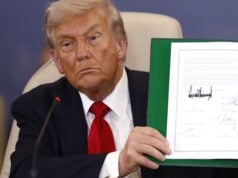
Prsident Trump video courtesy the White House
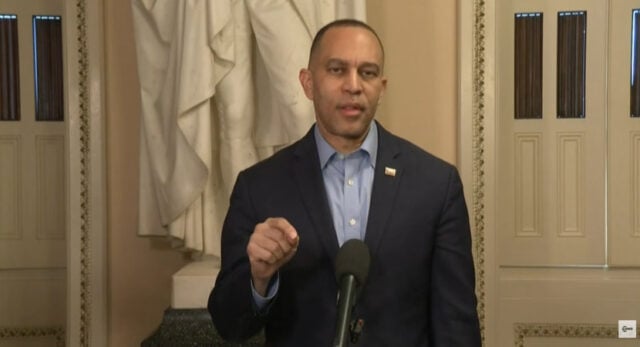
Minority leader Hakeem Jeffries video courtesy DWS
The lapse comes after Senate Democrats blocked a short-term funding extension, demanding that any final appropriations bill include sweeping reforms to the administration’s immigration enforcement tactics. The debate has been fueled by intense public outcry following the fatal shootings of Alex Pretti and Renee Good by federal agents in Minneapolis last month—incidents that have become a focal point for Democratic leaders pushing for increased accountability.

The Standoff: Accountability vs. Enforcement
At the heart of the disagreement is a list of ten demands from Democratic leadership. They are seeking to codify new restrictions into law, including a ban on the use of masks by federal law enforcement officers, a mandate for body-worn cameras, a requirement for third-party judicial warrants to enter private property, and stricter uniform use-of-force policies.
House Minority Leader Hakeem Jeffries (D-NY) has been a vocal critic of the administration’s current trajectory, arguing that the department’s enforcement arms have overstepped their bounds. Speaking on the House floor and in various statements, Jeffries made his position clear:
“The Trump administration has gone too far, ICE is completely out of control, and the American people know it,” Jeffries said. “Taxpayer dollars should be spent making life more affordable for everyday Americans, not brutalizing and killing U.S. citizens and law-abiding immigrant families. Absent bold and meaningful change, there is no credible path forward.”
Jeffries has characterized the current funding levels as a “slush fund” for “paramilitary tactics,” insisting that “dramatic changes are needed… Period. Full stop.”
President Donald Trump, who initially urged Congress to pass the funding package “WITHOUT DELAY,” has remained firm in his defense of federal law enforcement. While the administration has made some concessions—such as winding down specific operations in Minneapolis and deploying body cameras to certain units—the President has balked at the broader Democratic wish list, specifically the mask ban.
“We have to protect our law enforcement,” President Trump told reporters on Thursday. He noted that some of the Democratic demands would be “very, very hard to approve,” citing a recent court ruling that upheld the right of federal officers to wear masks for protection.
The White House maintains that the Republican-led House already passed a bipartisan funding bill weeks ago and that the current crisis is a “manufactured” shutdown by Senate Democrats. Despite the rhetoric, the White House sent a counter-proposal to Capitol Hill on Wednesday night, though Democratic leaders quickly dismissed it as “incomplete and insufficient.”
The Impact: Who Works and Who Waits?
Because the “One Big Beautiful Bill Act” (OBBBA), which passed last year, provided nearly $180 billion in supplemental funding for border security and wall construction, agencies like Immigration and Customs Enforcement (ICE) and Customs and Border Protection (CBP) are largely insulated from the immediate effects of the shutdown. These agencies can tap into those multi-year funds to maintain operations and pay their personnel.
The burden of the shutdown will instead fall on the department’s “non-enforcement” arms. Approximately 23,000 employees are expected to be furloughed, while the remaining 92% of the workforce—including TSA officers, Coast Guard members, and Secret Service agents—will be required to work without pay until a resolution is reached.
- TSA & Travel: Aviation security is expected to remain operational, but if the shutdown drags on, “blue flu” (unscheduled absences) could lead to checkpoint closures and significant travel delays, echoing the 43-day shutdown of late 2025.
- CISA: The Cybersecurity and Infrastructure Security Agency is expected to furlough nearly two-thirds of its staff, significantly slowing response times to cyber threats and the implementation of new reporting rules.
- FEMA: While the Disaster Relief Fund has a current balance sufficient for immediate emergencies, long-term planning and coordination with state partners will be “irrevocably impacted,” according to agency officials.
A Divided Congress
Republican leaders have expressed frustration that DHS was stripped from the broader spending package that the President signed earlier this month. Senate Majority Leader John Thune (R-SD) warned that the shutdown would primarily hurt “the people who are not going to be getting paychecks.”
Meanwhile, House Republicans, including Appropriations Chairman Tom Cole (R-OK), have argued that the Democrats’ focus on a “single-issue” ignores the critical national security missions of the Coast Guard and TSA. “Treating it as such ignores the full scope of impacts before us—and abandons responsible governance,” Cole said.
With both chambers in recess for the coming week, the negotiations move to the backrooms of the White House and the offices of Senate Minority Leader Chuck Schumer (D-NY). Lawmakers have been put on notice to return to Washington if a deal becomes imminent, but for now, the Department of Homeland Security remains a house divided, funded by supplemental bills for enforcement while its civilian wings go dark.
Sources
- AP News: Homeland Security shutdown seems certain as funding talks stall
- Punchbowl News: Why the DHS shutdown could drag on
- Government Executive: DHS to shut down after lawmakers fail to reach agreement
- CBS News: Democrats reject latest White House offer on ICE reforms
- House Appropriations Committee: Facing Reality: Democrats Ignore Facts Heading into DHS Shutdown
- Office of Hakeem Jeffries: Statement on DHS Funding and ICE Accountability
- Committee for a Responsible Federal Budget: What Happens If DHS Shuts Down
Disclaimer
Artificial Intelligence Disclosure & Legal Disclaimer
AI Content Policy.
To provide our readers with timely and comprehensive coverage, South Florida Reporter uses artificial intelligence (AI) to assist in producing certain articles and visual content.
Articles: AI may be used to assist in research, structural drafting, or data analysis. All AI-assisted text is reviewed and edited by our team to ensure accuracy and adherence to our editorial standards.
Images: Any imagery generated or significantly altered by AI is clearly marked with a disclaimer or watermark to distinguish it from traditional photography or editorial illustrations.
General Disclaimer
The information contained in South Florida Reporter is for general information purposes only.
South Florida Reporter assumes no responsibility for errors or omissions in the contents of the Service. In no event shall South Florida Reporter be liable for any special, direct, indirect, consequential, or incidental damages or any damages whatsoever, whether in an action of contract, negligence or other tort, arising out of or in connection with the use of the Service or the contents of the Service.
The Company reserves the right to make additions, deletions, or modifications to the contents of the Service at any time without prior notice. The Company does not warrant that the Service is free of viruses or other harmful components.