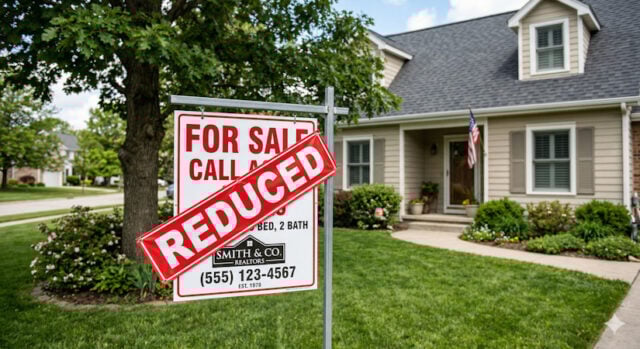
The United States housing market, which entered 2026 with a sense of cautious optimism, has been abruptly derailed by the outbreak of war in Iran. What began as a hopeful “spring awakening” for real estate has transformed into a period of intense volatility as geopolitical tensions, energy shocks, and a hawkish shift in monetary policy converge to squeeze both buyers and sellers. As of late March 2026, the primary transmission mechanism of this conflict into the American living room is the rapid ascent of mortgage interest rates, which have surged back toward levels not seen since the previous autumn.
The Sudden Reversal of Mortgage Rates
In February 2026, the narrative surrounding the U.S. mortgage market was one of relief. For the first time since 2022, the average 30-year fixed-rate mortgage dipped below the 6% threshold, hitting roughly 5.98%. This decline was fueled by cooling inflation data and a massive $200 billion mortgage-bond purchase program initiated by the Trump administration to stimulate affordability.
However, the launch of military operations on February 28, 2026, instantly reversed these gains. By March 20, 2026, the Mortgage Bankers Association (MBA) reported that average 30-year rates had spiked to 6.43%. This rapid 45-basis-point jump in less than a month has effectively “poured cold water” on the market, according to industry analysts. For a typical buyer of a median-priced home ($447,000), this rate hike adds approximately $100 to $150 to their monthly payment, totaling over $22,000 in additional interest costs over the life of a 30-year loan.
The Oil-Inflation Link
The primary driver behind rising rates is the war’s impact on global energy markets. The closure of the Strait of Hormuz—a chokepoint for 20% of the world’s oil consumption—sent crude prices soaring from $60 in December to nearly $100 per barrel in mid-March.

In modern economics, oil is a “universal input.” When energy costs rise, the cost of transporting goods and manufacturing materials follows. This “supply-side shock” has reignited fears of “sticky” inflation. Investors, anticipating that the Federal Reserve will be forced to keep interest rates “higher for longer” to combat this energy-driven inflation, have sold off government bonds.
Historically, when bond prices fall, yields rise. Because the 30-year mortgage rate is closely benchmarked to the 10-year Treasury yield, the surge in yields from 3.93% to over 4.35% in March has directly translated into more expensive home loans.
A “Safe Haven” Failure?
Typically, during times of war, investors flock to “safe-haven” assets like U.S. Treasuries, which usually pushes yields down and makes mortgages cheaper. However, the 2026 conflict has broken this traditional pattern.
Because this war is viewed as inherently inflationary (due to oil), the “inflation tax” on fixed-income assets is outweighing the “flight to safety.” Investors are demanding higher returns to compensate for the eroding purchasing power of the dollar, leading to the “safe-haven failure” observed in early March. Even gold, the quintessential crisis asset, saw a 14% single-day crash as institutional investors liquidated liquid holdings to cover losses in other sectors.
Impact on Housing Demand and Supply
The housing market is currently experiencing a “locked-in” effect on steroids. Existing homeowners who secured rates in the 3% to 4% range during the pandemic are now even more reluctant to sell. Trading a 3.5% rate for a 6.5% rate in a time of war-induced economic uncertainty is a non-starter for most families.
On the demand side, the MBA Refinance Index plummeted by nearly 30% between late February and late March. Purchase applications have also softened, as consumer confidence hit its lowest level of the year. The “Spring Interrupted” phenomenon means that 2026 sales volumes are now projected to mimic the anemic levels of 2025, rather than the breakout year many economists had predicted.
Regional Variations
The effect of the Iran War is not uniform across the United States. While the national trend is toward stagnation, a regional divide has emerged:
- The Sun Belt: Markets in Florida and Texas, which saw massive price appreciation in recent years, are seeing more significant corrections. Cities like Cape Coral and North Port are facing projected price declines of 8% to 10% as high rates finally sap buyer power.
- The Northeast and Midwest: In contrast, cities like Toledo, OH, and Syracuse, NY, remain resilient. Critically low inventory in these regions—sometimes 70% below pre-pandemic levels—is keeping prices stable or even rising, despite the war-driven rate hikes.
The Federal Reserve’s Dilemma
The Federal Reserve finds itself in a “policy bind.” In its March 18, 2026, meeting, the Federal Open Market Committee (FOMC) opted to hold the benchmark interest rate steady at 3.5%–3.75%.
Fed Chair Jerome Powell noted that the implications of the Middle East conflict are “uncertain.” On one hand, the war threatens to slow economic growth (a reason to cut rates). On the other hand, it is driving up energy-led inflation (a reason to raise or hold rates). Most market observers now expect only one rate cut for the remainder of 2026, a sharp decrease from the three or four cuts anticipated just months ago.
Looking Ahead
The trajectory of the U.S. housing market for the remainder of 2026 is now tethered to the front lines of the Middle East. If a de-escalation or diplomatic “deal” is reached between Washington and Tehran, analysts suggest mortgage rates could quickly retreat toward the 6% mark. However, if the conflict lingers or escalates into a broader regional war, the 30-year fixed rate could potentially test the 7% level by mid-summer.
For now, the American dream of homeownership remains in a state of suspended animation, caught between the domestic desire for affordability and the global reality of geopolitical conflict.
Sources Used
- Scotsman Guide – “Iran war crushes refinance demand in March” https://www.scotsmanguide.com/news/iran-war-crushes-refinance-demand-in-march/
- Marketplace – “How even mortgage rates are impacted by the war in the Middle East” https://www.marketplace.org/story/2026/03/04/iran-war-pushes-mortgage-rates-back-above-6
- Real Estate News – “A spring without sub-6% mortgages? Blame the war in Iran” https://www.realestatenews.com/2026/03/25/a-spring-without-sub-6-mortgages-blame-the-war-in-iran
- Washington Examiner – “Mortgage rates rise in defiance of Trump’s $200 billion push” https://www.washingtonexaminer.com/news/4500998/mortgage-rates-rise-defiance-trump-push-hurting-gop-affordability/
- World Property Journal – “Ongoing Middle East Conflict Pushes U.S. Mortgage Rates Higher Mid-March” https://www.worldpropertyjournal.com/real-estate-news/united-states/washington-dc-real-estate-news/iran-war-impact-on-mortgages-in-2026-iran-war-impact-on-home-sales-in-2026-middle-east-war-impact-on-us-housing-market-sam-khater-freddie-mac-israel-w-14699.php
- Mortgage Professional America – “Bond yields fall after promising Iran news” https://www.mpamag.com/us/mortgage-industry/market-updates/bond-yields-fall-after-promising-iran-news-offering-relief-following-latest-mortgage-rate-jump/569813
- Center for American Progress – “Trump’s War in Iran Is Increasing Mortgage Rates” https://www.americanprogress.org/article/trumps-war-in-iran-is-increasing-mortgage-rates/
- Federal Reserve – “Federal Reserve issues FOMC statement (March 18, 2026)” https://www.federalreserve.gov/newsevents/pressreleases/monetary20260318a.htm
- Charles Schwab – “What Iran Conflict Could Mean for the Bond Market” https://www.schwab.com/learn/story/what-iran-conflict-could-mean-bond-market
- Wealth Munshi – “Why Your Portfolio Keeps Losing Value During Global Conflicts” https://wealthmunshi.com/why-portfolio-losing-value-conflicts-safe-haven-assets-2026/
Disclaimer
Artificial Intelligence Disclosure & Legal Disclaimer
AI Content Policy.
To provide our readers with timely and comprehensive coverage, South Florida Reporter uses artificial intelligence (AI) to assist in producing certain articles and visual content.
Articles: AI may be used to assist in research, structural drafting, or data analysis. All AI-assisted text is reviewed and edited by our team to ensure accuracy and adherence to our editorial standards.
Images: Any imagery generated or significantly altered by AI is clearly marked with a disclaimer or watermark to distinguish it from traditional photography or editorial illustrations.
General Disclaimer
The information contained in South Florida Reporter is for general information purposes only.
South Florida Reporter assumes no responsibility for errors or omissions in the contents of the Service. In no event shall South Florida Reporter be liable for any special, direct, indirect, consequential, or incidental damages or any damages whatsoever, whether in an action of contract, negligence or other tort, arising out of or in connection with the use of the Service or the contents of the Service.
The Company reserves the right to make additions, deletions, or modifications to the contents of the Service at any time without prior notice. The Company does not warrant that the Service is free of viruses or other harmful components.