Continental Crisis: A Generational Storm Confronts the United States
WASHINGTON, D.C. — A massive, high-impact winter storm is poised to paralyze a 2,000-mile stretch of the United States this weekend, January 23–26, 2026. Meteorologists are warning of a “generational” event as a plunging polar vortex collides with a surge of moisture from the Gulf of Mexico, creating a volatile cocktail of heavy snow, crippling ice, and life-threatening cold. With over 130 million people under winter weather alerts, officials from Texas to New England are urging residents to finalize emergency preparations before the first flakes and freezing rain arrive Friday afternoon.
The “Dual-Threat” Forecast: Snow and Ice
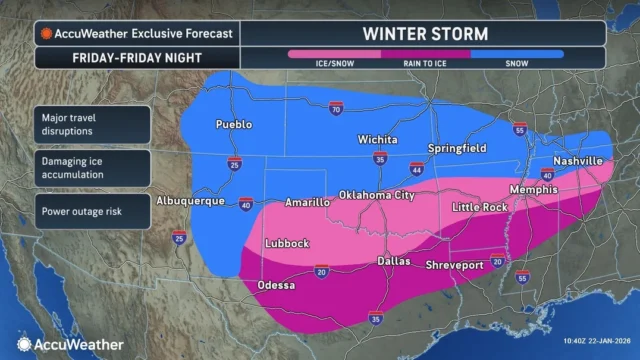
Forecasters have identified two primary “danger zones” associated with this system. To the north, a band of heavy, wind-driven snow is expected to dump 12 to 20 inches across the Midwest and into the Northeast. Major metropolitan areas, including Kansas City, St. Louis, Indianapolis, and Washington, D.C., are in the direct path of the heaviest accumulations.
To the south, a much more insidious threat looms: a significant ice storm. AccuWeather and the National Weather Service (NWS) have issued rare Ice Storm Warnings for parts of Texas, Arkansas, Mississippi, and Tennessee. In these regions, ice accretion could reach 0.50 to 0.75 inches. “Just a quarter-inch of ice can cause widespread tree damage and power outages,” noted AccuWeather Chief Meteorologist Jonathan Porter. “At half an inch or more, we are looking at a potential infrastructure crisis.”

Travel: A Nationwide Standstill
Travel is expected to become impossible across multiple states starting Friday evening.
- Aviation: Major hubs, including Dallas-Fort Worth (DFW), Memphis (MEM), and Charlotte (CLT), have already begun preemptive flight cancellations. Travelers are advised that even if their departure city is clear, the interconnected nature of U.S. air travel will likely result in thousands of delays nationwide.
- Roadways: State Departments of Transportation in Tennessee and Georgia have deployed brine trucks to pre-treat interstates, but officials warn that pre-treatment is ineffective against heavy freezing rain. Interstates 20, 40, and 81 are considered high-risk corridors where “black ice” and rapid snow accumulation will make driving treacherous.
Infrastructure and Power Outages
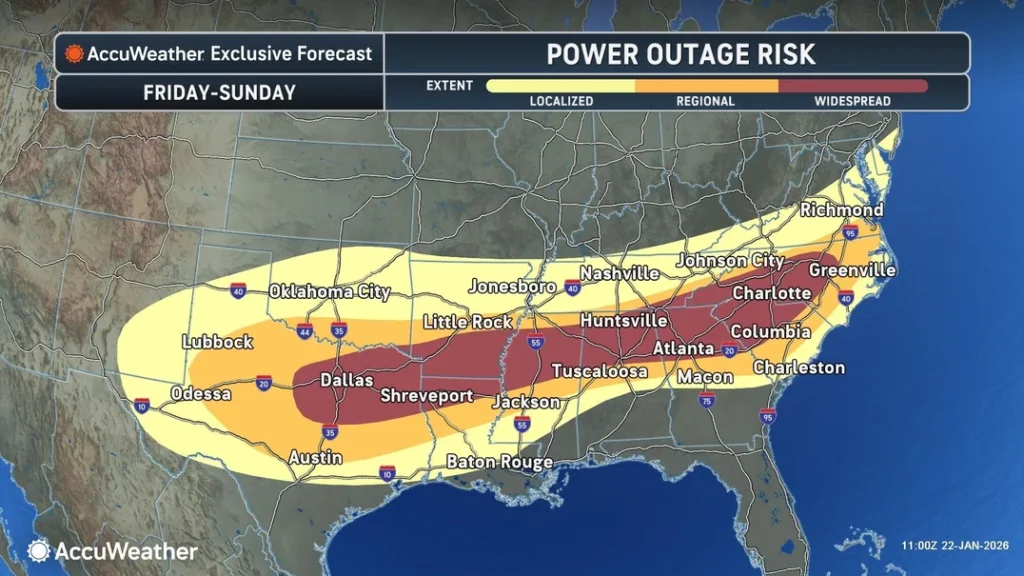 Energy grid operators, including PJM Interconnection and Entergy, have issued cold-weather alerts. The weight of heavy ice on power lines, combined with wind gusts of 30–40 mph, makes widespread and long-lasting power outages highly probable.
In the South, where infrastructure is less acclimated to sustained freezing temperatures, the concern is doubly focused on the electrical grid and residential plumbing. Homeowners are being urged to insulate pipes and allow faucets to drip to prevent bursts. Grid operators have also requested that residents minimize non-essential energy usage to reduce the strain on the system as demand for heating spikes to record levels.
Health Worries: The Arctic Follow-Up
Perhaps the most dangerous aspect of the storm is the “back-end” cold. As the precipitation moves offshore Sunday night, a brutal Arctic air mass will settle in.
- Frostbite: Wind chills in the Upper Midwest are forecast to plummet as low as $-55$°F. At these levels, frostbite can occur on exposed skin in less than five minutes.
- Hypothermia: Health officials are particularly concerned for those who may lose power. Without a secondary heat source, indoor temperatures can drop to dangerous levels within hours.
- Carbon Monoxide: The American Red Cross has issued a stern reminder regarding generator safety: “Never use a generator indoors, in a garage, or near a window.” Carbon monoxide poisoning remains a leading cause of death during major winter outages.
State of Emergency and Public Response
Governors in at least five states—including Georgia, North Carolina, and Tennessee—have already declared States of Emergency. These declarations allow for the mobilization of the National Guard and the suspension of certain transport regulations to speed the delivery of fuel and salt.
“This is not a ‘wait and see’ event,” said Georgia Governor Brian Kemp during a Thursday press briefing. “The window to prepare is closing. We need people off the roads and in a safe place by Saturday afternoon.”
Preparation Checklist
Experts recommend a “Stay-at-Home” kit containing:
- Water: One gallon per person per day for at least three days.
- Food: Non-perishable items that do not require cooking.
- Medicine: A one-month supply of critical prescriptions.
- Heat: Extra blankets, sleeping bags, and warm clothing (layers are key).
- Communication: Battery-powered or hand-crank weather radios.
As the storm evolves, residents are encouraged to monitor local NWS offices and trusted weather outlets for real-time updates on snow totals and ice accumulation.
Sources & Links
- AccuWeather: Major Winter Storm to Deliver Dangerous Ice, Snow to 12+ States
- National Weather Service (NWS): Winter Weather Alerts and Impact Graphics
- The Guardian: Powerful Winter Storm to Bring Heavy Snow Across Much of US This Weekend
- American Red Cross: Massive Winter Storm Threatens Millions; Preparedness Guide
- Entergy Storm Center: Winter Weather Preparation and Outage Map
- Georgia Government: Gov. Kemp Declares State of Emergency Ahead of Winter Storm Fern
Disclaimer
Artificial Intelligence Disclosure & Legal Disclaimer
AI Content Policy.
To provide our readers with timely and comprehensive coverage, South Florida Reporter uses artificial intelligence (AI) to assist in producing certain articles and visual content.
Articles: AI may be used to assist in research, structural drafting, or data analysis. All AI-assisted text is reviewed and edited by our team to ensure accuracy and adherence to our editorial standards.
Images: Any imagery generated or significantly altered by AI is clearly marked with a disclaimer or watermark to distinguish it from traditional photography or editorial illustrations.
General Disclaimer
The information contained in South Florida Reporter is for general information purposes only.
South Florida Reporter assumes no responsibility for errors or omissions in the contents of the Service. In no event shall South Florida Reporter be liable for any special, direct, indirect, consequential, or incidental damages or any damages whatsoever, whether in an action of contract, negligence or other tort, arising out of or in connection with the use of the Service or the contents of the Service.
The Company reserves the right to make additions, deletions, or modifications to the contents of the Service at any time without prior notice. The Company does not warrant that the Service is free of viruses or other harmful components.