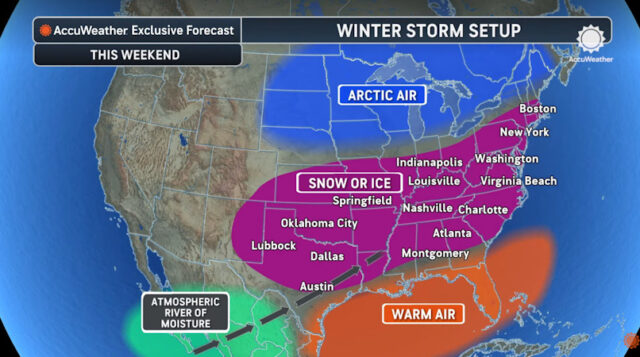
A massive and life-threatening winter weather system is poised to strike the United States this weekend, threatening to bring the most significant impacts of the season so far. Stretching from the southern Plains to the Northeast, the storm is expected to impact more than 150 million people across over two dozen states. Meteorologists are warning of a “dangerous combination” of heavy snow, crippling ice accretions, and a brutal Arctic blast that could leave hundreds of thousands without power and heat for an extended period.
Ice Threat Targets the South and East
The most treacherous aspect of this storm is the significant ice accretion forecast for the South and Mid-Atlantic. Starting Friday in Texas, the icy conditions will expand across the Southeast into the Carolinas. Forecasters are particularly concerned about major metropolitan hubs, including Dallas, Austin, Nashville, and Atlanta.
“Atlanta is facing an increasing risk of a major ice storm,” warned Dan DePodwin, AccuWeather Vice President of Forecasting Operations. In a worst-case scenario, operations at Atlanta’s Hartsfield-Jackson International Airport could be halted for days. The weight of the ice on power lines and tree limbs is expected to trigger widespread outages.

A unique and concerning factor for the Southeast involves the lingering effects of the 2024 hurricane season. In parts of eastern Georgia and South Carolina, trees weakened by Hurricane Helene may be more prone to snapping under the weight of even modest ice. This increases the likelihood of long-term power outages and hazardous road conditions.
Heavy Snow and Travel Gridlock
North of the freezing rain, a swath of heavy snow is expected to blanket a corridor from New Mexico and northwest Texas through the Plains and into the Northeast. Major cities including Oklahoma City, Washington, D.C., Philadelphia, New York City, and Boston are all in the path. Forecasters expect 6 to 12 inches of snow or more in areas where the air remains cold enough to prevent mixing with rain or sleet.
The implications for travel are severe. AccuWeather Chief Meteorologist Jonathan Porter noted that critical east-to-west arteries, including Interstates 20, 30, and 40, could see simultaneous closures. This would create a ripple effect, paralyzing supply chains and leaving thousands of travelers stranded. Major airports are bracing for thousands of cancellations that will likely impact flight schedules nationwide.
The Arctic Blast and Power Grid Concerns
Compounding the precipitation is a surge of frigid Arctic air. RealFeel® temperatures are forecast to plummet to 30 degrees below zero in Chicago by Friday morning. In parts of Wisconsin, Minnesota, and North Dakota, those values could reach a bone-chilling 40 to 50 degrees below zero.
This extreme cold poses a significant threat to infrastructure, particularly in Texas. Dallas could see temperatures remain below freezing for 60 to 80 consecutive hours, with the potential for that stretch to reach 100 hours if the Arctic front pushes further south. While not expected to match the historic 2021 freeze that caused $155 billion in losses, this will be the most significant test of the Texas power grid since that event.
“The combination of very cold air, ice, and snow may be the biggest test of the Texas power grid since February 2021,” Porter said. He noted that the freezing of energy assets was a primary cause of previous failures, and the upcoming ice storm will test the resiliency and winterization improvements made over the last few years.
Safety and Preparedness
The prolonged nature of this event means that many regions will deal with active snow or ice for 24 hours or longer. On the southern edge of the system, localized severe weather and thunderstorms are possible along the Gulf Coast and Florida.
Officials are urging residents in the path of the storm to prepare for the possibility of being without electricity and heat for several days, or even a week in the hardest-hit areas. Families are encouraged to stock up on emergency supplies, including non-perishable food, water, and warm blankets. Those who must travel are advised to carry an emergency kit in their vehicles, as the bitter cold significantly increases the risk of frostbite and hypothermia if stranded.
Disclaimer
Artificial Intelligence Disclosure & Legal Disclaimer
AI Content Policy.
To provide our readers with timely and comprehensive coverage, South Florida Reporter uses artificial intelligence (AI) to assist in producing certain articles and visual content.
Articles: AI may be used to assist in research, structural drafting, or data analysis. All AI-assisted text is reviewed and edited by our team to ensure accuracy and adherence to our editorial standards.
Images: Any imagery generated or significantly altered by AI is clearly marked with a disclaimer or watermark to distinguish it from traditional photography or editorial illustrations.
General Disclaimer
The information contained in South Florida Reporter is for general information purposes only.
South Florida Reporter assumes no responsibility for errors or omissions in the contents of the Service. In no event shall South Florida Reporter be liable for any special, direct, indirect, consequential, or incidental damages or any damages whatsoever, whether in an action of contract, negligence or other tort, arising out of or in connection with the use of the Service or the contents of the Service.
The Company reserves the right to make additions, deletions, or modifications to the contents of the Service at any time without prior notice. The Company does not warrant that the Service is free of viruses or other harmful components.