The Looming Threat: A Significant Coastal Storm
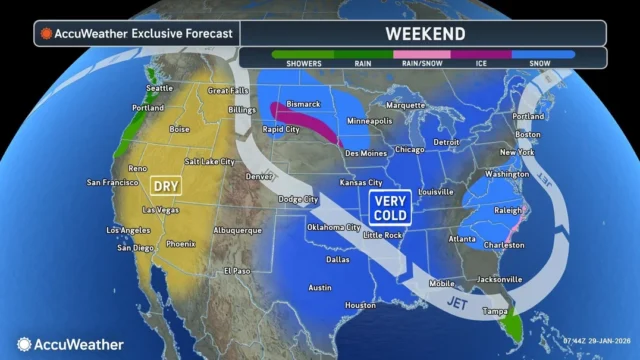
As the United States reels from one of the deadliest stretches of winter weather in recent memory, meteorologists at the National Weather Service (NWS) and the Weather Prediction Center (WPC) have issued urgent warnings for a significant coastal storm set to develop this weekend. Forecast to form off the Southeast Coast on Saturday, January 31, 2026, the system is expected to track northeastward through Sunday, February 1.
This developing low-pressure system is on a collision course with a deep, entrenched Arctic air mass currently gripping the eastern half of the country. This interaction is predicted to create a “worst-case scenario” for travel and infrastructure. Forecasters have high confidence that the storm will bring heavy snow, gusty winds, and hazardous travel conditions to the Mid-Atlantic and southern New England. While the exact “rain-snow line” remains a point of intense study, major metropolitan hubs from Charlotte to Boston are on high alert for significant accumulations.
The storm’s timing is particularly precarious. With ground temperatures already well below freezing from a month of persistent cold, any moisture—be it snow, sleet, or freezing rain—will likely bond instantly to surfaces, turning highways into ice rinks and further taxing an electrical grid already under repair.
Echoes of Tragedy: Remembering Winter Storm Fern
The urgency of the current forecast is underscored by the staggering toll of Winter Storm Fern, the “potentially historic” event that dominated the latter half of January. While early reports estimated lower casualties, confirmed figures have risen sharply. As of late January, official reports confirm that at least 50 people have died due to Fern’s wrath, with some local estimates and Wikipedia records suggesting a catastrophic total of over 100 fatalities across North America.

The casualties tell a story of a storm that was as diverse as it was deadly:
- Texas: In a heartbreaking incident near Bonham, three young boys died after falling through the ice of a private pond.
- Maine: An aviation disaster in Bangor claimed eight lives when a private jet crashed during takeoff in heavy snow.
- The South: “Crippling” ice accumulations of up to 0.60 inches caused widespread power outages, leading to deaths from carbon monoxide poisoning and hypothermia in Louisiana and Mississippi.
- The Northeast: In New York City alone, eight people were found dead outdoors after a weekend of sub-zero wind chills.
At its peak, Winter Storm Fern spanned 2,000 miles, prompting emergency declarations from 24 state governors. Over a million customers lost power during the height of the storm, and as of January 29, utility companies like Entergy are still working around the clock to restore service to nearly 100,000 people in the South.
AccuWeather’s 2026 Spring Forecast: No Early Relief
For those hoping the turn of the calendar to February or March will bring respite, AccuWeather’s 2026 U.S. Spring Forecast provides a sobering reality check. Lead Long-Range Expert Paul Pastelok warns that 2026 will be a “season of extremes,” defined by a very slow transition to warmth in the North and a dangerous push toward heat and drought in the South.
Lingering Winter in the North
AccuWeather predicts that a persistent cold pattern will hold its ground across the Northeast, Great Lakes, and Midwest. This “lingering winter” means that late-season snow and frost are likely to continue well into April. For residents in cities like Chicago, Detroit, and Pittsburgh, the heating season will be extended, potentially leading to higher utility bills as the Arctic air refuses to retreat.
Flooding and Fire Risks
The forecast also highlights two secondary but significant threats:
- Flood Risk: As the massive snowpack from Storm Fern and the upcoming weekend system eventually melts, AccuWeather warns of an elevated risk of river and flash flooding in the Mississippi and Ohio River valleys.
- Fire Risk: Conversely, the Southern Plains, Southwest, and even parts of Florida are expected to transition rapidly to heat. AccuWeather expects temperatures to be 2 to 3 degrees above historical averages, which, when combined with expanding drought conditions, creates a high risk for early-season wildfires.
Regional Breakdown of Upcoming Conditions
| Region | Weekend Outlook (Jan 31–Feb 2) | AccuWeather Spring Outlook |
| Mid-Atlantic | Heavy snow and high winds likely. | Slower transition; late frost risk. |
| New England | Coastal storm impacts; heavy snow. | Winter lingers through early April. |
| Southeast | Heavy rain and potential thundersleet. | Elevated fire risk; early warmth. |
| Midwest | Brutal wind chills; persistent cold. | High flooding risk from snowmelt. |
| Southwest | Mostly dry but colder than normal. | Expanding drought; 2–3°F above avg. |
A Changing Climate Signal
The volatility of the 2026 season is largely driven by the dissolution of La Niña. While a weak La Niña influenced the early winter, climate models from the Climate Prediction Center (CPC) and Severe Weather Europe indicate a 75% chance of a transition to ENSO-neutral conditions by spring. This “atmospheric handoff” often results in more erratic weather patterns, as seen in the sudden, violent shifts between record-breaking cold and the early-season heat predicted for the southern tier.
As the new storm approaches, emergency management officials are urging residents to finalize their preparations. “If the last storm taught us anything,” one official noted, “it’s that winter’s reach is longer and its grip tighter than we often expect.”
Sources and Links
- AccuWeather: 2026 U.S. Spring Forecast: Slow Transition to Spring Warmth
- The Watchers: Significant coastal storm forecast to impact U.S. East Coast this weekend
- The Guardian: More than 40 deaths from US winter storm as snow and ice persist
- Wikipedia: January 2026 North American winter storm
- NASA Earth Observatory: Snow Buries the U.S. Interior and East
- NOAA Climate Prediction Center: Probabilistic Hazards Outlook
Disclaimer
Artificial Intelligence Disclosure & Legal Disclaimer
AI Content Policy.
To provide our readers with timely and comprehensive coverage, South Florida Reporter uses artificial intelligence (AI) to assist in producing certain articles and visual content.
Articles: AI may be used to assist in research, structural drafting, or data analysis. All AI-assisted text is reviewed and edited by our team to ensure accuracy and adherence to our editorial standards.
Images: Any imagery generated or significantly altered by AI is clearly marked with a disclaimer or watermark to distinguish it from traditional photography or editorial illustrations.
General Disclaimer
The information contained in South Florida Reporter is for general information purposes only.
South Florida Reporter assumes no responsibility for errors or omissions in the contents of the Service. In no event shall South Florida Reporter be liable for any special, direct, indirect, consequential, or incidental damages or any damages whatsoever, whether in an action of contract, negligence or other tort, arising out of or in connection with the use of the Service or the contents of the Service.
The Company reserves the right to make additions, deletions, or modifications to the contents of the Service at any time without prior notice. The Company does not warrant that the Service is free of viruses or other harmful components.