The transition from winter to spring is rarely a quiet affair, and 2026 is proving to be no exception. As the calendar turns to March, a complex atmospheric tug-of-war is unfolding across the United States. Residents from the Great Plains to the Atlantic coast are facing a chaotic mix of weather hazards, ranging from slippery wintry mixes and ice jams to explosive severe thunderstorms and the looming specter of a busy tornado season.
According to AccuWeather, the immediate focus is a dual-threat scenario: a brief return to winter in the North and East, followed closely by a violent surge of severe weather across the nation’s midsection.
Winter’s Last Stand and a Sudden Spring Surge
For the Midwest and Northeast, March is entering “like a lion,” though the lion’s mane is tipped with ice. AccuWeather meteorologists are tracking two fast-moving systems bringing “brief bursts of winter” to regions that have already begun eyeing their spring wardrobes.

The first of these systems tracked across the Ohio Valley and Mid-Atlantic early this week, spreading a stripe of snow and freezing rain from Illinois to West Virginia. While many primary roads remained wet, AccuWeather warned that untreated surfaces and higher elevations would become dangerously slippery.
Hot on its heels, a second, more expansive storm is taking shape. This system is expected to track further north, focusing its wintry energy on the Great Lakes and upstate New York. “Some locations in upstate New York and central New England can pick up an inch or two of slushy snow and sleet,” AccuWeather reported.
However, this cold snap is destined to be short-lived. A dramatic northward bulge in the jet stream is set to usher in a surge of springlike warmth by mid-to-late week. Cities like Washington, D.C., and Philadelphia could see temperatures soar 10 to 20 degrees above historical averages for early March. This rapid warmup brings its own set of dangers, particularly regarding river ice. AccuWeather Senior Meteorologist Alex Sosnowski noted that as ice breaks up due to the warmth and rain, the risk of ice jams and rapid water level rises increases: “Some unprotected areas along flood-prone streams and rivers could be at risk.”
Severe Storms to Rumble Across the Central U.S.
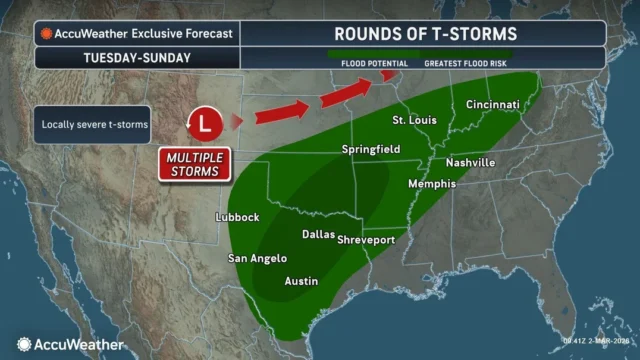
As the warm air surges northward, it will collide with colder Canadian air pressing south, creating a volatile boundary. This clash is the engine behind a multi-day severe weather outbreak forecast to erupt across the central United States starting Wednesday and lasting through the weekend.
AccuWeather experts warn that multiple rounds of thunderstorms will target a massive corridor stretching from Texas to Illinois. The primary threats include large hail, damaging wind gusts of up to 80 mph (tracked via the AccuWeather Local StormMax™), and the potential for tornadoes.
- Wednesday: The opening salvo will target central and northeastern Texas, extending into southeastern Kansas, southern Missouri, and southern Illinois.
- Thursday: The atmosphere is expected to “reload,” focusing the threat on northwestern Texas, western Oklahoma, and south-central Kansas.
- Friday and Beyond: The severe threat will pivot eastward, re-targeting Missouri and potentially expanding into the Ohio and Tennessee valleys over the weekend.
A significant concern for meteorologists is the timing of these storms. “In each round, the severe weather threat may continue well into the nighttime hours,” AccuWeather warned. Nocturnal tornadoes are statistically more dangerous as they are difficult to see and can catch residents while they are asleep. Additionally, while the rainfall may be beneficial for drought-stricken areas, the intensity of these storms raises the risk of flash flooding and urban inundation.
The 2026 Tornado Season Outlook
The current outbreak is a precursor to what AccuWeather long-range forecasters expect to be a transition year for severe weather. As the 2026 season ramps up, the departure of La Niña is playing a pivotal role in the atmospheric setup.
AccuWeather predicts a tornado count ranging between 1,050 and 1,250 for the year. This is near the historical average of 1,225 and significantly lower than the 1,544 preliminary reports seen in 2025. However, experts caution against equating fewer tornadoes with a “quiet” season.
“There may be fewer tornadoes reported compared to last year, but that does not mean this will be a quiet severe weather season,” said AccuWeather Meteorologist Alex Duffus. He emphasized that the risk of damaging straight-line winds and catastrophic flash flooding remains high. “Flash floods and damaging wind gusts can be just as destructive as tornadoes and often impact a much larger area.”
The geography of risk is also shifting as the season progresses:
- March: Focus remains on the corridor from Oklahoma to northern Georgia and north into Illinois.
- April: The “bullseye” moves toward the Mississippi River Valley.
- May: The traditional “Tornado Alley” from central Texas to eastern Nebraska will likely see the highest frequency of activity.
One limiting factor for early-season northern expansion is the Great Lakes. AccuWeather pointed out that as of early February, ice coverage on the lakes reached 58%—the highest level since 2019. This massive reservoir of cold water will likely act as a “chiller,” preventing severe weather from pushing into the northern Plains and upper Midwest until late April or May.
Preparation is Key
With the 2026 season now in full swing, AccuWeather urges residents to finalize their safety plans. This includes identifying safe rooms, ensuring multiple ways to receive warnings (especially those that can wake you up at night), and keeping emergency kits stocked.
As the “battle of the seasons” rages across the continental U.S. this week, the message from forecasters is clear: whether it is a late-season ice storm in the North or a tornado-producing cell in the South, the volatile nature of March 2026 demands constant vigilance. “It only takes one storm striking a densely populated or vulnerable community to make this a devastating season,” Duffus concluded.
For the millions in the path of this week’s storms, the “lion” of March has arrived with a roar that will be felt from the Rio Grande to the Great Lakes. Stay tuned to local forecasts and the AccuWeather app for minute-by-minute updates as these systems evolve.
Source: AccuWeather
Disclaimer
Artificial Intelligence Disclosure & Legal Disclaimer
AI Content Policy.
To provide our readers with timely and comprehensive coverage, South Florida Reporter uses artificial intelligence (AI) to assist in producing certain articles and visual content.
Articles: AI may be used to assist in research, structural drafting, or data analysis. All AI-assisted text is reviewed and edited by our team to ensure accuracy and adherence to our editorial standards.
Images: Any imagery generated or significantly altered by AI is clearly marked with a disclaimer or watermark to distinguish it from traditional photography or editorial illustrations.
General Disclaimer
The information contained in South Florida Reporter is for general information purposes only.
South Florida Reporter assumes no responsibility for errors or omissions in the contents of the Service. In no event shall South Florida Reporter be liable for any special, direct, indirect, consequential, or incidental damages or any damages whatsoever, whether in an action of contract, negligence or other tort, arising out of or in connection with the use of the Service or the contents of the Service.
The Company reserves the right to make additions, deletions, or modifications to the contents of the Service at any time without prior notice. The Company does not warrant that the Service is free of viruses or other harmful components.