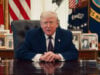
On a historic Wednesday morning, the quiet, marble halls of the United States Supreme Court were transformed into a theater of high-stakes political drama. For the first time in American history, a sitting president, Donald J. Trump, took a seat in the gallery to personally witness oral arguments in a case that could redefine the very fabric of American identity: Trump v. Barbara.
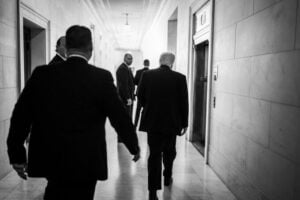
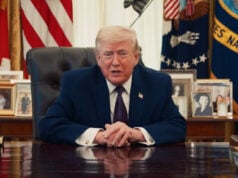
(Image: The White House)
A Presidential First
President Trump’s arrival at 10:00 a.m. ET on April 1, 2026, marked a stark departure from presidential precedent. While past presidents have visited the court for ceremonial events or state funerals, none have sat through the rigorous, often dry, legal sparring of oral arguments. His presence in the courtroom—just feet away from the nine justices he has often criticized or praised on social media—created an electric, if not “circus-like,” atmosphere, as described by some legal observers.
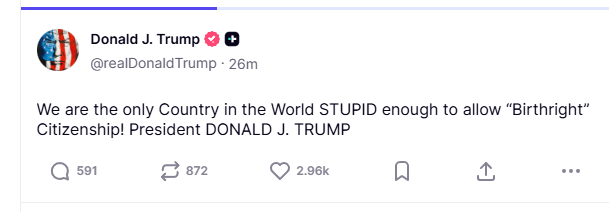
The case centers on an executive order signed on the first day of the President’s second term, which seeks to end the long-standing interpretation of the 14th Amendment. The order denies automatic citizenship to children born on U.S. soil if their parents are in the country illegally or on temporary visas.

The Legal Battle: Jurisdiction vs. Geography
The administration’s argument, presented by Solicitor General D. John Sauer, rests on a specific reading of the 14th Amendment’s Citizenship Clause: “All persons born or naturalized in the United States, and subject to the jurisdiction thereof, are citizens.”
Sauer argued that “subject to the jurisdiction” implies a requirement of political allegiance that undocumented immigrants or temporary visitors do not possess. He urged the Court to correct “long-enduring misconceptions” about the Constitution, arguing that the 1898 precedent Wong Kim Ark was narrower than commonly believed.
Opposing him was Cecillia Wang of the ACLU, who argued that the President was attempting to “radically reinterpret” a century of settled law. Wang noted that the 14th Amendment was designed specifically to ensure that citizenship was a matter of birth, not a gift from the government or a reflection of a parent’s status.
Initial Thoughts from the Bench
While the justices remain famously tight-lipped until a formal ruling is issued—expected by early summer—their lines of questioning offered a glimpse into their initial leanings.
- Justice Clarence Thomas: Continuing his post-pandemic tradition of leading the questioning, Thomas focused on the historical context of the 14th Amendment, asking whether the “jurisdiction” clause was originally intended to exclude groups other than the children of diplomats or invading armies.
- Chief Justice John Roberts: Often the Court’s institutionalist, Roberts’ questions seemed to probe the limits of executive power. He questioned whether a president could unilaterally change a constitutional interpretation that has stood for over 150 years without an act of Congress.
- Justice Samuel Alito: Celebrating his 76th birthday on the bench, Alito’s inquiries leaned toward the practicalities of “birth tourism,” a point the Trump administration has highlighted as a national security and integrity concern.
- The Liberal Wing: Justices Sonia Sotomayor, Elena Kagan, and Ketanji Brown Jackson appeared deeply skeptical. They pushed Sauer on the potential for “statelessness” among hundreds of thousands of children and the chaos that upending a century of settled law would cause for the administrative state.
A Tense Atmosphere
The President’s presence was a silent but powerful factor. Just weeks prior, Trump had labeled some members of the court a “disgrace” following an unfavorable ruling on global tariffs. His decision to attend in person was seen by many, including UCLA law professor Adam Winkler, as a “preemptive broadside” to signal the gravity he places on this immigration crackdown.
Outside the court, the scene was no less intense. Protesters carrying signs such as “Trump Must Go Now!” and “Barron Trump is the Child of an Immigrant” clashed with supporters in a visual representation of the nation’s deep divide.
As the arguments concluded and the President’s motorcade departed, the legal world was left to wonder: Will the “Trump Court”—which includes three of his own appointees—uphold the most significant challenge to the 14th Amendment in modern history, or will the tradition of judicial independence hold firm against the physical presence of the man who appointed them?
Sources Used and Links
- PBS News: Trump plans to be at the Supreme Court during arguments on his bid to limit birthright citizenship
- The Washington Post: Trump attends Supreme Court hearing on birthright citizenship
- SCOTUSblog: SCOTUStoday for Wednesday, April 1
- Democracy Docket: Supreme Court to hear arguments in Trump’s bid to eliminate birthright citizenship
- NPR Illinois: Trump attends Supreme Court arguments over his executive order, a presidential first
- WGBH News: Supreme Court considers a historic case about who is — and isn’t — born a citizen
Disclaimer
Artificial Intelligence Disclosure & Legal Disclaimer
AI Content Policy.
To provide our readers with timely and comprehensive coverage, South Florida Reporter uses artificial intelligence (AI) to assist in producing certain articles and visual content.
Articles: AI may be used to assist in research, structural drafting, or data analysis. All AI-assisted text is reviewed and edited by our team to ensure accuracy and adherence to our editorial standards.
Images: Any imagery generated or significantly altered by AI is clearly marked with a disclaimer or watermark to distinguish it from traditional photography or editorial illustrations.
General Disclaimer
The information contained in South Florida Reporter is for general information purposes only.
South Florida Reporter assumes no responsibility for errors or omissions in the contents of the Service. In no event shall South Florida Reporter be liable for any special, direct, indirect, consequential, or incidental damages or any damages whatsoever, whether in an action of contract, negligence or other tort, arising out of or in connection with the use of the Service or the contents of the Service.
The Company reserves the right to make additions, deletions, or modifications to the contents of the Service at any time without prior notice. The Company does not warrant that the Service is free of viruses or other harmful components.