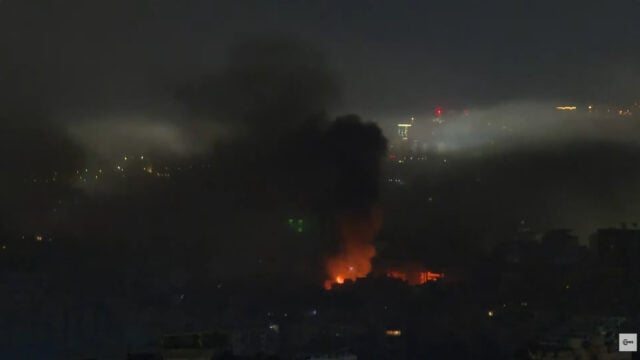
BEIRUT / WASHINGTON — In a dramatic escalation of hostilities across the Middle East, Israeli warplanes launched a series of devastating airstrikes on the Lebanese capital of Beirut early Wednesday, striking deep into the heart of residential neighborhoods and leaving scores of casualties in their wake. As the smoke cleared over the Aisha Bakkar district, the financial and humanitarian toll of the widening conflict began to emerge, with the Pentagon providing a staggering estimate of the costs associated with the ongoing campaign against Iran and its regional allies.
A Capital Under Fire: The Assault on Beirut
The strikes on Wednesday morning marked a significant shift in the geography of the conflict, moving beyond the southern suburbs of Dahiyeh into central, densely populated areas. According to the Lebanese Ministry of Health, at least 15 people were killed and 24 others injured in a single wave of attacks that targeted an apartment building in the Aisha Bakkar area. Witnesses described a scene of chaos as emergency crews dug through the rubble of the damaged structure, which Israeli sources claimed was linked to Al-Jamaa al-Islamiya, or the Islamic Group.
The strikes were not limited to the capital. Throughout Tuesday night and into Wednesday morning, the Israeli Air Force conducted what it termed “extensive” operations across southern Lebanon and the Bekaa Valley. The Ministry of Health’s Emergency Operations Center reported that since March 2, 2024, the total death toll from the intensified hostilities has climbed to 634 people, with over 1,500 injured.

| Region | Reported Casualties (March 11) | Notable Targets |
| Central Beirut | 15 Killed, 24 Injured | Aisha Bakkar apartment building |
| Southern Lebanon | 12 Killed (Tibnin, Shaqra) | Bint Jbeil, Nabatieh residential areas |
| Bekaa Valley | 1 Killed, 2 Injured | Village of Zilaya |
In a warning issued early Wednesday, the Israeli military urged residents in parts of Beirut to evacuate immediately, sparking a mass exodus of civilians who have already seen over 667,000 people displaced nationwide since the start of the month.
The $11.3 Billion Bill: Pentagon Reveals Economic Strain
While the human toll mounts in Lebanon, the economic reality of the conflict is hitting Washington. Internal Pentagon documents and briefings to Congress on Wednesday revealed that the first week of the war with Iran and its proxies has cost the United States an estimated $11.3 billion.
The breakdown of these costs illustrates the high-intensity nature of modern aerial and naval warfare:
- Munitions Depletion: The U.S. military reportedly burned through $5.6 billion in munitions during the first 48 hours of the assault on Iran. This includes the massive expenditure of Tomahawk cruise missiles and Patriot interceptors, the latter of which cost approximately $4 million per unit.
- Naval Operations: The deployment of two aircraft carrier strike groups and their supporting vessels is costing taxpayers roughly $30.7 million per day in operational and support costs.
- Aircraft Sorties: Daily flight operations for the more than 200 military aircraft stationed in the region add another $23.3 million per day to the tally.
The Trump administration is expected to formally request a supplemental defense budget of upwards of $50 billion to replenish depleted stocks and sustain the campaign, which military analysts warn could cost tens of billions of dollars if the conflict persists for even another three weeks.
Investigation Points to U.S. Responsibility for School Massacre
Amidst these soaring costs, a grim military investigation has cast a shadow over U.S. operations in Iran. Investigative teams looking into the March 3 strike on the Shajareh Tayyebeh primary school in Minab, Iran, have concluded that the United States is “most likely responsible” for the attack that killed 170 civilians, the majority of whom were young children.
Initial reports from the investigation, bolstered by satellite imagery and video analysis from organizations like Bellingcat and The New York Times, indicate that the school was hit by a “double-tap” strike. The first missile struck an adjacent naval base operated by the Islamic Revolutionary Guard Corps (IRGC), but a subsequent precision munition—identified by experts as a U.S. Tomahawk—leveled the school building where survivors were seeking shelter.
“The evidence, including recovered fragments and geolocated video of a Tomahawk missile impacting the site, indicates a tragic failure in targeting or intelligence,” stated an anonymous official familiar with the military probe.
While President Trump initially blamed Iranian inaccuracy for the tragedy, the mounting evidence from within the Department of War suggests otherwise. Human rights organizations have called the incident a “grave violation” of international law, demanding a formal war crimes inquiry.
Regional Outlook and Escalation
The conflict shows no signs of abating. As Israeli officials warn that parts of Beirut could soon “look like Gaza” if Hezbollah is not neutralized, the regional landscape is becoming increasingly volatile. Iranian retaliatory strikes involving ballistic missiles have triggered sirens across central Israel, though many have been intercepted by the very missile defense systems now draining the U.S. treasury.
For the civilians in Beirut and the families in Minab, the geopolitical and financial calculations of world powers remain secondary to the immediate reality of survival in a war that is growing more expensive and more lethal by the hour.
Sources Used and Links
- Xinhua: At least 15 killed, 24 injured in Israeli airstrikes on Lebanon
- The Times of Israel: Parts of Beirut will ‘look like Gaza’ if Lebanon doesn’t stop Hezbollah
- Responsible Statecraft: The cost of Trump’s Iran war: $5 billion and counting
- AP News: Pentagon says first week of Iran war cost the US $11.3 billion
- The Guardian: Video shows US Tomahawk missile hit base next to bombed Iranian school
- WAFA Agency: At least 64 killed, 142 injured in Israeli airstrikes across Lebanon today
- Washington Post: Early Iran strikes cost $5.6 billion in munitions
- Middle East Eye: US investigators say American strike most likely responsible for Iranian school massacre
Disclaimer
Artificial Intelligence Disclosure & Legal Disclaimer
AI Content Policy.
To provide our readers with timely and comprehensive coverage, South Florida Reporter uses artificial intelligence (AI) to assist in producing certain articles and visual content.
Articles: AI may be used to assist in research, structural drafting, or data analysis. All AI-assisted text is reviewed and edited by our team to ensure accuracy and adherence to our editorial standards.
Images: Any imagery generated or significantly altered by AI is clearly marked with a disclaimer or watermark to distinguish it from traditional photography or editorial illustrations.
General Disclaimer
The information contained in South Florida Reporter is for general information purposes only.
South Florida Reporter assumes no responsibility for errors or omissions in the contents of the Service. In no event shall South Florida Reporter be liable for any special, direct, indirect, consequential, or incidental damages or any damages whatsoever, whether in an action of contract, negligence or other tort, arising out of or in connection with the use of the Service or the contents of the Service.
The Company reserves the right to make additions, deletions, or modifications to the contents of the Service at any time without prior notice. The Company does not warrant that the Service is free of viruses or other harmful components.