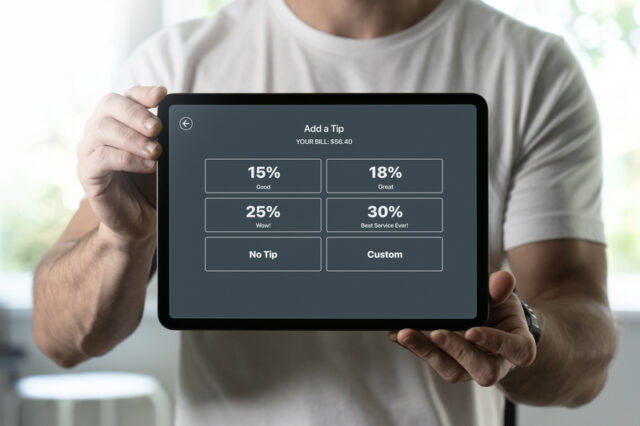
If you quietly grumble every time you’re confronted with a tip screen after you tap your card, phone, or smartwatch onto a payment terminal, you’re not alone. In a clear sign that tipping fatigue is hitting home, nearly half of respondents to a new survey said they’re tipping less than they used to.
You might even say we’ve reached a tipping point. (Sorry, sorry.)
Tipping has gone way beyond giving a few extra bucks to a bartender or bellhop. Greater adoption of technology like PayPal and Square, plus the pandemic-era expansion of contactless payments, means that dreaded tablet tip screen now accompanies an ever-expanding menu of transactions. But it seems customers’ frustrations, plus ongoing concerns about inflation and affordability, are trumping the social pressure to tip.
Although roughly two-thirds of respondents in a survey commissioned by restaurant tech provider Popmenu reported feeling pressured to leave a tip even when service was poor, 44% also said they’re leaving smaller tips this year compared to last.

At the same time, another three-quarters of respondents said they had noticed restaurants hiking the range of suggested tip amounts, contributing to what Brendan Sweeney, Popmenu cofounder and CEO, called “tipping fatigue.”
“This is compounded by customers having less disposable income due to inflated costs for food, energy and other necessities,” he said in a news release.
Across the board, 59% of people said they feel obligated to tip, down from 66% six months earlier.
Popmenu’s own data corroborates this shifting sentiment. It found that the percentage of people who tip 20% to restaurant waitstaff fell by four percentage points since a September 2025 survey. The number who tip delivery drivers 20% plunged by eight percentage points over the same time frame.
Service workers are caught in the middle
As workers who rely on tips confront these trends, they’re also dealing with a new tax break that might amount to less than its description might suggest.
In response to President Donald Trump’s 2024 campaign pledge to eliminate taxes on tips, the One Big Beautiful Bill Act passed by Congress last July included a “no tax on tips” provision. The IRS announced, then tweaked, the definition of what professions and roles were eligible. (You can check out a full list of who qualifies here.)
Although the nonpartisan Urban-Brookings Tax Policy Center estimated an average benefit of nearly $1,400 for eligible tipped workers, its experts questioned the effectiveness of the policy.
“It would be far simpler — and fairer and less risky — to simply continue to tax tips as normal income,” they wrote, noting that unscrupulous employers may game the current system. “Employers might simply cut workers’ base pay, pocketing the would-be gains for themselves.”
Other researchers were even more blunt in their assessments. A report by Economic Policy Institute found that most tipped workers wouldn’t see anywhere close to four figures.
“Most workers, including a large portion of tipped workers, will not benefit from this policy whatsoever,” a left-leaning think tank concluded.
The phrase “no tax on tips” is somewhat of an oversimplification. There is a cap of $25,000 on the amount of tip income that qualifies, and an income-based phase-out kicks in at $150,000 for single filers ($300,000 for married joint filers). The deduction doesn’t exclude tip earnings from all taxes; workers are still required to make the payroll contributions that fund Social Security and Medicare. They also might owe state income taxes, depending on where they live and work.
What’s more, the deduction — like the other new individual tax breaks included in the OBBBA — is a temporary feature, set to phase out after 2028 unless Congress extends it. And because the perk is structured as a deduction rather than a tax credit, the 37% of tipped workers who don’t earn enough to owe federal income tax won’t see any benefit at all.
Disclaimer
Artificial Intelligence Disclosure & Legal Disclaimer
AI Content Policy.
To provide our readers with timely and comprehensive coverage, South Florida Reporter uses artificial intelligence (AI) to assist in producing certain articles and visual content.
Articles: AI may be used to assist in research, structural drafting, or data analysis. All AI-assisted text is reviewed and edited by our team to ensure accuracy and adherence to our editorial standards.
Images: Any imagery generated or significantly altered by AI is clearly marked with a disclaimer or watermark to distinguish it from traditional photography or editorial illustrations.
General Disclaimer
The information contained in South Florida Reporter is for general information purposes only.
South Florida Reporter assumes no responsibility for errors or omissions in the contents of the Service. In no event shall South Florida Reporter be liable for any special, direct, indirect, consequential, or incidental damages or any damages whatsoever, whether in an action of contract, negligence or other tort, arising out of or in connection with the use of the Service or the contents of the Service.
The Company reserves the right to make additions, deletions, or modifications to the contents of the Service at any time without prior notice. The Company does not warrant that the Service is free of viruses or other harmful components.