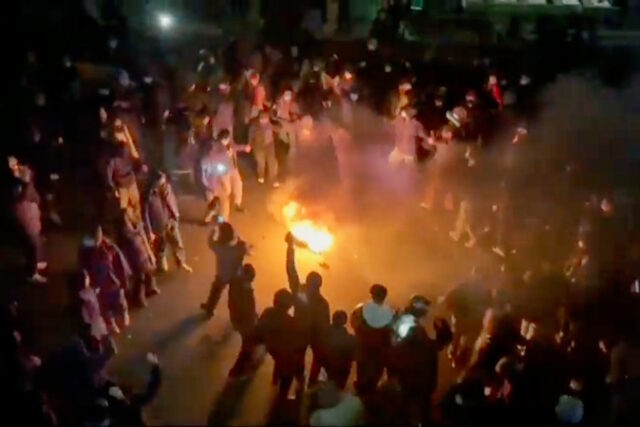
TEHRAN/DUBAI — The Islamic Republic of Iran has signaled a terrifying escalation in its response to the most significant domestic uprising in decades. On Wednesday, the head of Iran’s judiciary, Gholamhossein Mohseni-Ejei, announced that the state will proceed with “swift trials and executions” for those detained during the nationwide protests that have gripped the country since late December 2025.
Video from Global News
The announcement comes amidst what human rights organizations are calling the “2026 Iran Massacres,” a period of state-led violence that has reportedly claimed between 2,500 and 12,000 lives in less than three weeks. Despite a near-total internet blackout imposed on January 8, leaked footage and eyewitness accounts describe a nation in a state of siege, with security forces utilizing live ammunition, attack helicopters, and “finishing shots” against civilian demonstrators.
A Judiciary Poised for Mass Hangings
The judiciary’s latest decree effectively formalizes the use of the death penalty as a tool of political suppression. Officials have classified many of the estimated 18,000 detainees as mohareb—”enemies of God”—a charge that carries an automatic death sentence under Iran’s penal code.

Special branches of the Revolutionary Courts have been tasked with expediting these cases. Activists have specifically raised the alarm for Erfan Soltani, a 26-year-old protester arrested in Karaj, who reports suggest was scheduled for execution as early as January 14. Human rights groups warn that without immediate international intervention, Soltani’s death could mark the beginning of a cascade of state-sanctioned killings intended to terrorize the populace into submission.
Unprecedented Casualties and “Industrial-Scale” Repression
The scale of the current violence far exceeds previous unrest, including the 2022 “Woman, Life, Freedom” movement. In Tehran, footage from the Kahrizak forensic center reportedly showed hundreds of bodies in body bags, while hospitals in the capital are struggling to manage the influx of the wounded, many of whom are being arrested directly from their hospital beds.
The Human Rights Activists News Agency (HRANA) has confirmed that at least 12 children are among the dead. “What we are witnessing is the most violent repression in Iran’s contemporary history,” stated French Foreign Minister Jean-Noël Barrot, reflecting a sentiment echoed by several European leaders.
The crackdown has not been limited to the streets. The regime’s total communication blackout has left families unable to locate missing loved ones, creating a “black hole” of information that Amnesty International warns is being used to conceal crimes against humanity.
International Tensions and the “Trump Warning”
The domestic crisis is unfolding against a backdrop of severe regional instability. Following Israeli and U.S. airstrikes on Iranian nuclear and missile sites in mid-2025, the Iranian leadership has blamed “external conspiracies” for the current unrest.
U.S. President Donald Trump has issued a series of blunt warnings to Tehran, stating that the United States will take “very strong action” if the executions proceed. “Help is on its way,” Trump told protesters in a recent public address, a statement that has emboldened some demonstrators while leading the Iranian regime to threaten “preemptive strikes” against U.S. assets in the region. Reports indicate that personnel at key U.S. bases in Qatar have already been advised to evacuate in anticipation of potential retaliation.
A Regime in Crisis
The protests, which began in late December 2025 over a collapsing currency and 80% inflation, have evolved into a fundamental rejection of the 47-year-old clerical establishment. Chants for the return of the monarchy and the downfall of Supreme Leader Ali Khamenei have become commonplace in over 180 towns and cities.
While the regime continues to hold mass state-backed funerals for security personnel to project unity, the sheer persistence of the protests—even in the face of summary executions—suggests a breaking point. As UN experts call for an emergency session of the Security Council, the world watches to see if the threat of international “strong action” or the internal pressure of a defiant population will be enough to halt the gallows.
News Sources & References
- Iowa Public Radio (NPR/AP): Iran signals fast trials and executions for protesters, despite Trump’s warning
- Amnesty International: Iran: Massacre of protesters demands global diplomatic action
- Iran Human Rights (IHRNGO): At Least 734 Protesters Killed in Iran; IHRNGO Warns of Extrajudicial Executions
- The Guardian: With thousands dead, the Iranian regime may survive these protests – but not in its current form
- Institute for the Study of War (ISW): Iran Update, January 13, 2026
- Iran International: Mass killings reported as security forces use live fire on Iran protesters
- United Nations (OHCHR): Experts urge Iran to break cycle of violence, create space for dialogue
Disclaimer
The information contained in South Florida Reporter is for general information purposes only.
The South Florida Reporter assumes no responsibility for errors or omissions in the contents of the Service.
In no event shall the South Florida Reporter be liable for any special, direct, indirect, consequential, or incidental damages or any damages whatsoever, whether in an action of contract, negligence or other tort, arising out of or in connection with the use of the Service or the contents of the Service.
The Company reserves the right to make additions, deletions, or modifications to the contents of the Service at any time without prior notice.
The Company does not warrant that the Service is free of viruses or other harmful components