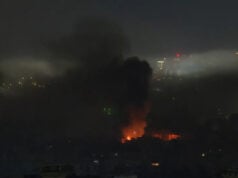
The geopolitical landscape of 2026 has reached a definitive and dangerous tipping point. In a televised address that sent shockwaves through global commodities markets, Iran’s Supreme Leader Ayatollah Mojtaba Khamenei issued a directive that the “leverage” of the Strait of Hormuz must be fully utilized to repel what he described as foreign aggression. This message, delivered amidst the ongoing smoke and fire of the U.S.-Israeli air campaign against the Islamic Republic, marks the most direct threat to the global energy supply since the 1970s.
The Message from Tehran: Leveraging the Chokepoint

On March 12, 2026, Ayatollah Mojtaba Khamenei—who assumed leadership following the reported death of his father, Ayatollah Ali Khamenei, in the opening salvos of the conflict—declared that the Strait of Hormuz is no longer a guaranteed passage for international commerce. The message, read by a news anchor on Iranian state television, was unambiguous: Iran intends to use its control over the 21-mile-wide waterway to force a cessation of hostilities.
“The leverage of closing the Strait of Hormuz should be used,” the statement read, adding that Iran would continue its “defensive” strikes against Gulf Arab neighbors that facilitate U.S. military operations. The Supreme Leader further called on the populations of regional states to “shut down” U.S. bases, dismissing promises of American protection as “nothing more than a lie.”
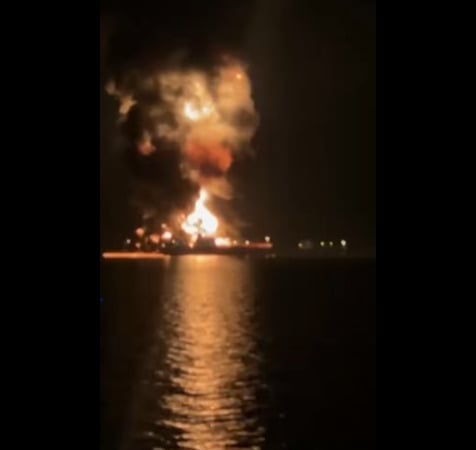
The timing of this message is critical. While Iranian naval assets have been heavily targeted by the U.S. Fifth Fleet and Israeli strikes, the threat of “asymmetric” closure—using land-based anti-ship missiles, unmanned surface vessels (USVs), and a limited but lethal deployment of naval mines—remains a potent deterrent. On Wednesday, a Thai-flagged tanker, the Mayuree Naree, was struck by a projectile in the Strait, an event analysts view as a “calling card” from Tehran to demonstrate that even without a physical blockade, the route is no longer safe for uninsured commercial traffic.

We are eliminating Iran’s ability to threaten American forces and regional partners through lethality and precision. pic.twitter.com/5Dkku2b3Nd
— U.S. Central Command (@CENTCOM) March 12, 2026
Gas Prices: The Economic Fallout
The immediate impact of the Hormuz rhetoric has been felt most acutely at the gas pump. For American consumers, the “peace dividend” of early 2026 has evaporated in a matter of days.
Comparing Prices: Pre-War vs. Today
To understand the scale of the shock, one must look back to February 27, 2026, the day before the U.S. and Israel launched “Operation Epic Fury.” At that time, global markets were relatively stable, and domestic energy production in the U.S. was at record highs.
| Metric | Pre-War (Feb 27, 2026) | Current (March 12, 2026) | Percentage Change |
| U.S. Average Gas Price | $2.98 | $3.54 | +18.8% |
| California Average | $4.64 | $5.20 | +12.1% |
| Brent Crude (per barrel) | $71.00 | $104.00 | +46.5% |
| WTI Crude (per barrel) | $67.00 | $95.00 | +41.8% |
In the United States, the average price for a gallon of regular unleaded has jumped by approximately 56 cents in less than two weeks. This represents the fastest increase in fuel costs in U.S. history, surpassing the spikes seen during the 2022 invasion of Ukraine. In high-demand regions like California, which relies heavily on imports that typically pass through the Pacific or from Asian refineries fed by Middle Eastern crude, prices have already cleared the $5.00 mark, with some stations in Los Angeles reporting prices as high as $6.49.
The surge is not limited to gasoline. Liquefied Natural Gas (LNG) prices in Europe and Asia have skyrocketed. Following Iranian drone strikes on Qatari energy infrastructure in Ras Laffan, QatarEnergy was forced to suspend production. This has caused European natural gas futures to surge by 77%, leading to fears of a renewed winter energy crisis for the EU.
How High Can Prices Go?
Market analysts and energy economists are now modeling “worst-case” scenarios that were unthinkable just months ago. The primary variable is the duration and effectiveness of the Hormuz blockade.
The $150 Barrel Scenario
If Iran successfully implements a total blockade of the Strait—through which 20% of the world’s oil and LNG flows—Goldman Sachs and J.P. Morgan analysts warn that Brent crude could easily surpass its all-time high of $147. Some projections suggest a jump to $150 or even $170 per barrel if the U.S. Strategic Petroleum Reserve (SPR) releases fail to calm the market.
Impact on U.S. Retail Prices
Should crude oil reach $120 per barrel, the U.S. national average for gasoline is expected to hit $4.25 per gallon. At $150 per barrel, Americans could face a national average of $5.00 to $5.50, with West Coast and Northeastern states seeing prices between $7.00 and $8.00.
President Donald Trump has attempted to manage expectations, stating that higher prices are “a very small price to pay for U.S.A., and World, Safety and Peace.” However, economists at EY-Parthenon estimate that this energy shock could push monthly inflation in March to 1%, the highest monthly jump in four years, potentially derailing any hopes of interest rate cuts by the Federal Reserve.
Strategic Realities and the “Shadow War”
The current crisis is unique because it combines a traditional naval blockade threat with high-tech “gray zone” warfare. The Institute for the Study of War (ISW) has noted that Iran has deployed fewer than 10 naval mines so far, suggesting they are holding their main arsenal of 5,000–6,000 mines in reserve. This “measured” escalation is designed to keep the world on edge without triggering a total environmental catastrophe or a Chinese intervention—Beijing currently buys about 5.4 million barrels of crude daily that passes through the Strait.
Furthermore, the “decapitation” of the Iranian leadership in the war’s first hours has not resulted in a collapse of the command structure. Instead, the transition to Mojtaba Khamenei appears to have solidified a “scorched earth” maritime policy.
The Global Response
In response to the surging prices and the Hormuz threat:
- The United States has announced the release of 172 million barrels of oil from the SPR.
- The International Energy Agency (IEA) is coordinating a global stock release, though Chief Fatih Birol warns that “alternative routes” like Saudi pipelines to the Red Sea cannot fully replace the volume of the Strait.
- China has activated emergency energy measures, signaling that its patience with the disruption of its primary energy artery is wearing thin.
Conclusion: A Precarious Future
The message from Iran is clear: they are willing to burn the global energy market to save their regime. As gas prices continue their upward march, the domestic political pressure on the Trump administration will likely mount. For the average commuter, the conflict in the Middle East is no longer a distant headline—it is a daily tax at the fuel pump that shows no signs of abating.
If the “lever” of Hormuz is pulled all the way, the world may be entering an era of energy scarcity that will redefine the global economy for the rest of the decade.
Sources Used and Links
- PBS Newshour: Iran’s supreme leader says closure of Strait of Hormuz should be used as leverage
- CBS News: Strike on Thai tanker in Strait of Hormuz may be message to the U.S., analyst says
- The Hindu: Israel-Iran war updates – March 10: U.S. destroys 16 Iranian mine-laying vessels ‘near Strait of Hormuz’
- The Guardian: Gas prices soar and oil jumps as Iran war pushes down global stock markets
- Northeastern Global News: With war in Iran, experts predict higher gas prices and inflation
- WHYY: How the Iran war and surging oil prices are affecting consumers at the gas pump and beyond
- American Progress: The War in Iran Will Raise Fuel Prices and Costs Throughout the Economy
- Anadolu Ajansı: US raises 2026 oil price forecast amid Hormuz tensions
- Institute for the Study of War (ISW): Iran Update Morning Special Report, March 11, 2026
- Capital.com: Crude Oil Price Forecast | Strait of Hormuz Closure
- Chatham House: US energy prices were set to rise long before the Iran war
Disclaimer
Artificial Intelligence Disclosure & Legal Disclaimer
AI Content Policy.
To provide our readers with timely and comprehensive coverage, South Florida Reporter uses artificial intelligence (AI) to assist in producing certain articles and visual content.
Articles: AI may be used to assist in research, structural drafting, or data analysis. All AI-assisted text is reviewed and edited by our team to ensure accuracy and adherence to our editorial standards.
Images: Any imagery generated or significantly altered by AI is clearly marked with a disclaimer or watermark to distinguish it from traditional photography or editorial illustrations.
General Disclaimer
The information contained in South Florida Reporter is for general information purposes only.
South Florida Reporter assumes no responsibility for errors or omissions in the contents of the Service. In no event shall South Florida Reporter be liable for any special, direct, indirect, consequential, or incidental damages or any damages whatsoever, whether in an action of contract, negligence or other tort, arising out of or in connection with the use of the Service or the contents of the Service.
The Company reserves the right to make additions, deletions, or modifications to the contents of the Service at any time without prior notice. The Company does not warrant that the Service is free of viruses or other harmful components.