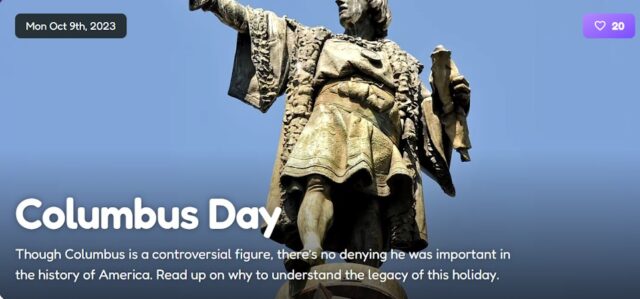
Columbus Day on the second Monday in October is observed in the United States each year. The day signifies Christopher Columbus’ arrival to America on October 12, 1492.
Christopher Columbus was long given credit for discovering North America. However, long before Columbus was born (1451-1506), Leif Erikson landed on these shores. The Italian-born explorer did sail across the Atlantic, though, and more than once. In fact, he made four transatlantic voyages. His first was in 1492. Hence the rhyme, “In 1492, Christopher Columbus sailed the ocean blue.”
- 1492 – Columbus was looking for Asia and landed his three ships near the Bahamas.
- 1492 – On Christmas Eve Columbus’s flagship ran into a coral reef on the northern coast of Hispaniola.
- 1500 – In August 1500 people demanded Columbus be arrested and a royal commissioner dispatched to Hispaniola and brought Columbus back to Spain in chains, however, King Ferdinand still granted the explorer his freedom and subsidized a fourth voyage.
- 1792 – celebrations recognizing the 300th anniversary of his landing in the New World took place in New York City and other US cities.
- 1892 – President Benjamin Harrison valls on the citizens to celebrate the 400th anniversary
- 1906 – Colorado is first to observe Columbus Day as it became an official state holiday. More and more people and states began to recognize the observance.
- 1929 – Charles Curtis serves as the first U.S. Vice President of Native American descent under President Herbert Hoover.
- 1934, President Roosevelt made Columbus Day a national holiday. It became effective in 1937. Teachers, preachers, poets, and politicians used the day to teach ideals of patriotism.
- 1950s – Cherokee Admiral Joseph J. “Jocko” Clark rises to command the U.S. Seventh Fleet during the Korean War, making him the most powerful war chief in American Indian history.
- 1968 – Columbus Day was declared a federal public holiday on the second Monday in October by President Lyndon B. Johnson.
- 1989 – South Dakota became the first state to make Indigenous People’s Day an official holiday.
- 2018 – Los Angeles removes the bronze statue of Christopher Columbus from Grand Park.
- There are no portraits of Christopher Columbus that are known to exist, therefore nobody is quite sure what he looked like.
- One of Columbus’ ships, the Santa Maria, wrecked on the coast of the Americas and did not make the return voyage.
- The day is called Dia de la Hispanidad or Fiesta National in Spain.
- 22 states have chosen not to recognize Columbus Day as a holiday. These states include Hawaii, South Dakota, and Alaska. South Dakota celebrates Native American Day.
- Many states have replaced Columbus Day with Indigenous Peoples Day as a response to the brutality Columbus showed towards Native Americans upon his arrival to the “New World.”
- Hawaii celebrates Discoverers’ Day instead.
- Christopher Columbus has been reburied in many different places around the world.
- Pinta means “the painted one,” in Spanish. The Pinta ship was given its name by the sailors.
Sources:

Disclaimer
Artificial Intelligence Disclosure & Legal Disclaimer
AI Content Policy.
To provide our readers with timely and comprehensive coverage, South Florida Reporter uses artificial intelligence (AI) to assist in producing certain articles and visual content.
Articles: AI may be used to assist in research, structural drafting, or data analysis. All AI-assisted text is reviewed and edited by our team to ensure accuracy and adherence to our editorial standards.
Images: Any imagery generated or significantly altered by AI is clearly marked with a disclaimer or watermark to distinguish it from traditional photography or editorial illustrations.
General Disclaimer
The information contained in South Florida Reporter is for general information purposes only.
South Florida Reporter assumes no responsibility for errors or omissions in the contents of the Service. In no event shall South Florida Reporter be liable for any special, direct, indirect, consequential, or incidental damages or any damages whatsoever, whether in an action of contract, negligence or other tort, arising out of or in connection with the use of the Service or the contents of the Service.
The Company reserves the right to make additions, deletions, or modifications to the contents of the Service at any time without prior notice. The Company does not warrant that the Service is free of viruses or other harmful components.