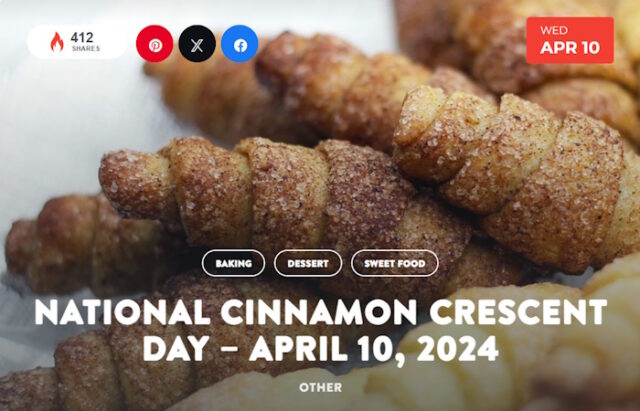
It’s time to fill the home with warmth on National Cinnamon Crescent Day! Each year, this pastry holiday causes mouth-watering excitement on April 10th.
- 2000 BC – Cinnamon dates back to 2,000 B.C., when it was imported from Egypt to China and was so highly prized that it was regarded as a gift fit for monarchs.
- 1st Century AD – Pliny the Elder writes that 12 oz of cinnamon holds more value than five two pounds of silver.
- 500 AD – In the Middle Ages, cinnamon was only affordable by the wealthy elite of society. A person’s social rank could be determined by the number of spices they could afford.
- 13th Century – Crescent rolls are believed to have originated during the 13th century. They are the modified form of kipferl, which is more basic. Crescent rolls are more of a pastry variety, unlike kipferl.
- 17th Century – The Dutch seize the island of Ceylon, the biggest supplier of cinnamon.
- 18th Century – Philadelphia-style cinnamon rolls date back to the 18th century. It contains honey, sugar, cinnamon and raisins.
- 1833 – Cinnamon harvest begins in Java, Sumatra, Borneo, Mauritius, Réunion, and Guyana.
- 1920s – The cinnamon bun is a Swedish invention that swept the U.S. ever since the 1950’s. The product is actually dated back to the 1920s.
- 1965 – The Pillsbury company launched a refrigerated crescent roll. This was also when the Pillsbury Doughboy first came on the scene.
- True cinnamon, or Ceylon cinnamon is native to Sri Lanka.
- In Ancient Egypt, cinnamon was used in the embalming process.
- Two teaspoons of cinnamon has about 12 calories.
- Cinnamon has many health benefits. It has shown promise in the treatment of diabetes, arthritis, high cholesterol, memory function, and even leukemia and lymphoma.
- Cinnamon rolls are known in Sweden as “kanelbulle.” This word literally means cinnamon bun. Other than kanelbulle, cinnamon rolls and cinnamon bun, they are also known as sticky rolls and sticky buns.
- Cinnamon may be one of the oldest spices in the world. In the Bible it is mentioned in Exodus 30:23, Proverbs 7:17, and revelation 18:13 to name just a few.
- Cinnamon, according to Chinese medicine can be used as a way of treating a wide range of ailments including nausea and colds.
- Sri Lanka produces around 90% of the Cinnamomum Verum (cinnamon variety) used across the world.
- A typical Swede eats 316 cinnamon buns per year.
- The Pillsbury Doughboy was also known as “Poppin’ Fresh” and still represents Pillsbury’s refrigerated dough products today.
- An oil extracted from cinnamon, eugenol, has been used as a local anesthetic and antiseptic by dentists.
- What is the difference between a croissant and a crescent roll? The two are very similar, but croissants have more of a puff pastry dough making them extra flaky. Crescent rolls have more of a homemade roll texture.
- Cinnamon is regularly used in face and body scrubs as complexion enhancers.
- Recipes vary, but one small cinnamon crescent contains approximately 100 calories.
Sources:

Disclaimer
Artificial Intelligence Disclosure & Legal Disclaimer
AI Content Policy.
To provide our readers with timely and comprehensive coverage, South Florida Reporter uses artificial intelligence (AI) to assist in producing certain articles and visual content.
Articles: AI may be used to assist in research, structural drafting, or data analysis. All AI-assisted text is reviewed and edited by our team to ensure accuracy and adherence to our editorial standards.
Images: Any imagery generated or significantly altered by AI is clearly marked with a disclaimer or watermark to distinguish it from traditional photography or editorial illustrations.
General Disclaimer
The information contained in South Florida Reporter is for general information purposes only.
South Florida Reporter assumes no responsibility for errors or omissions in the contents of the Service. In no event shall South Florida Reporter be liable for any special, direct, indirect, consequential, or incidental damages or any damages whatsoever, whether in an action of contract, negligence or other tort, arising out of or in connection with the use of the Service or the contents of the Service.
The Company reserves the right to make additions, deletions, or modifications to the contents of the Service at any time without prior notice. The Company does not warrant that the Service is free of viruses or other harmful components.