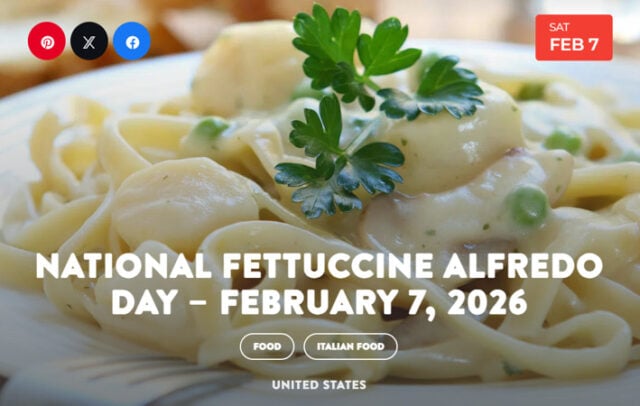
February 7 is National Fettuccine Alfredo Day. You don’t get the status as one of the most popular pasta dishes created without good reason. Fettuccine Alfredo is an Italian (obviously) pasta dish consisting of fresh fettuccine tossed with butter and Parmesan cheese. It’s simple yet delicious. It’s so tasty that it deserves a day all to itself. Whether you are dining out or doing a spot of home cooking, make sure that Fettuccine Alfredo is on the menu on February 7.
- 5000 BC – We typically think of pasta as being invented in Italy, but the first recorded reports of people eating pasta came from China, as early as 5,000 B.C.
- 1892 – Alfredo di Lelio begins working in the restaurant owned by his mother, Angelina.
- 1908 – Alfredo di Lelio, an Italian restaurateur, created Fettuccine Alfredo to offer his wife something to eat after she had given birth to their first child.
- 1914 – It was named by an Italian restaurateur at his restaurant, Alfredo, on the Via della Scrofa in Rome. Said to have been a dish he made at home, but for years was too reluctant to sell to his customers because it was so rich.
- 1927 – The restaurant became famous when Mary Pickford and Douglas Fairbanks stopped in and fell in love with the dish during their honeymoon. To express their gratitude, they gave him a golden fork and spoon along with a photo of them eating in his restaurant. He proudly displayed the photo on the wall. Pickford and Fairbanks served his dish to their friends and associates when they returned to Hollywood. Word about the new dish quickly spread.
- 1943 – Di Lelio sold the restaurant; however, its originality remained.
- 1950 – Di Lelio and his son, Armando, opened another restaurant called II Vero Alfredo, which means “the true Alfredo.” The restaurant is now managed by Alfredo’s grandchildren.
- 1959 – Some local businessmen tracked down the famous Alfredo and offered to build him a new restaurant. Although he was retired, he agreed to show up as a greeter. The new Alfredo ll location at 30 Piazza Augusto Imperatore is a few blocks from his original location.
- 1977 – Another Alfredo’s opens near Rockefeller Center in New York.
- Fettuccine is a flat, thick noodle made of flour and egg. (literally meaning “little ribbons” in Italian)
- The original recipe for Fettuccine “Alfredo” is pasta made from fettuccine noodles tossed with one part Parmesan cheese and 3 parts butter. Alfredo sauce is an emulsified liquid that forms a smooth, rich coating on pasta.
- Alfredo retired and sold his restaurant, Alfredo’s sauce recipe, and all, to Mr. Mario Mozzetti, and the restaurant is still in business today.
- To make it a single-dish meal, chicken and vegetables, such as peas, are often served on top.
- In jarred Alfredo sauce available in supermarkets, the sauce is thickened with starch rather than cheese.
- As you’d expect, Italy is the country that eats the greatest amount of pasta worldwide. As you might not expect, however, the #2 and #3 countries that eat the most pasta are Venezuela and Tunisia.
- Fettuccine Alfredo provides 18 grams of protein and 30 percent of the daily recommended intake of calcium. Protein helps your immune system function and calcium is vital for bone strength and heart health. This dish provides plenty of vitamin A and that’s good for preventing blindness and infections.
- In Italy, the dish known as fettuccine Alfredo (often called fettuccine al burro) is typically just fresh fettuccine tossed with butter and finely grated Parmigiano‑Reggiano, using a little starchy pasta water to create a creamy emulsion—there is no cream or garlic involved.
- In the United States, restaurant and home versions more often use a richer sauce based on heavy cream, butter, and Parmesan, frequently with added garlic, and serve larger portions as a main course rather than a small first course.
A few years ago, when SouthFloridaReporter.com wrote about Fettuccine Alfredo Day, we received the following email from Alfredo di Lelio’s grandson. Here’s what he wrote:
“Concerning your article I have the pleasure to tell you the history of my grandfather Alfredo Di Lelio, who is the creator of “Fettuccine all’Alfredo” (“Fettuccine Alfredo”) in 1908 in the “trattoria” run by his mother Angelina in Rome, Piazza Rosa (Piazza disappeared in 1910 following the construction of the Galleria Colonna / Sordi). This “trattoria” of Piazza Rosa has become the “birthplace of fettuccine all’Alfredo”.
More specifically, as is well known to many people who love the “fettuccine all’Alfredo”, this famous dish in the world was invented by Alfredo Di Lelio concerned about the lack of appetite of his wife Ines, who was pregnant with my father Armando (born February 26, 1908).

Alfredo di Lelio opened his restaurant “Alfredo” in 1914 in Rome and in 1943, during the war, he sold the restaurant to others outside his family.
In 1950 Alfredo Di Lelio decided to reopen with his son Armando his restaurant in Piazza Augusto Imperatore n.30 “Il Vero Alfredo” (“Alfredo di Roma”), whose fame in the world has been strengthened by his nephew Alfredo and now managed by me, with the famous “gold cutlery” (fork and spoon gold) donated in 1927 by two well-known American actors Mary Pickford and Douglas Fairbanks (in gratitude for the hospitality).
See also the website of “Il Vero Alfredo”.
I must clarify that other restaurants “Alfredo” in Rome do not belong to my brand “Il Vero Alfredo – Alfredo di Roma”.
I inform you that the restaurant “Il Vero Alfredo –Alfredo di Roma” is in the registry of “Historic Shops of Excellence” of the City of Rome Capitale.
Best regards Ines Di Lelio”
Sources:
Disclaimer
Artificial Intelligence Disclosure & Legal Disclaimer
AI Content Policy.
To provide our readers with timely and comprehensive coverage, South Florida Reporter uses artificial intelligence (AI) to assist in producing certain articles and visual content.
Articles: AI may be used to assist in research, structural drafting, or data analysis. All AI-assisted text is reviewed and edited by our team to ensure accuracy and adherence to our editorial standards.
Images: Any imagery generated or significantly altered by AI is clearly marked with a disclaimer or watermark to distinguish it from traditional photography or editorial illustrations.
General Disclaimer
The information contained in South Florida Reporter is for general information purposes only.
South Florida Reporter assumes no responsibility for errors or omissions in the contents of the Service. In no event shall South Florida Reporter be liable for any special, direct, indirect, consequential, or incidental damages or any damages whatsoever, whether in an action of contract, negligence or other tort, arising out of or in connection with the use of the Service or the contents of the Service.
The Company reserves the right to make additions, deletions, or modifications to the contents of the Service at any time without prior notice. The Company does not warrant that the Service is free of viruses or other harmful components.