As the Iran war stretches into its second month, gas prices continue to rise for drivers in the U.S. with no end in sight.
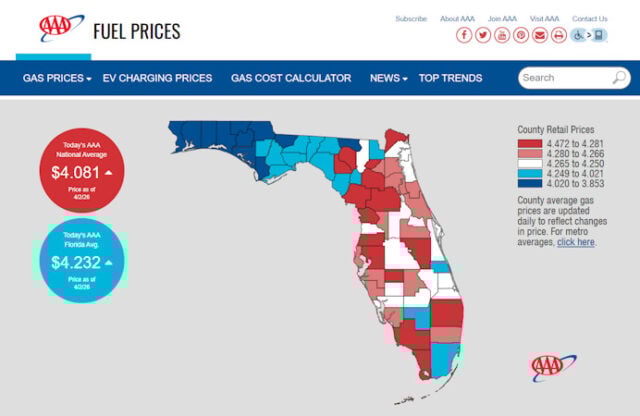
On Thursday, the national average price for a gallon of regular, unleaded gas hit $4.08, according to AAA’s gas tracker. That marks an increase of nearly 40% from $2.93 in the days before the U.S. and Israel launched a bombing campaign on Iran that started Feb. 28.
Experts who spoke with Money say that Americans should expect high gas prices to linger even after the Iran war concludes. And when the war will end is a big, open question.
“Many Americans have been concerned to see the recent rise in gasoline prices here at home,” Trump said. “This short-term increase has been entirely the result of the Iranian regime.”

Trump blamed Iran for sending oil prices into disarray because it closed the Strait of Hormuz, a critical international waterway for oil trade located along the country’s southern shore. He stated that the strait will re-open once the war is over.
“When this conflict is over, the strait will open up naturally. It will just open up naturally,” Trump said. “It will resume the flowing and the gas prices will rapidly come back down.”
When Russia invaded Ukraine in February 2022, gas prices surged and peaked above $5 a gallon later that year. But the spike was relatively short-lived, and prices fell back to pre-war levels by November 2022. However, experts don’t expect gas prices to fall quickly this time around, even in the best-case scenarios.
“I don’t think it’s going to be that clear-cut,” says Patrick De Haan, head of petroleum analysis at GasBuddy. “Things could worsen before they get better.”
When will gas prices come back down?
The biggest factors driving up gas prices right now are the ongoing Iran war and the closure of the Strait of Hormuz. Although the U.S. produces most of the oil needed for gas domestically, oil is a global commodity, and major supply shocks affect its price.
For gas prices to come back down, those international issues must first be resolved.
On Wednesday, Trump said the U.S. was on track to complete all of its military objectives “very shortly,” although he suggested that the war could go on for at least “two to three weeks” as the U.S. plans to “hit [Iran] extremely hard.”
Even if the Iran war were to end today, experts say gas prices will remain elevated.
“It will take weeks, if not months, to re-open the Strait of Hormuz and for global oil production and prices to normalize,” Mark Zandi, chief economist at Moody’s Analytics, says in an email.
“There is also a lag between when oil prices decline and this results in lower gas prices,” he adds. “This goes to the old adage that gas prices go up like a rocket and fall like a feather.”
The type of fuel also makes a difference. Diesel and jet fuel, for example, have different supply chains and disruptions ripple through more slowly than gas. De Haan notes that the conflict will especially affect airlines — and the price of plane tickets — for months to come.
“I wouldn’t say you’re going to lose the summer travel season,” he says, “but it’s going to be a really, really rough one.”
‘No going back to $3 a gallon’
It’s not just a question of when gas prices might fall, but by how much. Experts tell Money that drivers shouldn’t expect to see pre-war gas prices any time soon.
“I don’t think that gasoline prices are going to return to their pre-war level because there’s going to be a heightened geopolitical risk that’s now priced into the oil market,” says Andrew Lipow, president of the energy consulting firm Lipow Oil.
Now that Iran has essentially shut down the Strait of Hormuz, Lipow says that will always be a tangible risk going forward. Basically, the cat is out of the bag.
Zandi and De Haan agree, saying that the potential for the strait shutting down in the future will make oil shipping more expensive, thus keeping gas prices elevated long-term.
“Even if the war ended today,” Zandi says, “there is no going back to $3 for a gallon of regular unleaded for the foreseeable future.”
Disclaimer
Artificial Intelligence Disclosure & Legal Disclaimer
AI Content Policy.
To provide our readers with timely and comprehensive coverage, South Florida Reporter uses artificial intelligence (AI) to assist in producing certain articles and visual content.
Articles: AI may be used to assist in research, structural drafting, or data analysis. All AI-assisted text is reviewed and edited by our team to ensure accuracy and adherence to our editorial standards.
Images: Any imagery generated or significantly altered by AI is clearly marked with a disclaimer or watermark to distinguish it from traditional photography or editorial illustrations.
General Disclaimer
The information contained in South Florida Reporter is for general information purposes only.
South Florida Reporter assumes no responsibility for errors or omissions in the contents of the Service. In no event shall South Florida Reporter be liable for any special, direct, indirect, consequential, or incidental damages or any damages whatsoever, whether in an action of contract, negligence or other tort, arising out of or in connection with the use of the Service or the contents of the Service.
The Company reserves the right to make additions, deletions, or modifications to the contents of the Service at any time without prior notice. The Company does not warrant that the Service is free of viruses or other harmful components.