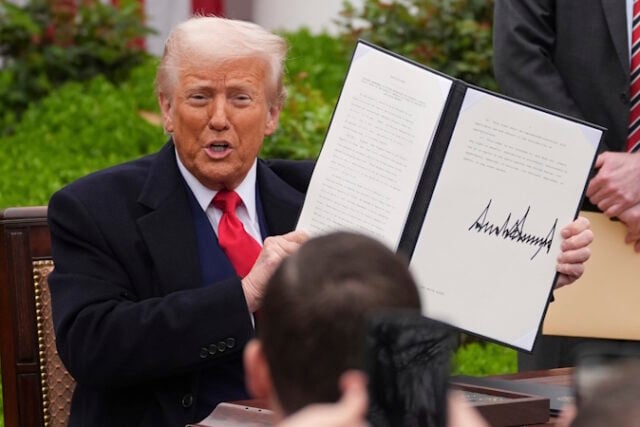
The landscape of American trade policy underwent a seismic shift on February 20, 2026, when the U.S. Supreme Court ruled 6–3 that the administration’s sweeping global tariffs, imposed under the International Emergency Economic Powers Act (IEEPA), were an unconstitutional overreach of executive authority. While thousands of American businesses celebrated the ruling, the real financial victors were not just the importers themselves, but a select group of “litigation financiers” and hedge funds. These entities spent much of 2025 betting against the legal durability of the tariffs—and they are now poised to collect billions in government refunds.
The Rise of the “Tariff Refund” Trade
Throughout 2025, as the effective U.S. tariff rate surged from 2.4% to over 11%, many small and mid-sized American companies found themselves in a liquidity crunch. These businesses were forced to pay hundreds of millions in duties on goods from China, Vietnam, and Mexico, waiting for legal challenges to wind through the courts.
Seeing an opportunity, specialized investment firms began offering “upfront liquidity” to these importers. In a practice known as tariff-claim purchasing, investors bought the rights to future government refunds at a steep discount—typically 20 to 40 cents on the dollar.
For a company that had paid $10 million in tariffs, a hedge fund might offer $3 million in immediate cash. If the tariffs had been upheld, the hedge fund would have lost $3 million. But with the Supreme Court’s recent strike-down, these funds now hold the rights to the full $10 million refund plus interest (currently yielding 5-6% via Treasury rates), netting a profit of over 200% on their investment.

Key Players and Companies
Several prominent Wall Street names and boutique firms emerged as leaders in this “Tariff Arb” (arbitrage) strategy:
- Cantor Fitzgerald: Perhaps the most controversial player in this space. Reports emerged that while former Chairman Howard Lutnick served as Secretary of Commerce—a key architect of the tariff policy—the firm (now run by his sons, Brandon and Kyle Lutnick) was actively marketing a financial product to bet on the tariffs being overturned. The firm reportedly had the capacity to trade hundreds of millions of dollars in these refund rights.
- King Street Capital Management & Anchorage Capital Advisors: Known as “special-situations” hedge funds, these firms targeted the legal uncertainty of the IEEPA-backed tariffs. By treating the litigation as a distressed asset, they were able to accumulate a diversified portfolio of refund claims across the retail and manufacturing sectors.
- Jefferies Financial Group & Oppenheimer & Co.: These institutions acted as primary brokers, connecting cash-strapped importers (such as furniture retailers and electronics distributors) with institutional capital looking to hedge against the administration’s trade stance.
- Fulcrum Capital Holdings: This firm specialized in the legal nuances of the Court of International Trade, where over 1,800 tariff-related suits were filed in 2025 alone.
The Scale of the Payout
The Penn Wharton Budget Model and other analysts estimate that the U.S. government now owes approximately $175 billion to $200 billion in refunds for duties collected under the invalidated IEEPA authority.
While major corporations like Apple, Amazon, and Costco—who filed their own suits—will receive direct refunds, the “shadow” market created by hedge funds means that a significant portion of that $175 billion will flow directly to Wall Street balance sheets rather than back into the operations of the small businesses that originally paid the tax.
Market Winners Beyond the Refund
Beyond the direct legal bets, institutional investors profited by “shorting” domestic producers that were artificially buoyed by tariff protection.
- Retail Giants: Firms that maintained “buy” ratings on Walmart (WMT) and Target (TGT) through the 2025 volatility are seeing immediate gains. These companies are now expected to see a sharp expansion in margins as input costs drop.
- Tech Logistics: Companies like Apple (AAPL), which spent billions diversifying its supply chain to India and Vietnam to avoid the “China tax,” are now seeing those operational costs balanced by the cessation of duty payments.
Sources and Links
- TradeAlgo: “A Surge in Tariff-Refund Bets Turns Into Wall Street’s New Trade” (Nov 2025)
- Reuters / Pakistan Today: “Businesses celebrate win over Trump tariffs, but refunds will take time” (Feb 2026)
- Investing.com: “Wall Street’s Secret $500 Billion Bet Against Trump Tariffs” (Nov 2025)
- The New Republic: “Trump Secretary Silent as Sons Poised to Make Bank From End of Tariffs” (Feb 2026)
- U.S. Senate Committee on Finance: “Wyden, Warren Probe Lutnick Firm’s Potential Conflicts of Interest” (Aug 2025)
- Zacks Investment Research: “Stocks to Watch as the Supreme Court Rescinds President Trump’s Tariffs” (Feb 2026)
- Penn Wharton Budget Model: “The Economic Effects of President Trump’s Tariffs” (Apr 2025)
- Tax Foundation: “Trump Tariffs: Tracking the Economic Impact” (Feb 2026)
Disclaimer
Artificial Intelligence Disclosure & Legal Disclaimer
AI Content Policy.
To provide our readers with timely and comprehensive coverage, South Florida Reporter uses artificial intelligence (AI) to assist in producing certain articles and visual content.
Articles: AI may be used to assist in research, structural drafting, or data analysis. All AI-assisted text is reviewed and edited by our team to ensure accuracy and adherence to our editorial standards.
Images: Any imagery generated or significantly altered by AI is clearly marked with a disclaimer or watermark to distinguish it from traditional photography or editorial illustrations.
General Disclaimer
The information contained in South Florida Reporter is for general information purposes only.
South Florida Reporter assumes no responsibility for errors or omissions in the contents of the Service. In no event shall South Florida Reporter be liable for any special, direct, indirect, consequential, or incidental damages or any damages whatsoever, whether in an action of contract, negligence or other tort, arising out of or in connection with the use of the Service or the contents of the Service.
The Company reserves the right to make additions, deletions, or modifications to the contents of the Service at any time without prior notice. The Company does not warrant that the Service is free of viruses or other harmful components.