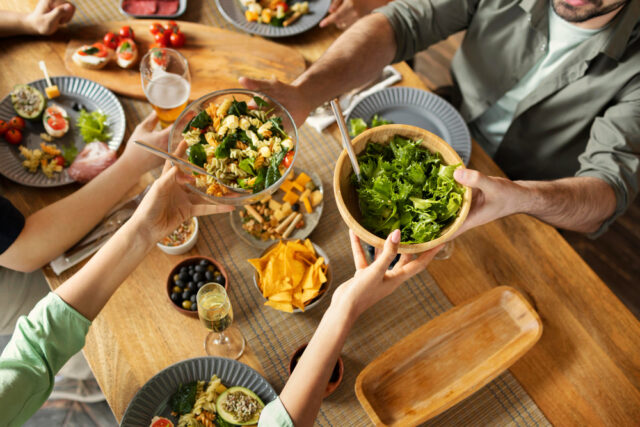
Healthy eating during the holidays can seem like an impossible assignment. From Thanksgiving onward, many Americans are inundated with family gatherings and holiday parties featuring fatty dishes, plentiful desserts and free-flowing alcohol. Jennifer Welper, wellness executive chef at Mayo Clinic, has tips to help you navigate the holidays in a healthier way. But those tips don’t include forbidding cookies or throwing out Grandma’s beloved casserole recipe.
“It’s part of life and part of memories — people come together over food,” she says. “You want to make sure that you don’t completely strip holiday dishes of what they were meant to be.”
Chef Jen has strategies to make sure you don’t feel sluggish, overfed and sugared-out over the holidays.
Easy ways to lighten up holiday meals
Holiday spreads tend to be laden with savory, creamy and fatty foods. Add something light and fresh — a lightly dressed salad, a fancy fruit plate or a vinegar-based slaw — and you may be surprised how quickly those lighter dishes are snatched up.

“You might still feel very full later, but what’s inside of your stomach is not going to be so heavy,” Chef Jen says. When it comes to appetizers, you can still offer chicken wings or meatballs, she says. But also offer lighter dishes such as veggie platters, lettuce wraps, or a fresh black bean and corn salsa.
And don’t forget about fruit. “What people don’t seem to do over the holidays is have a fruit bowl. It seems like once summer’s over, the fruit disappears,” Chef Jen says.
Make the healthy options easy to eat. For instance, Chef Jen has noticed that people don’t touch clementines when she serves them with the peels on — but when pre-peeled, “people will eat those like candy,” she says.
Make vegetables the star of the holiday table
“A big thing that I tell people to focus on: Make the vegetables delicious,” Chef Jen says — even if that means relying on less healthy ingredients such as cheese or honey to punch up the taste.
“Even if it’s Parmesan cauliflower, and there’s a good amount of Parmesan — if you have half a plate of cauliflower, you’re still having half a plate of cauliflower. Where before it might have been more gravy, another bun or more mashed potatoes,” she says.
Other ideas for delicious vegetable dishes include balsamic-glazed Brussels sprouts or sauteed carrots in honey and sage. These recipes are included in Chef Jen’s cookbook Cook Smart, Eat Well. Another strategy to encourage more veggies: Serve salad as a first course to set a good foundation before the rest of the meal.
Simple mocktail recipes
Alcoholic drinks can pack a lot of calories, and excessive drinking can contribute to health problems such as poor sleep, fatigue, liver disease and increased risk of certain cancers. Plus, a hangover is the last thing you want if you’re hosting overnight guests or expecting busy mornings with children.
If you’re looking to limit or eliminate booze this holiday season — but still want to have a fun or fancy drink — you’re in luck. There’s a wide selection of nonalcoholic beers, wines and cocktails at grocery and liquor stores that can be enjoyed in social settings.
If you choose to drink alcohol, Chef Jen suggests having a glass of water between alcoholic drinks. This can rehydrate you and increase feelings of fullness so you don’t indulge in quite as many calories.
To make your own mocktails:
Champagne fooler
Mix 2 cups unsweetened apple juice or apple cider, 1 1/2 teaspoon fresh lemon juice, and 2 cups lemon sparkling water.
Pour into chilled glasses.
Serves 4. Each serving contains 57 calories and 12 grams of sugar.
Cranberry spritzer
In a large pitcher, mix 1 quart reduced-calorie cranberry juice, 1/2 cup fresh lemon juice, 1 quart carbonated water, 1/4 cup sugar and 1 cup raspberry sherbet.
Pour into tall, chilled glasses and garnish with lemon or lime wedges.
Serves 10. Each serving contains about 100 calories and 20 grams of sugar.
With dessert, Chef Jen is a proponent of enjoying favorites in moderation. Modifying a dessert to make it healthier may just lead you to overindulge.
“The moment you start making a dessert ‘healthier,’ you give it a halo effect, and then you’ll have a second piece,” she says. “In terms of calories, fat and sugar content, by the time you have the second piece, you might just as well have had one unaltered one.”
So enjoy the tradition and nostalgia of certain desserts and dishes — but in moderation, she says. “My Grandma Welper’s apple pie is my favorite, and I don’t want her to make that healthy,” she says. “I don’t eat apple pie very often, and I want her to make it the way it always is.”
Remember, eating healthy over the holidays is not about self-denial or overhauling tradition. In fact, an all-or-nothing mentality may encourage you to overindulge, Chef Jen says. You may think, “I’ll start eating healthy after the holidays.” It’s often more realistic to focus on gradual improvements and celebrate small wins, she says.
“We think we have to make these dramatic makeovers and it’s not that at all. It’s more like, ‘Hey, can you throw an extra serving of fruit or veggies into your celebration?’” she says.
Easy ingredient swaps for healthier cooking
In other cases, you can make easy substitutions without sacrificing taste. For example, Chef Jen provides cocktail meatballs — one of her family’s favorites — with a few alterations.
“I’ll use really lean meat, and sometimes I’ll put in a little ground turkey or chicken. No one can ever tell the difference because the sauce masks it,” she says. “I’m not taking anything away. I’m just slightly manipulating it.”
And you might find that other recipes don’t require quite as much butter or sugar as the recipe calls for. “If you usually make your green beans with a stick of butter, try using half a stick,” she says. “You probably didn’t really need the other half.”
Butter, margarine, shortening, oil
For baked goods, substitute half the butter, shortening or oil with one of these:
- pureed low-fat cottage cheese
- mashed banana
- prune or pumpkin puree
- fat-free yogurt.
For stovetop cooking, sauté food in broth or a small amount of healthy oil such as olive, canola or peanut. If using cooking spray, keep the heat significantly lower.
Sugar
In many baked goods, you can reduce the amount of sugar by 1/3 to 1/2 without affecting the texture or taste. But make sure you use at least 1/4 cup sugar for every cup of flour to keep items moist.
To boost sweetness when reducing sugar, add spices such as cinnamon, cloves or nutmeg or flavoring such as vanilla or almond. In place of sugar, use honey or sugar substitutes such as sucralose.
Salt
For baked goods, reduce the amount of salt by up to half. This does not apply to yeast-leavened items, such as bread.
When cooking or frying, use herbs and spices. Add salt toward the end of food preparation if needed and use sparingly. Try adding a squeeze of lime or lemon juice to enhance the salt flavor.
This article originally appeared in the Mayo Clinic Health Letter.
Disclaimer
Artificial Intelligence Disclosure & Legal Disclaimer
AI Content Policy.
To provide our readers with timely and comprehensive coverage, South Florida Reporter uses artificial intelligence (AI) to assist in producing certain articles and visual content.
Articles: AI may be used to assist in research, structural drafting, or data analysis. All AI-assisted text is reviewed and edited by our team to ensure accuracy and adherence to our editorial standards.
Images: Any imagery generated or significantly altered by AI is clearly marked with a disclaimer or watermark to distinguish it from traditional photography or editorial illustrations.
General Disclaimer
The information contained in South Florida Reporter is for general information purposes only.
South Florida Reporter assumes no responsibility for errors or omissions in the contents of the Service. In no event shall South Florida Reporter be liable for any special, direct, indirect, consequential, or incidental damages or any damages whatsoever, whether in an action of contract, negligence or other tort, arising out of or in connection with the use of the Service or the contents of the Service.
The Company reserves the right to make additions, deletions, or modifications to the contents of the Service at any time without prior notice. The Company does not warrant that the Service is free of viruses or other harmful components.