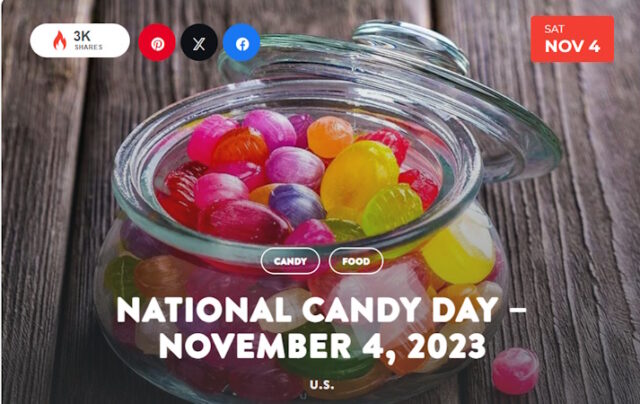
On November 4th we celebrate the sweet holiday, National Candy Day. Candies have a long history of attracting us with their bright colors and delightful flavors. They also come in a variety of fun sizes and shapes.
- Late 13th century – Middle English first began using the word candy. Borrowed from the Old French cucre candi, it is derived in turn from Persian Qand and Qandi, cane sugar.
- 18th Century -the first candy likely came to America from Britain and France. At the time, people made the simplest form of candy from crystallized sugar – rock candy. However, even the most basic form of sugar was considered a luxury and was only attainable by the wealthy.
- 19th Century – The first chocolate eggs were made in Europe in the early 19th century and remain among the most popular treats associated with Easter.
- 1800s – the period when physicians commonly prescribed chocolate to patients with broken hearts.
- 1806 – The oldest candy company in the US opens in Salem, Massachusetts. The Ye Old Pepper Companie was started by Mary Spencer after a shipwreck. She began peddling a rock candy called “Salem Gibralter” (the first candy sold commercially) from a church
- 1817 – In a town in Yorkshire, England, Samuel Parkinson began making butterscotch as a hard candy
- 1830s – markets opened and the candy business underwent a drastic change. Not only did the price of candy drop, but penny candies targeted children.
- 1844 – A Dutch man invented the first hard chocolate candy in 1844.
- 1847 – The invention of the candy press made it possible to produce multiple shapes and sizes of candy at one time.
- 1847 – The first chocolate candy bars were made by Joseph Fry using bittersweet chocolate.
- 1849 – During the 1849 Gold Rush, Dombringo Ghirardelli from Italy began making chocolate in San Francisco. His factory still stands at Ghirardelli Square.
- 1851 – Confectioners begin using a revolving steam pan to assist in boiling sugar.
- 1871 – Candy buttons are small dots of colored sugar on a strip of waxed paper. Originally made by the New England Confectionery Company (Necco)
- 1875 – Milk chocolate was first introduced in 1875 by Henry Nestle and Daniel Peter.
- 1883 – Salt Water Taffy was Invented in Atlantic City in 1883.
- 1896 – Tootsie Rolls debuted in 1896, introduced by Leo Hirshfield of New York who named them after his daughter’s nickname, “Tootsie”.
- 1897 – Machine-spun cotton candy was invented in 1897 by the dentist William Morrison and confectioner John C. Wharton, and first introduced to a wide audience at the 1904 World’s Fair as “Fairy Floss” with great success, selling 68,655 boxes at 25¢ per box (equivalent to $6 per box today).
- 1922 – In Germany, Haribo gummy bears were the first gummi candy ever made
- 1928 – Reese’s Peanut Butter Cups are created.
- 1930s – Until the 1930s the Sugar Daddy candy pop was called the “Papa Sucker.”
- 1941 – M&M plain Chocolate Candies were introduced in 1941 in response to slack chocolate sales in summer.
- 1949 – Bill and Dorothy Harmsen founded the Jolly Rancher company. Getting its start in Golden, Colorado, the company sold ice cream, candy, and chocolate at local stores. The fun fact here comes in the name.
- Since these tasty hard candies were created in the West, Bill wanted them to represent the spirit of the people. The name, “Jolly Rancher,” was chosen to connote a “hospitable Western company.”
- 1953 – Peeps were first put into production, it took 1,620 minutes to make one. Now, it only takes six minutes from start to finish to make one Peep! Now every day, factories make 5.5 million Peeps.
- 1956 – Pop rocks were invented by accident in 1956 by William A. Mitchell, a chemist experimenting with manufacturing an “instant” soda. The candy is essentially carbon dioxide dissolved in sugar—when the sugar melts on your tongue, the carbon dioxide “crackles” as it’s released—the same mechanism that makes soda fizzy. Mitchell also invented Tang, Cool Whip, and Jell-O.
- 1960 – Starburst candies were invented in the UK by Peter Phillips.
- 1981 – Gummy worms were introduced on July 15, 1981, the 50th anniversary of gummy bears.
- 1981 – During Ronald Reagan’s 1981 inauguration, Jelly Belly served more than 3 tons of jelly beans!
- Sugar wasn’t always readily available, so the first candies were made with honey. Candy makers coated coat fruits and flowers with honey. This method preserved the flowers and nuts or created forms of candy.
- Originally a form of medicine, candy calmed the digestive system or cooled a sore throat. At that time, combined with spices and sugar, candy only appeared in the purses and the dishes of the wealthy.
- How many licks does it take to get to the center of a tootsie-pop? According to student researchers at Purdue, it’s 364 licks.
- The name “Pez” comes from the German word “pfeffErminZ,” meaning “peppermint.”
- Americans purchase nearly 600 million pounds of candy a year for Halloween.
- An incredible 90 million pounds of chocolate candy is sold during Halloween week, taking a strong lead compared to other holidays.
- Almost 65 million pounds are sold during the week leading up to Easter and only 48 million pounds during Valentine’s week.
- Over 10% of annual candy sales happen on the days leading up to Halloween — that is nearly $2 billion dollars in sales.
- Chocolate is clearly the preferred choice of sweets for many. Of the $1.9 billion sold in Halloween candy each year, $1.2 billion was on chocolate candy and only $680 million on sugar candy.
- More than 35 million pounds of candy corn will be produced this year. That equates to nearly 9 billion pieces — enough to circle the moon nearly four times if laid end-to-end.
- Candy Corn is the most searched-for candy term on Google — more popular than candy apples, gummy worms and candy pumpkins.
- The day of the year with the most candy sales? October 28th. And of all the 365 days in the year, the top five candy-selling days are all in October.
- The average American household spends $44 a year on Halloween candy!
- Germans consume twice as much candy as Americans.
- 65% of American candy bars were introduced more than 50 years ago.
- A one-ounce piece of milk chocolate contains about the same amount of caffeine as a cup of decaffeinated coffee.
- Tootsie Rolls, according to the official recipe, the previous day’s Tootsie Roll batch is mixed into the new batch each day, so theoretically, this means there’s a tiny amount of the very first Tootsie Rolls in every new roll made today.
- Tootsie Rolls were added to soldiers’ rations during World War II due to their durability in all weather conditions.
- Every day, 64 million Tootsie Rolls are made. That’s over 44,440 Tootsie Rolls per minute.
- 200 million Skittles are produced each day.
- Americans over 18 years of age consume 65 percent of the candy that is produced each year.
- The ancient Aztecs believed that chocolate was an aphrodisiac. Chocolate contains phenylethylamine (PEA), a natural substance that is said to stimulate the same reaction in the body as falling in love.
- 2.8 billion pounds of chocolate is consumed in America each year, which is over 11 pounds per person.
- The U.S. produces more chocolate than any other country in the world but the Swiss consume the most, followed closely by the United Kingdom.
- The melting point of cocoa butter is just below the body temperature, which is why chocolate melts when you put it in your mouth.
- Americans eat 25 pounds of candy, per person, per year. The people of Denmark eat more than 36 pounds of candy per person, per year.
- President Nixon regularly had the breakfast of champions, Milky Way! Supposedly, the president had a sweet tooth and loved Milky Way bars.
- All Hershey’s Kisses have a white paper strip that comes out of the top of the wrapper. But do you know what it’s called? This little flag is actually called a “plume.” Hershey’s originally introduced it to distinguish itself from phony knock-off candies.
- Rock candy was a happy accident of a Scottish hard candy maker.
- In Canada, Kit Kat fingers are especially popular in Canada. Nestle has claimed that 700 Kit Kat fingers are consumed every second!
- 36 million — the number of heart-shaped boxes of chocolate that are sold on Valentine’s Day.
- The Snickers candy bar was named after Frank Mars’ family horse.
Sources:

Disclaimer
Artificial Intelligence Disclosure & Legal Disclaimer
AI Content Policy.
To provide our readers with timely and comprehensive coverage, South Florida Reporter uses artificial intelligence (AI) to assist in producing certain articles and visual content.
Articles: AI may be used to assist in research, structural drafting, or data analysis. All AI-assisted text is reviewed and edited by our team to ensure accuracy and adherence to our editorial standards.
Images: Any imagery generated or significantly altered by AI is clearly marked with a disclaimer or watermark to distinguish it from traditional photography or editorial illustrations.
General Disclaimer
The information contained in South Florida Reporter is for general information purposes only.
South Florida Reporter assumes no responsibility for errors or omissions in the contents of the Service. In no event shall South Florida Reporter be liable for any special, direct, indirect, consequential, or incidental damages or any damages whatsoever, whether in an action of contract, negligence or other tort, arising out of or in connection with the use of the Service or the contents of the Service.
The Company reserves the right to make additions, deletions, or modifications to the contents of the Service at any time without prior notice. The Company does not warrant that the Service is free of viruses or other harmful components.