The Silence of the Alarms
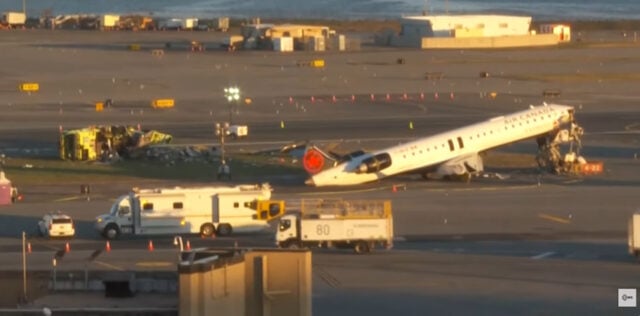
In the sterile, high-tension atmosphere of today’s press briefing, National Transportation Safety Board (NTSB) Chair Jennifer Homendy confirmed what many in the aviation community feared: a “ghost” on the runway led to the deaths of two pilots. On Sunday night, March 22, 2026, Air Canada Express Flight 8646—a Bombardier CRJ-900 operated by Jazz Aviation—collided with a Port Authority fire truck while landing on Runway 4 at LaGuardia Airport.
Today, the NTSB clarified why the airport’s state-of-the-art safety net failed to catch the impending disaster. The Airport Surface Detection Equipment (ASDE-X) and Runway Status Lights (RWSL), designed specifically to prevent runway incursions, never triggered an alarm. The reason? The fire truck was essentially invisible to the digital eye.
“The system didn’t work as intended because the fire truck did not have a transponder,” Homendy stated. Without that small electronic device broadcasting the vehicle’s position, the safety logic of the airport’s computer systems assumed the runway was clear, even as a 50,000-pound emergency vehicle lumbered into the path of a landing jet.

The 20-Second Window of Error
The collision occurred at approximately 11:37 p.m. local time. The investigation has zeroed in on a frantic 20-second window that preceded the impact. At the time, the tower was managing a separate “odor” emergency involving a United Airlines flight at Terminal B.
According to preliminary data and tower audio:
- The Clearance: A controller cleared the Port Authority Aircraft Rescue and Firefighting (ARFF) vehicle to cross Runway 4 to reach the United flight.
- The Landing: Flight 8646 was already on short final, roughly 100 feet (30 meters) in the air, when that clearance was given.
- The Realization: Seconds later, the controller realized the conflict. Audio captured by LiveATC.net records the desperate commands: “Stop, stop, stop, Truck 1, stop!”
- The Impact: The CRJ-900 struck the vehicle at high speed. The aircraft’s nose was sheared, the cockpit was destroyed, and the jet eventually came to rest with its tail on the tarmac.
In the aftermath, a voice—presumably the controller’s—can be heard saying, “I messed up.” Homendy cautioned against immediate blame, noting that the controller was only a few hours into their shift and was navigating a “heavy workload environment” exacerbated by recent staffing shortages across the FAA.
Technical Breakdown: The Failure of ASDE-X
To understand the gravity of this oversight, one must look at how modern airports manage the “ground game.”
| System | Function | Why It Failed |
| ASDE-X | Integrates radar and transponder data to track all airport movements. | It could not “see” the truck without an active transponder signal. |
| RWSL | Red lights on the runway that automatically illuminate when it is unsafe to enter. | No signal from the truck meant the lights stayed off, signaling “clear” to the pilots. |
| Ground Radar | Primary radar used to detect physical objects. | While it may have shown a “blip,” the system requires transponder data to differentiate and alert. |
Homendy pointed out that while the NTSB has long advocated for better surface safety, it has never explicitly mandated that every single maintenance and fire vehicle on airport grounds carry a transponder. “They should,” she added firmly today. “It is a gap in our safety layers that has now cost lives.”
The Human Cost: Profiles in the Cockpit
The tragedy is defined not just by technical failures but by the loss of two highly respected aviators. The pilots killed in the crash were both based in Canada and have been identified as:
- Antoine Forest (30): A native of Coteau-du-Lac, Quebec. Forest was described by former colleagues at Air Saguenay as a “great pilot” who was “always friendly, always careful.” He had been with Jazz Aviation since 2022.
- Mackenzie Gunther: A 2023 graduate of Seneca Polytechnic’s aviation technology program. Seneca announced that flags at its campuses would be lowered to half-mast on Tuesday in honor of the young alumnus.
Passengers on the flight credit the pilots’ last-second reflexes with saving the lives of the 72 people in the cabin. Passenger Jack Cabot described the moment of impact: “We came in for a regular landing, then it felt like we hit a wall. It was a sharp bang. We didn’t have any directions because the pilot’s cabin had been destroyed.”
A Miraculous Survival
Perhaps the most harrowing story to emerge from the wreckage is that of a flight attendant. During the impact, the aircraft’s fuselage was severed near the front. The flight attendant, still strapped into her jumpseat, was thrown from the aircraft and onto the tarmac. Rescuers found her still in the seat, miraculously alive with serious but non-life-threatening injuries.
In total, 41 people were transported to hospitals, including two fire department personnel from the truck who are reportedly in stable condition.
A Broken System in a Strained Era
The LaGuardia crash comes at a particularly volatile time for American aviation. The industry is currently grappling with:
- Government Shutdown Pressures: Long security lines and administrative delays have been the norm in early 2026.
- Staffing Shortages: Air traffic controllers have been working overtime to cover gaps, leading to concerns about fatigue and “brain-dead” moments—a term used by retired controller Harvey Sconick when discussing the incident with the New York Post.
- Environmental Factors: Winter storms and rising operational costs have already put New York’s airports on edge.
LaGuardia, the region’s third-busiest airport, remains partially paralyzed. While most operations resumed Monday afternoon, Runway 4 remains a crime scene. Investigators had to cut a hole through the roof of the CRJ-900 to retrieve the Flight Data Recorder (FDR) and Cockpit Voice Recorder (CVR) because the aircraft’s tail was resting on the ground, blocking the usual access panels.
What’s Next for the Investigation?
The NTSB’s “Go-Team” is currently sifting through what Homendy described as a “tremendous amount of debris.” The black boxes have already been transported to the NTSB lab in Washington D.C. for analysis.
Over the coming months, the investigation will focus on:
- ATC Fatigue: Analyzing the schedules and mental state of the controllers on duty.
- Vehicle Coordination: Determining why a vehicle was cleared to cross a runway with an active landing in progress.
- Regulatory Reform: Potentially moving toward a mandatory transponder rule for all airport surface vehicles.
A preliminary report is expected within 30 days, but the final determination of “probable cause” could take 12 to 24 months. For the families of Forest and Gunther, and the survivors still recovering in New York hospitals, that wait will feel like a lifetime.
As the industry reflects on this “entirely avoidable” tragedy, the lesson is clear: in a world of high-tech automation, it only takes one missing piece of data—one missing transponder—for the entire system to come crashing down.
Sources and Links
- AP News: Fire truck in LaGuardia crash lacked equipment needed to trigger runway warning system, NTSB says
- NTSB Official Site: DCA26MA161 Investigation Details
- CBS News New York: LaGuardia Airport runway crash investigators are on scene in NYC
- The Guardian: Two pilots killed after Air Canada jet collision at LaGuardia
- CTV News: Pilots killed in plane crash at N.Y.’s LaGuardia Airport identified
- Hindustan Times: LaGuardia Airport crash was ‘entirely avoidable’; expert blames FAA, controllers
- LocalMemphis (AP): New York plane crash investigation looking at cockpit recorder and controllers
Disclaimer
Artificial Intelligence Disclosure & Legal Disclaimer
AI Content Policy.
To provide our readers with timely and comprehensive coverage, South Florida Reporter uses artificial intelligence (AI) to assist in producing certain articles and visual content.
Articles: AI may be used to assist in research, structural drafting, or data analysis. All AI-assisted text is reviewed and edited by our team to ensure accuracy and adherence to our editorial standards.
Images: Any imagery generated or significantly altered by AI is clearly marked with a disclaimer or watermark to distinguish it from traditional photography or editorial illustrations.
General Disclaimer
The information contained in South Florida Reporter is for general information purposes only.
South Florida Reporter assumes no responsibility for errors or omissions in the contents of the Service. In no event shall South Florida Reporter be liable for any special, direct, indirect, consequential, or incidental damages or any damages whatsoever, whether in an action of contract, negligence or other tort, arising out of or in connection with the use of the Service or the contents of the Service.
The Company reserves the right to make additions, deletions, or modifications to the contents of the Service at any time without prior notice. The Company does not warrant that the Service is free of viruses or other harmful components.