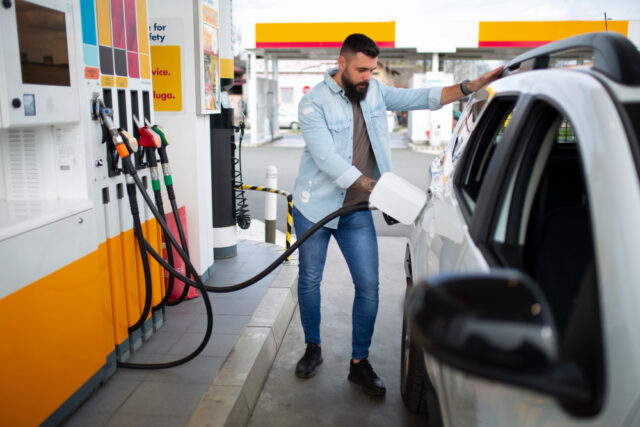
The surge in crude oil to over $100 per barrel is not just a high-level market statistic—it is an immediate tax on every American driver. Historically, for every $10 increase in the price of a barrel of oil, the price at the gas pump typically rises by about $0.24 to $0.25 per gallon.
With prices now at $108.15 for WTI and $107.70 for Brent, the “small price” of geopolitical strategy is translating into a very large bill at the pump.
Current Reality: The Immediate Spike
As of March 8, 2026, the national average for regular gasoline has already jumped to $3.45 per gallon. This represents a staggering $0.47 increase in just a single week.
- Regional Variance: While the $3.45 average is the national headline, California and parts of the West Coast are already seeing average prices above $5.16, with some premium stations in metropolitan hubs reporting over $6.00.
- The “Lag” Factor: Gasoline prices at the pump usually lag behind oil futures by several days. Since crude jumped nearly 20% this weekend, consumers should expect another $0.20 to $0.30 increase by mid-week as stations replenish their tanks at the new, higher wholesale rates.
The Forecast: Where Prices Are Headed
Economists and energy analysts are modeling three primary scenarios based on the duration of the Iran conflict and the status of the Strait of Hormuz:

| Scenario | Crude Oil Price | Est. National Gas Avg. | Economic Impact |
| Short-Term (2-4 weeks) | $105 – $115 | $3.85 – $4.10 | Contained; slight dip in spring travel. |
| Sustained (3-6 months) | $125 – $140 | $4.50 – $4.85 | GDP growth slows by ~0.8%; consumer sentiment drops. |
| Max Escalation | $150+ | $5.25 – $6.00+ | Possible recession; historic highs set in 2022 are shattered. |
Here are the AAA Florida Average Gas Prices
Beyond the Pump: The “Hidden” Costs
The impact on your wallet doesn’t stop at your car’s fuel tank. Sustained $100+ oil creates a domino effect across the economy:
- Airlines: Jet fuel is a massive overhead cost. Expect “fuel surcharges” to return to ticket prices for summer travel, potentially increasing fares by 15–20%.
- Groceries: Almost all food is transported by diesel-powered trucks. Diesel has already jumped to $4.60 per gallon (up $0.83 in a week), which will inevitably lead to higher prices for produce and meat within the next 30 days.
- Inflation: S&P Global warns that a sustained $100 oil reality adds approximately 0.60 percentage points to headline inflation, complicating the Federal Reserve’s ability to lower interest rates.
The Silver Lining? Domestic Production
The U.S. is currently producing a near-record 13.6 million barrels per day. While this doesn’t stop the global price from rising (since oil is a global commodity), it does mean that American energy companies are seeing record profits. Analysts expect this “price signal” to trigger a massive surge in shale drilling in the Permian Basin, which could help bring prices back down toward $3.00 by late 2026 if the military conflict stabilizes.
Sources and Links
- AAA Gas Prices (Live Tracker): National Average Jumps Nearly 27 Cents to $3.25
- Note: Reports as of March 8, 2026, show a continuing upward trend toward $3.45 in several regions.
- The Guardian: White House worries as gas prices jump amid ongoing US-Israel war on Iran
- Details the $125/barrel “tipping point” for GDP and the 0.8% growth risk.
- 24/7 Wall St.: Gas Prices Could Set New All-Time High By the End of March
- Provides the March 8 national average of $3.45 and consumer sentiment analysis.
- First Coast News (TEGNA): Gas prices surge nationwide as crude oil hits $100 a barrel
- Confirms regional spikes, including California’s average reaching $5.16.
- J.P. Morgan Global Research: Oil Price Forecast for 2026 | Geopolitical Risk Analysis
- Explains the “76% price increase” historically associated with regime changes in oil-producing nations.
- U.S. Energy Information Administration (EIA): Short-Term Energy Outlook (STEO)
- Source for U.S. domestic production data (13.6 million barrels per day).
- Hellenic Shipping News: Analysts see oil at $100/bbl amid Hormuz disruption
- Forecasts from Goldman Sachs and Wood Mackenzie regarding the Strait of Hormuz blockade.
Disclaimer
Artificial Intelligence Disclosure & Legal Disclaimer
AI Content Policy.
To provide our readers with timely and comprehensive coverage, South Florida Reporter uses artificial intelligence (AI) to assist in producing certain articles and visual content.
Articles: AI may be used to assist in research, structural drafting, or data analysis. All AI-assisted text is reviewed and edited by our team to ensure accuracy and adherence to our editorial standards.
Images: Any imagery generated or significantly altered by AI is clearly marked with a disclaimer or watermark to distinguish it from traditional photography or editorial illustrations.
General Disclaimer
The information contained in South Florida Reporter is for general information purposes only.
South Florida Reporter assumes no responsibility for errors or omissions in the contents of the Service. In no event shall South Florida Reporter be liable for any special, direct, indirect, consequential, or incidental damages or any damages whatsoever, whether in an action of contract, negligence or other tort, arising out of or in connection with the use of the Service or the contents of the Service.
The Company reserves the right to make additions, deletions, or modifications to the contents of the Service at any time without prior notice. The Company does not warrant that the Service is free of viruses or other harmful components.