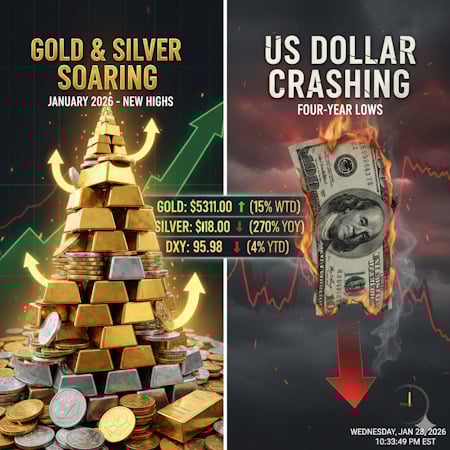
The global financial landscape is undergoing a tectonic shift as January 2026 draws to a close. In a dramatic reversal of the “King Dollar” era, the U.S. dollar has retreated to its weakest levels since early 2022. This vacuum in currency confidence has propelled gold and silver into a historic “supercycle,” with gold breaching the psychologically significant $5,300 mark and silver staging a parabolic rally toward $120 per ounce.
The dual phenomenon—a sinking greenback and a sky-high metals complex—is not merely a market fluke; it is the result of a “perfect storm” of domestic policy shifts, institutional de-dollarization, and a fundamental repricing of hard assets amid fiscal instability.
The Metal Mania: Gold at $5,300 and Silver’s Industrial Surge
For decades, gold was viewed as a slow-moving hedge. In early 2026, it has become a high-velocity sanctuary. As of late January, spot gold traded at an all-time high of $5,311 per ounce, gaining over 15% in a single week.

However, it is silver that has stolen the spotlight. Often referred to as “poor man’s gold,” silver has shed that modest title, rising nearly 270% over the past year to hit $118. This surge is fueled by a critical supply deficit and an explosion in industrial demand. With the U.S. officially designating silver as a “critical mineral” and China restricting exports, the metal has become indispensable for the infrastructure of the future, specifically:
- AI Data Centers: High-conductivity silver is essential for the advanced processors powering the AI boom.
- Green Energy: Solar panel manufacturing continues to consume massive quantities of physical silver.
- Electric Vehicles (EVs): The automotive transition has created a baseline of demand that mining output simply cannot meet.
The Dollar’s “Crisis of Confidence”
While metals climb, the U.S. Dollar Index (DXY) has slipped below the 96.00 mark. Market analysts point to several factors for this decline, including the “credibility discount” being applied to U.S. fiscal policy.
Speculation regarding the “Mar-a-Lago Accord”—a theoretical policy push by the Trump administration to deliberately weaken the dollar to boost domestic manufacturing—has led global hedge funds to trim their dollar holdings. Simultaneously, a “Yen Squeeze” has forced investors to cover yen-based loans as the Japanese currency rebounds, further dragging down the dollar.
Impact on the Global Economy
The sliding dollar is a double-edged sword, creating distinct winners and losers across trade, travel, and investment.
1. International Trade: The Exporter’s Advantage
A weaker dollar makes American-made goods cheaper for foreign buyers. This is a central pillar of the current administration’s “America First” manufacturing strategy.
- Exports: Boeing jets, American soybeans, and tech hardware become more competitive in European and Asian markets.
- Imports: Conversely, the cost of importing foreign goods—from French wine to Japanese electronics—is rising. This “import inflation” may keep consumer prices high even as the Federal Reserve weighs further interest rate cuts.
2. Travel: The End of the “Cheap Europe” Trip
For American tourists, the days of a dominant dollar are fading. With the Euro climbing back above $1.20 and the Yen strengthening, the purchasing power of U.S. travelers has significantly eroded.
- Increased Costs: Hotels, dining, and transportation in popular destinations like Italy, Japan, and the UK are now 10–15% more expensive than they were a year ago.
- Inbound Boost: On the flip side, the U.S. is becoming a “budget” destination for foreign tourists, which could provide a much-needed boost to the domestic hospitality and service sectors.
3. Investments: A Flight to Tangibles
The “paper market” is facing a reckoning. As U.S. debt-to-GDP reaches historic highs, institutional investors are diversifying away from U.S. Treasuries.
- Central Bank Diversification: Central banks across the Global South are aggressively swapping dollar reserves for physical gold to insulate themselves from potential sanctions and dollar volatility.
- Portfolio Shifting: Financial advisors are increasingly moving clients into “hard money” and commodity-linked equities. With the 200-day moving average for gold sitting 30% below current prices, some warn of a correction, but the structural demand remains relentless.
Looking Ahead
As the world watches the Federal Reserve’s next move and the transition of its leadership in May, the trajectory for gold and silver remains bullish in the eyes of many. While the U.S. Treasury has officially reiterated its commitment to a “strong dollar policy,” the market’s actions suggest a different reality. For now, the “gold standard” is returning—not as a policy, but as a market necessity.
Sources & References
- Bloomberg: U.S. Dollar Index Hits Four-Year Low Amid Policy Uncertainty
- Reuters: Gold Touches Record High as Trump Signals Weaker Greenback
- The Economic Times: Why Silver Prices are Up 50% in January 2026
- Morgan Stanley Research: 2026 Investment Strategy: The Dollar’s Structural Decline
- Investopedia: How a Weakening Dollar Impacts Your Portfolio and Travel
- CNBC: Precious Metals Supercycle: Gold Breaches $5,000 Milestone
- Federal Reserve (FRED): Nominal Broad U.S. Dollar Index Data
Disclaimer
Artificial Intelligence Disclosure & Legal Disclaimer
AI Content Policy.
To provide our readers with timely and comprehensive coverage, South Florida Reporter uses artificial intelligence (AI) to assist in producing certain articles and visual content.
Articles: AI may be used to assist in research, structural drafting, or data analysis. All AI-assisted text is reviewed and edited by our team to ensure accuracy and adherence to our editorial standards.
Images: Any imagery generated or significantly altered by AI is clearly marked with a disclaimer or watermark to distinguish it from traditional photography or editorial illustrations.
General Disclaimer
The information contained in South Florida Reporter is for general information purposes only.
South Florida Reporter assumes no responsibility for errors or omissions in the contents of the Service. In no event shall South Florida Reporter be liable for any special, direct, indirect, consequential, or incidental damages or any damages whatsoever, whether in an action of contract, negligence or other tort, arising out of or in connection with the use of the Service or the contents of the Service.
The Company reserves the right to make additions, deletions, or modifications to the contents of the Service at any time without prior notice. The Company does not warrant that the Service is free of viruses or other harmful components.