I. The Midnight Truce and the Morning After
On the evening of Tuesday, April 7, 2026, a weary world briefly exhaled. After weeks of escalating naval skirmishes in the Persian Gulf and a devastating air campaign across the Iranian plateau, President Donald J. Trump announced a two-week “fragile” ceasefire between the United States and the Islamic Republic of Iran. Brokered in the eleventh hour by Pakistani Prime Minister Shehbaz Sharif, the deal was hailed as a “triumph of strength” by the White House and a “victory for regional sovereignty” by Tehran.
However, the silence of the guns lasted less than twelve hours. By Wednesday morning, the “Peace of Ramadan” was replaced by a chaotic discord of interpretations that has left diplomats scrambling and global markets in a tailspin. The fundamental point of contention—one that now threatens to reignite a full-scale regional war—is whether the ceasefire extends to the sovereign territory of Lebanon and the activities of Hezbollah.
While the agreement’s text was initially kept under wraps, the differing public statements from Washington, Tehran, and Jerusalem suggest that the negotiators may have relied on a “constructive ambiguity” that has since proven more destructive than constructive. As of Thursday, April 9, the Middle East stands at a more dangerous precipice than it did before the pens ever hit the paper.

II. The “Lebanon Loophole”: A Fatal Ambiguity
The core of the crisis lies in the definition of the “parties” to the ceasefire. Iranian President Masoud Pezeshkian and Parliament Speaker Mohammad Bagher Ghalibaf have been adamant: Lebanon is an inseparable component of the 10-point plan that formed the basis of the truce. According to Tehran, the ceasefire was contingent upon a total cessation of hostilities across the “Axis of Resistance,” including a halt to Israeli operations in Lebanon.
“The terms of the ceasefire are clear and explicit,” stated Iranian Foreign Minister Syed Abbas Araghchi. “The US must choose between enforcing the ceasefire or allowing continued conflict through Israel. The ball is in the US court.”
Conversely, the Trump administration has categorized Lebanon as a “separate skirmish.” In a series of posts and official briefings, the White House has maintained that the deal was strictly a bilateral pause between the US and Iran to allow for the safe passage of energy tankers and the discussion of nuclear de-escalation—specifically the removal of what Trump has termed “Nuclear Dust.”
The confusion has created a vacuum that has been filled by rapid military escalation. Israel, not a formal signatory to the US-Iran deal but a key strategic partner, has moved to exploit this ambiguity. Prime Minister Benjamin Netanyahu’s government argues that because Hezbollah is not a national military but a “terrorist proxy,” it cannot be a party to a state-level ceasefire.
III. Strait of Hormuz: The Chokepoint as a Political Lever
The immediate consequence of this “Lebanon Gap” has been felt at the world’s most critical maritime chokepoint. Iran, claiming that the US and Israel have already violated the spirit of the truce, has re-closed the Strait of Hormuz.
For the global economy, the stakes could not be higher. One-fifth of the world’s oil and gas passes through these narrow waters. The International Maritime Organization (IMO) reports that approximately 2,000 ships, including massive crude carriers and six tourist cruise liners, are currently stranded in the Persian Gulf. More than 20,000 seafarers are trapped aboard these vessels, caught in a high-stakes game of geopolitical chicken.
Iran’s Fars news agency confirmed on Wednesday that the Iranian Revolutionary Guard Corps (IRGC) had resumed stopping all tankers, asserting that the waterway would remain impassable until Israel ceased its “barbaric aggression” in Beirut. This move has sent Brent Crude prices soaring, erasing the brief “peace dividend” markets enjoyed on Wednesday morning.
“The priority now is to ensure the safety of navigation to guarantee an evacuation,” said Damien Chevallier, Director of the IMO’s Maritime Safety Division. “We do not wish to see a return to escalation, but ship operators must carefully assess the risk.”
IV. Israel’s “Largest Strike”: Netanyahu’s Defiance
While the US and Iran argued over definitions, the Israel Defense Forces (IDF) launched what has been described as the largest coordinated strike on Lebanon since the current conflict began. On Wednesday, over 100 Hezbollah command centers and military sites were targeted in a massive wave of aerial bombardment.
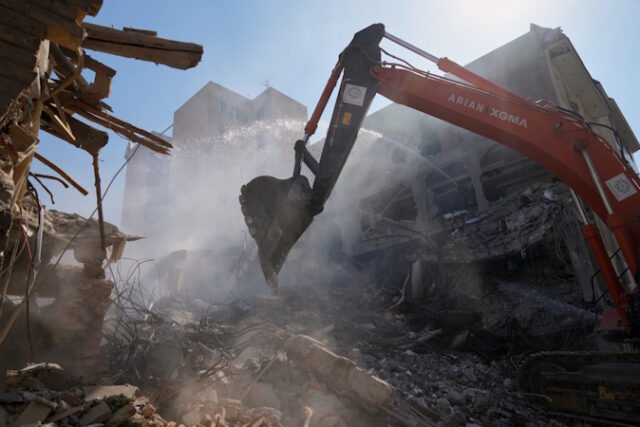
The devastation was centered on Beirut, particularly the Corniche al-Mazraa and Bechara El Khoury neighborhoods. Plumes of black smoke hung over the Mediterranean as high-rise buildings were reduced to rubble. Lebanon’s health ministry reported a staggering toll: 254 people killed and nearly 900 wounded in a single day.
Prime Minister Netanyahu, in a televised address to the nation, was unapologetic. “Let me be clear: the ceasefire with Iran will not include Hezbollah,” he stated. “Our finger remains on the trigger. Israel is stronger than ever, and Iran is weaker than ever. We will achieve our objectives—either through agreement or through renewed fighting.”
This escalation has placed the United States in a difficult position. While the White House wants to preserve the pause with Iran to secure its own interests—including the return of “Nuclear Dust” (enriched uranium stocks)—it cannot easily restrain an Israeli government that views the current moment as a historic opportunity to dismantle Hezbollah’s infrastructure.
V. JD Vance and the Budapest Clarification
In an effort to manage the fallout, U.S. Vice President JD Vance addressed reporters in Budapest on Wednesday before boarding Air Force Two. Vance’s comments were aimed at lowering the temperature while firmly holding the line on the US interpretation of the deal.
“I think this comes from a legitimate misunderstanding,” Vance said, referring to the discrepancy between the US and Iranian positions. “I think the Iranians thought that the ceasefire included Lebanon, and it just didn’t. The U.S. position was that the ceasefire would focus on Iran and U.S. allies, including Israel and the Gulf Arab states.”
Vance’s framing of the situation as a “misunderstanding” rather than a “betrayal” suggests a desperate attempt to keep the door open for diplomacy. However, he also issued a stark warning: “If Iran wants to let this negotiation fall apart over Lebanon, which has nothing to do with them, that’s ultimately their choice.”
The Vice President confirmed that he will be meeting with key negotiators this weekend in Pakistan to go over the granular details of the deal. The mission is high-stakes: Vance must convince the Iranians to decouple the Lebanon conflict from the Hormuz transit agreement, or the two-week ceasefire will end before it even reaches its fourth day.
VI. Trump, Rutte, and the NATO Crisis
While the Middle East burned, another fire was smoldering in Washington. President Trump held a closed-door meeting on Wednesday with NATO Secretary-General Mark Rutte. The meeting, which lasted more than two hours, was described by Rutte as “frank” and “open,” but White House sources suggest it was highly contentious.
Trump’s frustration centers on the perceived lack of support from European allies during the opening phases of the Iran war. Specifically, several NATO members denied US military planes use of their airspace and declined to send naval assets to help clear the Strait of Hormuz.
White House spokeswoman Karoline Leavitt quoted Trump as telling Rutte: “They were tested, and they failed.”
Trump has reportedly characterized NATO as a “paper tiger” and is currently reviewing a plan to redistribute US troops across the continent. Under this proposal, troops would be moved out of “unhelpful” countries—those that remained neutral or obstructive during the Iran campaign—and moved to nations like Poland or the Baltic states that provided more direct support.
“He is clearly disappointed with many NATO allies, and I can see his point,” Rutte admitted during a subsequent interview with CNN. While Rutte argued that the “large majority” of Europeans had been helpful, the damage to the transatlantic relationship appears severe. Trump’s “mission failed” verdict on NATO adds a layer of global instability just as the US needs a unified front to manage the crisis in the Persian Gulf.
VII. The Road to the Weekend Summit
As we move toward the weekend, the world’s attention turns to Pakistan, where JD Vance and the Iranian delegation will attempt to salvage the truce. The “Ramadan Truce” currently exists only in name.
In Tehran, air defenses have been activated in Isfahan and Kerman, reflecting fears that the ceasefire is a pretext for a surprise strike. In Beirut, residents are clearing the streets as ambulances struggle to reach the wounded. In the Persian Gulf, 20,000 seafarers watch the horizon, waiting for a signal that the world’s most vital waterway is once again open for business.
The coming 48 hours will determine if the “legitimate misunderstanding” cited by Vice President Vance can be resolved through traditional diplomacy, or if the “finger on the trigger” mentality of the regional powers will lead to a conflagration that no ceasefire can contain.
Sources and Links:
- The Guardian: “Middle East ceasefire threatens to unravel as Israel assaults Lebanon and Iran blocks oil tankers”
- The Forward: “US and Iran agree to ‘fragile’ 2-week ceasefire; Israel says deal does not extend to Lebanon”
- The Hindu: “U.S. did not agree that ceasefire would cover Lebanon, Vance says”
- LiveMint: “Vance clarifies US-Iran ceasefire scope — ‘Iranians thought it included Lebanon, and it just didn’t’”
- Dubai Eye 103.8: “Trump criticizes NATO over Iran in meeting with alliance’s boss”
- The Jerusalem Post: “Donald Trump weighs punishing certain NATO states over lack of support for Iran war”
- The Hindu (Live Updates): “Iran-Israel war updates: Ceasefire threatened as Israel expands Lebanon strikes, Iran closes strait again”
- UN News: “Iran ceasefire raises hopes for reopening key Strait of Hormuz”
- India Today: “Hezbollah not part of ceasefire deal: Netanyahu vows to continue strikes in Lebanon”
- The Guardian (Beirut Updates): “At least 254 killed after Israel hits Lebanon with massive wave of airstrikes”
Disclaimer
Artificial Intelligence Disclosure & Legal Disclaimer
AI Content Policy.
To provide our readers with timely and comprehensive coverage, South Florida Reporter uses artificial intelligence (AI) to assist in producing certain articles and visual content.
Articles: AI may be used to assist in research, structural drafting, or data analysis. All AI-assisted text is reviewed and edited by our team to ensure accuracy and adherence to our editorial standards.
Images: Any imagery generated or significantly altered by AI is clearly marked with a disclaimer or watermark to distinguish it from traditional photography or editorial illustrations.
General Disclaimer
The information contained in South Florida Reporter is for general information purposes only.
South Florida Reporter assumes no responsibility for errors or omissions in the contents of the Service. In no event shall South Florida Reporter be liable for any special, direct, indirect, consequential, or incidental damages or any damages whatsoever, whether in an action of contract, negligence or other tort, arising out of or in connection with the use of the Service or the contents of the Service.
The Company reserves the right to make additions, deletions, or modifications to the contents of the Service at any time without prior notice. The Company does not warrant that the Service is free of viruses or other harmful components.