The Call That Bridged Worlds
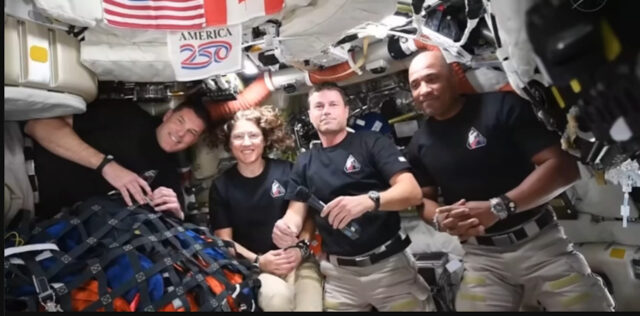
On the evening of Monday, April 6, 2026, as the Orion spacecraft drifted beyond the far side of the moon and began its long arc back toward Earth, a familiar voice crackled across the Deep Space Network. President Donald J. Trump, speaking from the White House, connected with the four-person crew of Artemis II to celebrate a milestone that hasn’t been reached in over half a century.
“Today you’ve made history and made all America really proud, incredibly proud,” the President told the crew during a 12-minute conversation. He referred to the astronauts—NASA’s Reid Wiseman, Victor Glover, Christina Koch, and the Canadian Space Agency’s Jeremy Hansen—as “modern-day pioneers.” The call was more than a ceremonial congratulation; it served as a high-profile validation of a space policy that Trump has championed since his first term, framing the lunar mission as the first step in a larger “manifest destiny” into the stars.
The President’s rhetoric throughout the call was consistent with his vision for “American space superiority.” He praised the crew’s “courage” and “genius,” noting that their voyage was merely a precursor to the “whole big trip to Mars.” For a President who has often tied national greatness to technological and military dominance, the success of Artemis II represents a significant political and symbolic victory.
Shattering the Apollo 13 Record
The timing of the call was mathematically significant. Earlier that Monday, the Artemis II crew officially surpassed the distance record for human spaceflight previously held by the ill-fated Apollo 13 mission. In April 1970, Jim Lovell, Jack Swigert, and Fred Haise reached a distance of 248,655 miles from Earth. On Flight Day 6 of their mission, the Artemis II quartet pushed that boundary further, reaching a maximum distance of 252,712 miles.

Commander Reid Wiseman reported to the President that the spacecraft was performing “magnificently,” despite the vast distance. The crew had just completed their closest approach to the lunar surface—a flyby that brought them within 4,067 miles of the moon’s cratered landscape. This maneuver utilized the moon’s gravity to “slingshot” the Orion capsule back toward Earth, a critical test of the navigation and life-support systems that will eventually carry humans to the lunar south pole and beyond.
The Crew of the Orion
President Trump made sure to acknowledge the diverse makeup of the crew, which represents a series of “firsts” for deep space exploration.
- Reid Wiseman (Commander): A veteran of the International Space Station, Wiseman’s steady leadership was evident as he described the “indescribable” view of the lunar far side to the President.
- Victor Glover (Pilot): The first person of color to fly a lunar mission, Glover spoke to the President about the importance of the mission for future generations of Americans.
- Christina Koch (Mission Specialist): As the first woman to travel to the moon, Koch shared her observations of the lunar geology, noting how the textures and lighting of the moon’s surface appeared vastly different from the high-resolution photos she had studied on Earth.
- Jeremy Hansen (Mission Specialist): The lone Canadian on the flight, Hansen’s presence highlighted the international cooperation that underpins the Artemis Accords. Trump acknowledged the “great partnership” with Canada, a sentiment that underscored the diplomatic utility of the mission.
A Vision of “Space Superiority”
The President’s call comes at a time of heightened geopolitical tension, where the “New Space Race” with China is at the forefront of Washington’s strategic planning. Trump has been vocal about ensuring the United States returns to the moon before any other nation. During the conversation, he reiterated his directive for “American space superiority,” a policy he has linked closely to the creation of the Space Force during his first term.
Experts note that the Artemis program is essentially “Trump’s baby.” It was established under his first administration in 2017 with the signing of Space Policy Directive 1. While the program saw continued support during the intervening years, its acceleration in 2025 and 2026 has been a hallmark of the current administration’s agenda. The President has frequently contrasted the “bold action” of Artemis with the perceived “stagnation” of previous decades, framing the current mission as a return to the spirit of the 1960s.
“America is a frontier nation,” Trump told the crew, “and we are going to keep it that way. We aren’t just going back to the moon to visit; we are going there to stay.”
Technical Triumphs and Minor Tribulations
The mission has not been without its minor hiccups, which the President briefly touched upon with his signature humor. Reports of a “burning smell” coming from the spacecraft’s toilet system—a sophisticated piece of hardware that cost millions to develop—had made headlines earlier in the week. However, the crew assured the President that the issue was resolved and that “spirits remained high.”
More importantly, the Orion spacecraft, launched atop the Space Launch System (SLS) rocket on April 1, has performed flawlessly in the harsh radiation environment of deep space. The crew also had the unique opportunity to witness a solar eclipse from their vantage point near the moon, an event Christina Koch described as “a profound alignment of the celestial bodies that reminded us of our small but significant place in the universe.”
The “Earthrise” photo attempt—a recreation of the iconic image captured during Apollo 8—was another highlight discussed during the call. As the Earth rose over the lunar horizon, the crew captured high-definition imagery that the President promised would be “the most famous photos ever taken.”
The Path Forward: Artemis III and Mars
As the call concluded, the conversation shifted toward the future. Artemis II is a “test flight,” meant to prove that the Orion and SLS can safely carry humans to the moon and back. The success of this mission clears the way for Artemis III, currently slated for 2027, which will see American astronauts actually step foot on the lunar surface for the first time since 1972.
President Trump’s focus, however, was already shifting toward the Red Planet. He emphasized that the moon is a “proving ground” for Mars. The administration’s budget priorities have increasingly shifted toward nuclear thermal propulsion and long-duration life support systems, technologies essential for the multi-year journey to Mars.
“You’re the ones showing us it can be done,” Trump said. “You’re the trailblazers for the people who will one day walk on Mars.”
The Homecoming
The Artemis II mission is far from over. The crew is currently in the “trans-Earth injection” phase, hurtling back toward their home planet at speeds exceeding 25,000 miles per hour. A critical milestone remains: the re-entry into Earth’s atmosphere. The Orion capsule will face temperatures of nearly 5,000 degrees Fahrenheit as it hits the atmosphere, testing the heat shield to its absolute limit.
Splashdown is scheduled for Friday, April 10, 2026, in the Pacific Ocean off the coast of San Diego. The USS John P. Murtha is already in position to recover the capsule and its history-making crew.
For President Trump, the successful splashdown will likely serve as a centerpiece for his upcoming policy addresses, reinforcing his message of American resurgence. For the four astronauts, it will be the end of a journey that has taken them further from home than any human being in the history of our species.
As Mission Control Houston signed off following the President’s call, they issued a simple, stirring message to the crew: “We are Earthbound and ready to bring you home.”
Sources Used and Links:
- AP News: Artemis II breaks Apollo 13’s distance record with daring moon flyby that included a solar eclipse
- CBS News: Trump calls Artemis II astronauts “modern-day pioneers” in live conversation after circling the moon
- Fox News: Artemis II crew nears ‘epic lunar flyby,’ set to push deeper into space than any human before
- NASA (News Release): NASA’s Artemis II Crew Eclipses Record for Farthest Human Spaceflight
- NASA (Missions Blog): Artemis II Flight Day 6: Crew Ready for Lunar Flyby
- The Guardian: Donald Trump wants the US back on the moon before his term ends. Can it happen?
- Space.com: ‘The Space Force is my baby’: Trump lauds military space in State of the Union but skips Artemis 2 moon crew namedrop
Disclaimer
Artificial Intelligence Disclosure & Legal Disclaimer
AI Content Policy.
To provide our readers with timely and comprehensive coverage, South Florida Reporter uses artificial intelligence (AI) to assist in producing certain articles and visual content.
Articles: AI may be used to assist in research, structural drafting, or data analysis. All AI-assisted text is reviewed and edited by our team to ensure accuracy and adherence to our editorial standards.
Images: Any imagery generated or significantly altered by AI is clearly marked with a disclaimer or watermark to distinguish it from traditional photography or editorial illustrations.
General Disclaimer
The information contained in South Florida Reporter is for general information purposes only.
South Florida Reporter assumes no responsibility for errors or omissions in the contents of the Service. In no event shall South Florida Reporter be liable for any special, direct, indirect, consequential, or incidental damages or any damages whatsoever, whether in an action of contract, negligence or other tort, arising out of or in connection with the use of the Service or the contents of the Service.
The Company reserves the right to make additions, deletions, or modifications to the contents of the Service at any time without prior notice. The Company does not warrant that the Service is free of viruses or other harmful components.