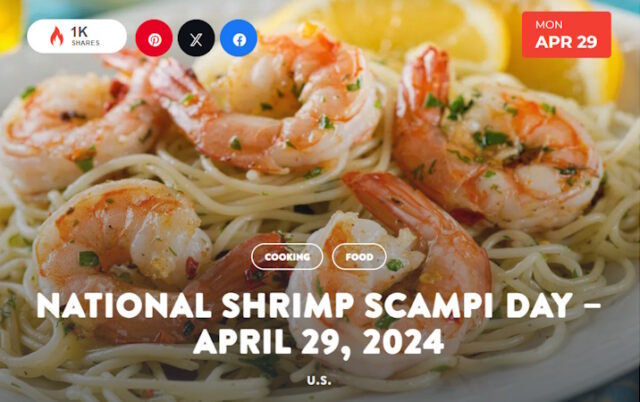
Shrimp scampi has different meanings around the world. In the U.S. “shrimp scampi” is the “menu name” for shrimp in Italian-American cuisine. Scampi’s served in garlic butter, dry white wine, and parmesan cheese — either with bread or over pasta or rice — although sometimes just the shrimp alone.
Most variants of “shrimp scampi” come on pasta. Consider National Shrimp Scampi Day on April 29 your opportunity to have this dish any way you like.
- The exact origins of National Shrimp Scampi Day are somewhat murky, with no clear record of who started it or why.
- 1920 – Shrimp scampi is first mentioned and printed in American cookbooks
- 1945 – Following World War II, shrimp scampi’s popularity boomed as Italian dishes became more mainstream.
- 1950s – The Norway lobster became popular in Britain and eventually replaced the Dublin Bay prawns.
- 2010 – The Fish Fight campaign, launched by Heston Blumenthal and Hugh Fearnley-Whittingstall, champions scampi as a better alternative source of protein.
- The word “scampi” means “shrimp”. Therefore, “shrimp scampi” is “shrimp shrimp”
- The pistol shrimp can deliver an explosive attack hotter than the surface of the sun and loud enough to rupture a human ear drum.
- Some shrimp are capable of glowing in the dark.
- Every shrimp is born male, and some develop into females.
- One billion pounds of shrimp are eaten every year by Americans.
- Over five billion pounds of shrimp are produced every single year.
- A shrimp can average about 6 inches while the longest ever found was at 16 inches.
- Ever wonder what shrimp eat? Most shrimp are omnivorous, but some are specialized for particular modes of feeding.
- Some shrimp can live as long as six and a half years, while some only live about a year or so.
- There are 16 different stages of life found in shrimp from egg to full adult.
- There are over 128 species of shrimp.
- Every shrimp is born a male and then becomes female as they mature.
- The average shrimp has 10 legs.
- The name for raw, uncooked shrimp is “green”.
- Shrimps are decapod crustaceans.
- They have elongated bodies.
- They also have a primarily swimming mode of locomotion.
- Shrimps are born from… eggs.
- A female shrimp may lay 1500 to 14000 eggs.
- Most shrimp live in saltwater but they also live in freshwater.
- A shrimp’s head and tail are also edible. However, most dishes serve shrimp without the shell. Even if you choose not to eat the shell, it can add flavor to a dish so leaving it on until you’re ready to eat is an option too.
- Shrimp scampi itself has Italian-American roots, evolving from the Italian dish “scampi,” which traditionally uses langoustines. When Italian immigrants brought the recipe to America, shrimp became a more accessible substitute, giving birth to the shrimp scampi we know today.
- Shrimp are also incredibly nutritious, packed with protein, vitamin D, vitamin B3, and zinc, making them a healthy addition to any diet.
- Shrimp have their hearts located in their heads, which is a fascinating tidbit that often surprises people.
Sources:

Disclaimer
Artificial Intelligence Disclosure & Legal Disclaimer
AI Content Policy.
To provide our readers with timely and comprehensive coverage, South Florida Reporter uses artificial intelligence (AI) to assist in producing certain articles and visual content.
Articles: AI may be used to assist in research, structural drafting, or data analysis. All AI-assisted text is reviewed and edited by our team to ensure accuracy and adherence to our editorial standards.
Images: Any imagery generated or significantly altered by AI is clearly marked with a disclaimer or watermark to distinguish it from traditional photography or editorial illustrations.
General Disclaimer
The information contained in South Florida Reporter is for general information purposes only.
South Florida Reporter assumes no responsibility for errors or omissions in the contents of the Service. In no event shall South Florida Reporter be liable for any special, direct, indirect, consequential, or incidental damages or any damages whatsoever, whether in an action of contract, negligence or other tort, arising out of or in connection with the use of the Service or the contents of the Service.
The Company reserves the right to make additions, deletions, or modifications to the contents of the Service at any time without prior notice. The Company does not warrant that the Service is free of viruses or other harmful components.