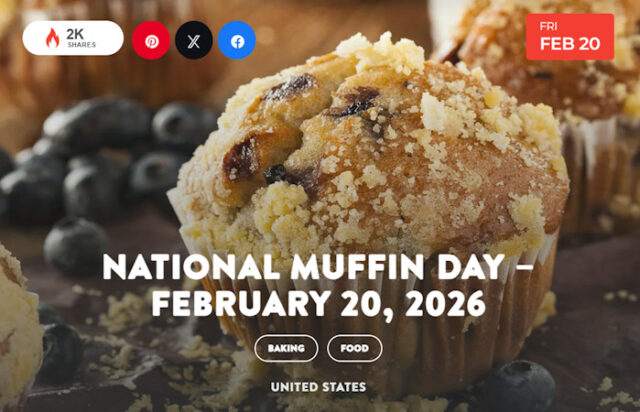
The beloved muffin deserves a day of its own, and for that, we have February 20. It’s National Muffin Day!
Who doesn’t like a big, tasty muffin to start their day in the morning? Muffins are an essential morning staple for many people (and great in the evenings too).
Muffin Day is an opportunity for you to celebrate everything you might love about muffins with the people around you.
- 10th – English muffins, which are yeast-raised and cooked on a griddle, date back to the 10th century in Wales.
- 18th Century – American muffins are ‘quick breads’ made in individual molds. Quick breads were not developed until the end of the 18th century.
- 1703 – Originally spelled “moofin”, the word muffin made its way into circulation and may have come from the German form of “muffen”, which is the plural form meaning small cakes. It also may have come from the French word “moufflet” which is used for soft baked goods.
- 18th century – In 18th- and 19th-century London, muffin sellers walked the streets, carrying trays of hot muffins on their heads or arms while ringing a handbell to attract customers. Their distinctive calls and bells became so common that local authorities occasionally tried to regulate the noise, and this tradition likely inspired the famous “Muffin Man” rhyme about a baked-goods vendor on Drury Lane.
- Do you know the Muffin Man? The Muffin Man, the Muffin Man. Do you know the Muffin Man Who lives in Drury Lane? The muffin man went door to door delivering English muffins along Drury Lane. Many households on Drury Lane had their food delivered. The rhyme was first published around 1820.
- 19th Century – Recipes for muffins are common in 19th-century American cookbooks.
- 1972 – The McDonald’s Egg McMuffin was introduced in 1972; it consists of American cheese, Canadian bacon, an English muffin, and an egg.
- 1997 – In an episode of “Dexter’s Laboratory,” Dexter’s dad goes crazy over muffins.
- 2013 – Feeling a burden for the sentiment against homeless people in his hometown of San Francisco, Jacob Kauffman decides to do a small thing by baking and handing out muffins on the street. He and others in his sphere donate to the local homelessness charity for everyone who joins the project by making and handing out muffins. Some people even began affectionately referring to him as “The Muffin Man.”
- 2015 – Created by Jacob Kauffman and Julia Levy, the idea came when the two met during an interview for Levy’s blog as she told the story of Kauffman and his habit of giving away muffins to hungry people each morning on his walk to work. The two collaborate to create the day.
- 2016 – Word about the day spreads quickly, and in its second year of existence, more than 100 people are involved in baking muffins and giving them away, a gift matched by Jacob Kauffman. The event takes place all over the world, including California, New York, Boston, Canada, and Hong Kong. Thousands of dollars are collected for charities supporting the homeless.
- American muffins are referred to as baked bread in small tins, while “English” Muffins are oven-baked, then cooked in a griddle.
- The word Muffin likely derives its name from the Old German word Muffen, the plural of Muffe meaning a small cake.
- American muffins are similar to a cupcake in size and cooking methods but cupcakes are almost always made with cake batter.
- English muffins are small, round, flat yeast-leavened bread that is commonly sliced horizontally, toasted, and buttered.
- American muffins have round bases, rounded tops, and are usually sweet, but there are also savory kinds (like cornbread muffins).
- Four U.S. states have adopted a State Muffin. (Massachusetts – Corn, Minnesota – Blueberry, New York – Apple, and Washington – Blueberry).
- Muffins are similar in size and cooking method to cupcakes, the main difference being that cupcakes tend to be frosted. Cupcakes are topped with creamy, American frosting. Usually, the fillings inside the muffins add enough excitement to the baked good.
- There’s English muffins, Portuguese muffins, American muffins, and so many hybrids (cruffins, duffins, muffin tops, and a whole lot more). If you don’t love one of them, you’re bound to find another that you do! And don’t even get us started on flavors: blueberry, cranberry orange, bran, chocolate chip. There’s a muffin for everyone.
Sources:

Just Fun Facts
Disclaimer
Artificial Intelligence Disclosure & Legal Disclaimer
AI Content Policy.
To provide our readers with timely and comprehensive coverage, South Florida Reporter uses artificial intelligence (AI) to assist in producing certain articles and visual content.
Articles: AI may be used to assist in research, structural drafting, or data analysis. All AI-assisted text is reviewed and edited by our team to ensure accuracy and adherence to our editorial standards.
Images: Any imagery generated or significantly altered by AI is clearly marked with a disclaimer or watermark to distinguish it from traditional photography or editorial illustrations.
General Disclaimer
The information contained in South Florida Reporter is for general information purposes only.
South Florida Reporter assumes no responsibility for errors or omissions in the contents of the Service. In no event shall South Florida Reporter be liable for any special, direct, indirect, consequential, or incidental damages or any damages whatsoever, whether in an action of contract, negligence or other tort, arising out of or in connection with the use of the Service or the contents of the Service.
The Company reserves the right to make additions, deletions, or modifications to the contents of the Service at any time without prior notice. The Company does not warrant that the Service is free of viruses or other harmful components.