Florida is currently a land of atmospheric extremes. After a winter season that felt more like mid-summer, the Sunshine State is grappling with a dramatic shift in weather patterns that has replaced near-record warmth with a biting chill. However, the cooling temperatures bring little relief to a state parched by an intensifying drought; instead, the arrival of dry, gusty winds is priming the landscape for a potentially volatile wildfire season.
Video courtesy of AccuWeather
The End of the 80-Degree Streak
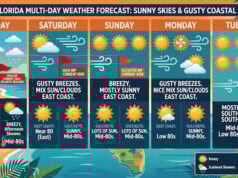
For much of February, Florida residents and tourists alike enjoyed a stretch of heat that pushed the limits of historical records. Cities like Orlando and Jacksonville saw the mercury climb well into the 80s this past Saturday, flirting with record highs and providing a tropical backdrop for the state’s many outdoor attractions.
That warmth came to an abrupt end as a potent cold front swept through the peninsula. While the front brought spotty showers to central and southern regions, the moisture was largely superficial. Any dampening of the vegetation was quickly undone by the northwest winds trailing the front. These winds acted as a massive atmospheric sponge, wicking away surface moisture and ushering in a much colder, denser air mass from the north.

By Monday, the transition was complete. High temperatures in Miami, which had been basking in the 80s as recently as Sunday, are projected to struggle to reach the 60s. For a region unaccustomed to sustained cold, the drop is more than just a statistical anomaly—it is a shock to the system.
A Freeze Threat in the “Sunshine State”
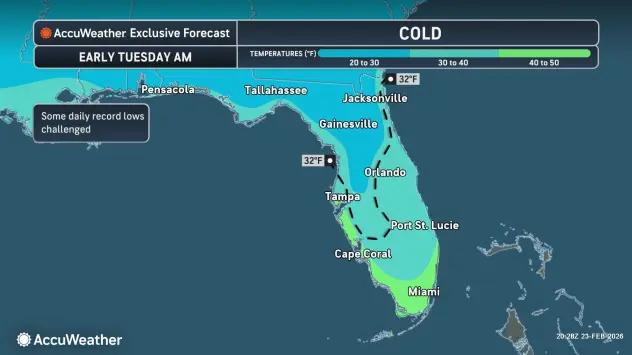
The most significant concern about the temperature drop is the risk of a freeze. From Monday night into Tuesday morning, the mercury is expected to plummet. Sub-freezing temperatures are forecasted for areas stretching from north of Orlando through the Florida Panhandle.
Agriculture is the lifeblood of rural Florida, and while meteorologists do not expect this cold snap to significantly damage the state’s iconic citrus crop, the threat to smaller-scale gardening and ornamental plants is real. Homeowners are being urged to cover sensitive vegetation or bring potted plants indoors. In the coldest pockets of the state, the AccuWeather RealFeel® temperatures are expected to dip into the 20s during the early morning hours, a harsh reality for those visiting theme parks who may have only packed for the beach.
The Powder Keg: Wildfire Risks Escalate
While the cold is grabbing the headlines, the more dangerous threat may be invisible: the plummeting humidity. The same northwest winds that bring the chill are also fueling a heightened wildfire risk. Florida is currently a powder keg of bone-dry brush and parched soil.
The fire risk is particularly acute across central and eastern Florida, specifically along the Interstate 95 corridor. This elevated danger follows a harrowing week in which a brush fire in Kissimmee decimated a local plant nursery, serving as a grim reminder of how quickly a spark can turn into a catastrophe under these conditions.
The technical metrics used by fire officials are flashing red. The Keetch-Byram Drought Index (KBDI), which measures moisture deficiency in the upper soil layers and the deep duff, is currently high across most of the state. In Southern Florida, these readings have entered the “very high to extreme” categories. When the KBDI reaches these levels, fire intensity increases significantly, making blazes much harder for ground crews to contain.
Drought Conditions Deepen
The current weather pattern is exacerbating a long-term moisture deficit. Data through February 19 shows that Jacksonville is experiencing its 18th-driest start to a year on record, with less than 2 inches of rain. Orlando is seeing an even more severe trend, marking its 13th-driest start to the year with a paltry 1.14 inches of precipitation.
The “extreme drought” category—the second-highest classification provided by drought monitors—has expanded by a staggering 62% across Florida in just the last month. This isn’t just a Florida problem; the drought footprint is expanding across the Southeast, with significant portions of Louisiana and Mississippi also reporting severe moisture shortages.
Safety Measures and the Outlook Ahead
Given the volatile conditions, experts are issuing a stern warning to the public. Through Tuesday, the use of open flames, power equipment that might emit sparks, or any outdoor burning is strongly discouraged. Something as seemingly minor as a discarded cigarette butt or a spark from a lawnmower blade hitting a rock could trigger a fast-moving wildfire in the current environment.
There is a small glimmer of hope on the horizon. By Tuesday, the winds are expected to relax, providing some relief to firefighters by slowing the potential spread of any new ignitions. On Wednesday, a slight increase in humidity should further dampen the fire risk. However, the core of the problem—the lack of significant rainfall—remains unaddressed.
Meteorologists note that meaningful rain is unlikely until the end of the week or perhaps next weekend. Even then, it may not be enough to break the “full throttle” drought currently gripping the state. According to AccuWeather’s long-range forecasting team, Florida is looking at a higher-than-average brush fire risk throughout the remainder of the spring.
Conclusion
Florida finds itself at a meteorological crossroads. The departure of the 80-degree heat offers a temporary break from the subtropical humidity, but it brings with it the twin dangers of a killing frost and a rampant fire threat. As residents reach for their coats and farmers prepare their covers, the state remains on high alert, waiting for the rains that are desperately needed to soak the scorched earth.
Disclaimer
Artificial Intelligence Disclosure & Legal Disclaimer
AI Content Policy.
To provide our readers with timely and comprehensive coverage, South Florida Reporter uses artificial intelligence (AI) to assist in producing certain articles and visual content.
Articles: AI may be used to assist in research, structural drafting, or data analysis. All AI-assisted text is reviewed and edited by our team to ensure accuracy and adherence to our editorial standards.
Images: Any imagery generated or significantly altered by AI is clearly marked with a disclaimer or watermark to distinguish it from traditional photography or editorial illustrations.
General Disclaimer
The information contained in South Florida Reporter is for general information purposes only.
South Florida Reporter assumes no responsibility for errors or omissions in the contents of the Service. In no event shall South Florida Reporter be liable for any special, direct, indirect, consequential, or incidental damages or any damages whatsoever, whether in an action of contract, negligence or other tort, arising out of or in connection with the use of the Service or the contents of the Service.
The Company reserves the right to make additions, deletions, or modifications to the contents of the Service at any time without prior notice. The Company does not warrant that the Service is free of viruses or other harmful components.