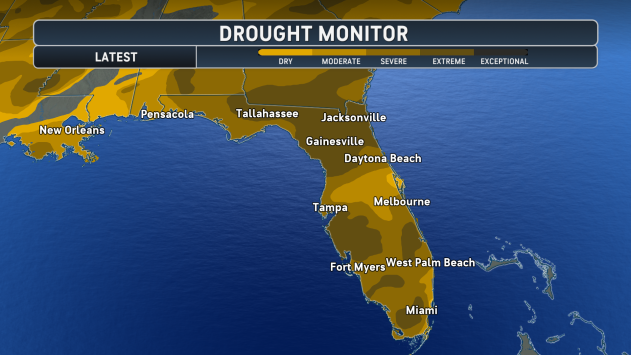
Florida, a state usually defined by its lush wetlands and predictable afternoon thunderstorms, is currently undergoing a dramatic and dangerous transformation. According to recent data from the U.S. Drought Monitor, a staggering 99% of the state is officially mired in a moderate drought or worse. The rapid deterioration of moisture levels has left the landscape brown, fueled an increase in wildfire activity, and pushed local officials to call for heightened water conservation efforts.
The statistics are jarring even for a region used to a distinct “dry season.” For much of the peninsula, the months between September and May typically see lower precipitation, but the current levels have plunged far below historical norms. “Almost the entire state had fallen into a drought by the middle of February, with nearly half of Florida experiencing extreme drought conditions,” weather experts noted, highlighting a complete reversal from the conditions seen just one year ago.
A Tale of Dry Cities
While the drought is widespread, specific cities serve as startling case studies for how little rain has actually fallen. Tampa, in particular, has become the poster child for the state’s parched conditions. Since the beginning of September, the city has measured a mere 5.25 inches (133.4 mm) of rain. Under normal circumstances, Tampa would expect over 16 inches during that same period. This represents the lowest rainfall total for the city since record-keeping began in the late 1890s.
Tallahassee, the state capital, is facing a similar crisis. Usually a recipient of over 21 inches of rain between September and mid-February, it has seen only about 8 inches this season—just 38% of its normal capacity. This marks the second-lowest value recorded in the city in over 130 years.

“Multiple cities across the state are running three-digit rainfall deficits,” meteorologists report. The lack of rain is exacerbated by unseasonably warm temperatures, which increase evaporation rates and strip whatever moisture remains from the topsoil.
The Paradox of Florida Rainfall
AccuWeather has recently highlighted a growing paradox in Florida’s changing climate. While the total annual rainfall in some regions has not shifted dramatically over decades, the way that rain falls has changed. Heavy downpours and tropical deluges are becoming more frequent, while the steady, productive showers that the ecosystem relies on are disappearing.
“Total rainfall across the United States has actually diminished a little bit,” said Brett Anderson, AccuWeather Senior Meteorologist. “But extreme rainfall—events of three or four inches over 24 hours—we’ve seen a significant uptick in those types.”
This shift is problematic for a drought-stricken state. When rain falls too quickly on ground that has been compacted and hardened by drought, it cannot soak in. Instead, the water runs off into drainage systems, rivers, and eventually the ocean, carrying fertilizers and pollutants with it. This runoff doesn’t just fail to quench the soil; it can actually trigger ecological disasters like red tide in coastal waters. To truly break the current drought, Florida needs weeks of consistent, gentle “soaker” rains rather than the violent storms the state is prone to.
Wildfire and Economic Risks
The environmental impact is already visible. The Florida Forest Service recently reported over 130 active wildfires across the state, burning nearly 19,000 acres. The Keetch-Byram Drought Index (KBDI), which measures the dryness of the soil on a scale from 0 (saturated) to 800 (desert-like), shows widespread values exceeding 500 across 34 counties. Once the index passes 500, fire danger increases significantly, and deep-burning fires become harder to extinguish.
Agriculture is also on the front lines. Farmers in Southwest Florida are struggling to keep crops hydrated as irrigation sources dwindle and the soil loses its ability to hold moisture. In urban areas like Miami-Dade and Monroe counties, the drought is being described as the worst in 25 years, prompting a renewed focus on infrastructure and the long-term sustainability of the state’s water supply.
Looking Toward the Horizon
The short-term forecast offers little hope for a quick fix. While occasional cold fronts may bring scattered showers to North Florida, long-range outlooks from the U.S. Climate Prediction Center suggest that below-normal rainfall will likely persist through the spring.
Florida’s rainy season typically doesn’t kick into high gear until June, when sea breezes and tropical moisture return in earnest. Until then, the state remains in a precarious waiting game. With 99% of the territory under drought conditions, residents are being urged to strictly follow local watering restrictions. As the “Sunshine State” lives up to its name a bit too well this year, the focus remains on the sky, waiting for the relief that only a long, wet summer can provide.
Source: AccuWeather
Disclaimer
Artificial Intelligence Disclosure & Legal Disclaimer
AI Content Policy.
To provide our readers with timely and comprehensive coverage, South Florida Reporter uses artificial intelligence (AI) to assist in producing certain articles and visual content.
Articles: AI may be used to assist in research, structural drafting, or data analysis. All AI-assisted text is reviewed and edited by our team to ensure accuracy and adherence to our editorial standards.
Images: Any imagery generated or significantly altered by AI is clearly marked with a disclaimer or watermark to distinguish it from traditional photography or editorial illustrations.
General Disclaimer
The information contained in South Florida Reporter is for general information purposes only.
South Florida Reporter assumes no responsibility for errors or omissions in the contents of the Service. In no event shall South Florida Reporter be liable for any special, direct, indirect, consequential, or incidental damages or any damages whatsoever, whether in an action of contract, negligence or other tort, arising out of or in connection with the use of the Service or the contents of the Service.
The Company reserves the right to make additions, deletions, or modifications to the contents of the Service at any time without prior notice. The Company does not warrant that the Service is free of viruses or other harmful components.