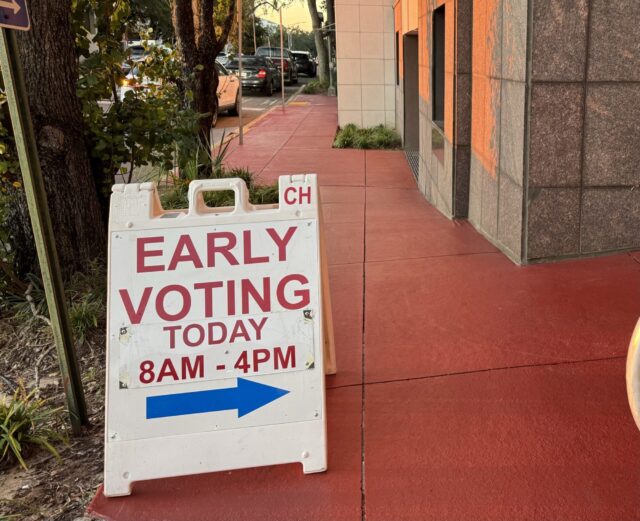
An election bill that would require proof of American citizenship to vote and limit the kinds of identification voters could show at the polls was approved in the Republican-controlled Florida House on Wednesday. The vote was 88-31, along party lines.
The bill (HB 991) is similar to the citizenship requirement in the Safeguard American Voters Eligibility (SAVE America) Act, the federal legislation advocated by President Trump that passed the U.S. House of Representatives two weeks ago.
Advocates say it’s necessary to ensure that non-citizens aren’t eligible to vote in the Sunshine State, but voter rights groups and Democrats contend there has been little evidence of such fraud. The bill, they say, will disenfranchise an unknown number of registered voters in Florida.

The bill also removes student IDs as an acceptable form of identification when voting at the polls — language not included in the companion bill moving through the Florida Senate.
Rep. Jenna Persons-Mulicka, R-Fort Myers, is the bill’s sponsor. She said voters would not have to provide proof of citizenship when they actually register to vote, but only if information is relayed back to their local supervision of elections that they are not a U.S. citizen and must provide proof of citizenship.
“Just as the SAVE America Act is common sense, this election integrity bill is common sense,” she said. “Floridians want election integrity. They want to ensure that only U.S. citizens vote. They want to ensure that only proper forms of voter ID is allowed. They want to fight back against foreign influence in our elections.”
The proposal moving through both chambers of the Legislature says that the U.S. citizenship status of every Florida voter would need to be verified through Florida Department of Highway Safety and Motor Vehicles records before their voter registration is considered valid. Applicants must prove citizenship by providing a REAL ID-compliant driver’s license, a birth certificate, a valid passport, or another acceptable method.
Democrats say that could be a problem for voters having trouble accessing any of those personal documents. After a similar law in Kansas was stuck down by the courts, they note, it was revealed in litigation that the legislation resulted in blocking the voter registrations of more than 31,000 U.S. citizens who were otherwise eligible to vote.
Jim Crow
Rep. Ashley Gantt, D-Miami, introduced an amendment that she said would address people like her aunt, who she said was born at home in South Carolina during the Jim Crow era and was never issued a birth certificate.
“As written, the bill will block eligible U.S. citizens from registering to vote and remove longtime voters from the rolls. This is reality, not conjecture,” she said.
“It will force additional paperwork and red tape on voters who don’t have a Florida driver’s license or a state ID and impose burdensome documentation requirements on any voter without a passport or Florida REAL ID, disproportionately affecting students, seniors, and people with disabilities.”
An analysis by the Bipartisan Policy Center of The Heritage Foundation’s Election Fraud Cases database found 77 instances of noncitizen voting between 1999 and 2023, each of which was investigated by the appropriate authorities.
Last year, Florida found 198 “likely noncitizens who illegally registered and/or voted in Florida” out of the more than 13 million people on its voter rolls, according to a report from the state’s Office of Election Crimes and Security. The office referred 170 of them to state and federal law enforcement for further investigation and prosecution. The remaining 28 individuals were referred to the Division of Elections for list maintenance.
Among the forms of identification voters would no longer be allowed to produce at the polls are student IDs, retirement center IDs, U.S. uniformed services or Merchant Marine Military IDs, and debit or credit cards.
Rep. Anna Eskamani, D-Orlando, said there was “no legitimate reason” to ban student IDs unless the point was to make it “more difficult for a student to vote.”
“It says later on in the bill that all government IDs are accepted except public higher institutions,” she said. “So, I’m forced to draw the conclusion that we just want to make it harder for students to vote.”
The bill sponsors say use of REAL ID-compliant driver’s licenses would address citizenship concerns with the state and note that the Highway Safety reported last year that 99% of Floridians with either driver’s licenses or ID licenses were REAL ID-compliant.
What happens in November?
Rep. Alex Rizo, R-Miami, is the son of Cuban immigrants. He spoke passionately about the need to ensure fair elections.
“When we talk about election integrity, folks, let me tell you something — there are people who represent districts here, you don’t have to go far, [who are] one generation away from tyranny. One generation away from a democracy stolen in the name of elections! Of free elections! Let’s let people vote regardless — it doesn’t matter if they vote once, twice, three times, it’s okay. And so, that’s why I’m very proud that I’m going to be voting up on this bill and that our elections are safe and will continue to be safe.”
The bill also says that by July 1, 2027, a driver’s license or Florida identification card of a U.S. citizen must include the immigration status of the licensee as last recorded in the system at the time of issuance or renewal.
Most provisions of the House version of the bill would go into effect in January 2027. However, its Senate companion, awaiting a vote in that chamber, would go into effect in July, before the November midterm elections.
Disclaimer
Artificial Intelligence Disclosure & Legal Disclaimer
AI Content Policy.
To provide our readers with timely and comprehensive coverage, South Florida Reporter uses artificial intelligence (AI) to assist in producing certain articles and visual content.
Articles: AI may be used to assist in research, structural drafting, or data analysis. All AI-assisted text is reviewed and edited by our team to ensure accuracy and adherence to our editorial standards.
Images: Any imagery generated or significantly altered by AI is clearly marked with a disclaimer or watermark to distinguish it from traditional photography or editorial illustrations.
General Disclaimer
The information contained in South Florida Reporter is for general information purposes only.
South Florida Reporter assumes no responsibility for errors or omissions in the contents of the Service. In no event shall South Florida Reporter be liable for any special, direct, indirect, consequential, or incidental damages or any damages whatsoever, whether in an action of contract, negligence or other tort, arising out of or in connection with the use of the Service or the contents of the Service.
The Company reserves the right to make additions, deletions, or modifications to the contents of the Service at any time without prior notice. The Company does not warrant that the Service is free of viruses or other harmful components.