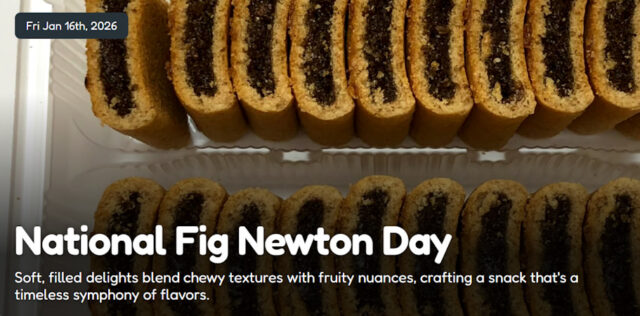
You either love ‘em or you hate ‘em. But you can’t deny their popularity. Fig Newtons have remained a much-loved pastry for over a century, so no wonder they get their own day. January 16 is National Fig Newton Day, and we know you can’t wait to enjoy a few in celebration.
- 11,400 Years ago – Archaeological evidence suggests that figs were among the first domesticated crops, cultivated in the Jordan Valley around 11,400 years ago, highlighting their significance in early agriculture.
- Ancient Mediterranean Era – Figs were a staple crop in ancient Mediterranean economies, used extensively in diets and as an economic commodity, underscoring their central role in ancient societies.
- 9400 BC – Parthenocarpic figs, dating back to 9400–9200 BCE, were found at Gilgal I, suggesting they were intentionally cultivated, marking a shift in ancient agricultural practices.
- Biblical Times – Figs are frequently mentioned in the Bible and other ancient texts, symbolizing prosperity and peace, and were central to cultural and religious practices in ancient societies.
- 19th century – Many physicians believed most illnesses were related to digestive problems. As a remedy, they recommended a daily intake of biscuits and fruit. Fig rolls served as an ideal solution to their advice, as they remained a locally produced, handmade product.
- 1889 – William Moore of New York bought out eight bakeries to start the New York Biscuit Company (including Kennedy Biscuit). In 1890, Chicago-based Adolphus Green began the American Biscuit Company by merging 40 midwestern bakeries.
- 1891 – Philadelphia baker and fig-lover, Charles Roser, invented and patented the machine, which inserted fig paste into a thick pastry dough.
- 1891 – The Philadelphia bakery produced the first Fig Newtons. The company named the pastries after the town of Newton, Massachusetts.
- 1898 – Moore and Green merged in 1898, making the National Biscuit Company, or N.B.C. Among the purchases were the machines of Mitchell and Roser’s cookie recipe.
- 1901 – Mitchell’s machine for sugar wafers was also purchased; N.B.C. started mass-producing sugar wafers in 1901. Both Mitchell and Roser walked away wealthy.
- 1991 – Fig Newton Day festivities were enjoyed by thousands who celebrated in the Boston suburb with free cookies and more entertainment on the 100th anniversary of the cookie’s creation.
- 1997 – Fig Newtons are NOT the Massachusetts state cookie, having been beaten by another famous cookie in 1997 – the Chocolate Chip Cookie.
- 2012 – Nabisco dropped the word “Fig” from the product’s name.
- The Cambridgeport, MA-based Kennedy Biscuit Company then purchased Roser’s recipe. They began mass production after purchasing the recipe.
- They had named many of their other cookies for nearby towns and almost called it the “Fig Shrewsbury” before Newton won.
- Fig Newtons were among the first commercially baked products in America.
- Because of the lowly Fig Newton, the legendary Nabisco baking company had its roots.
- Fig Newtons are the 3rd most popular cookie in the U.S., and over 1 billion are consumed each year.
- Fig Newtons were for sale for over 130 years before they were known as cookies.
- Currently, Nabisco manufactures strawberry, apple cinnamon, raspberry, cherry, and blueberry Newton flavors, none of which sell a fraction of the original fig variety due to brand awareness and their comparative lack of sex appeal.
- Some flavors included Fig Newtons Bars, Raspberry & Yogurt, Strawberry Kiwi Fruit, Strawberry Shortcake Cookies, and more. These have all been discontinued.
Sources:

Disclaimer
Artificial Intelligence Disclosure & Legal Disclaimer
AI Content Policy.
To provide our readers with timely and comprehensive coverage, South Florida Reporter uses artificial intelligence (AI) to assist in producing certain articles and visual content.
Articles: AI may be used to assist in research, structural drafting, or data analysis. All AI-assisted text is reviewed and edited by our team to ensure accuracy and adherence to our editorial standards.
Images: Any imagery generated or significantly altered by AI is clearly marked with a disclaimer or watermark to distinguish it from traditional photography or editorial illustrations.
General Disclaimer
The information contained in South Florida Reporter is for general information purposes only.
South Florida Reporter assumes no responsibility for errors or omissions in the contents of the Service. In no event shall South Florida Reporter be liable for any special, direct, indirect, consequential, or incidental damages or any damages whatsoever, whether in an action of contract, negligence or other tort, arising out of or in connection with the use of the Service or the contents of the Service.
The Company reserves the right to make additions, deletions, or modifications to the contents of the Service at any time without prior notice. The Company does not warrant that the Service is free of viruses or other harmful components.