NEW YORK — A federal jury has convicted Asif Merchant, a trained operative of the Iranian government’s Islamic Revolutionary Guard Corps (IRGC), on charges of murder-for-hire and attempting to commit an act of terrorism transcending national boundaries. The verdict, delivered in the Eastern District of New York, marks the conclusion of a high-stakes counterterrorism investigation that thwarted a plot to assassinate U.S. government officials, including President Donald Trump.
Merchant, also known as “Asif Raza Merchant,” was revealed during the trial to be a deeply embedded asset of the IRGC, a designated foreign terrorist organization. Evidence presented by prosecutors painted a chilling picture of a state-sponsored mission to sow chaos on American soil through targeted killings, document theft, and orchestrated civil unrest.
A Mission Born in Tehran
The recruitment of Merchant began in late 2022. According to trial testimony, Merchant was groomed by IRGC handlers in Pakistan and Iran, where he received specialized training in tradecraft and countersurveillance. By 2023, he was dispatched to the United States with an initial mandate to scout for potential recruits who could serve as “sleeper cells.”
Merchant’s mission escalated significantly in 2024. He testified that his handlers sent him back to the U.S. with a directive to engage “Mafia” types to execute a three-pronged attack: stealing sensitive documents or digital drives from targets’ homes, organizing disruptive protests at political rallies, and culminating in the assassination of high-ranking political figures.

The Sting Operation
Merchant’s undoing began when he reached out to an acquaintance in New York, Nadeem Ali, whom he believed would facilitate the criminal enterprise. Instead, Ali immediately alerted federal authorities and began working as a confidential source for the FBI.
In June 2024, during a recorded meeting in New York, Merchant signaled the gravity of his intent. Using a “finger gun” gesture, he clarified that his “opportunity” for Ali involved killing targets within the United States. He specifically sought individuals capable of navigating heavy security details, noting that the targets would have “security all around” them.
The FBI subsequently introduced Merchant to purported hitmen who were, in reality, undercover law enforcement officers. During these meetings, Merchant detailed his requirements: he wanted document theft, protests, and the “killing of a political person.” He informed the undercover officers that the specific identity of the assassination target would be relayed via code words once Merchant had safely exited the United States.
Financial Ties and Arrest
To cement the deal, Merchant arranged for a $5,000 cash advance to be sent from an overseas source. On June 21, 2024, he met the undercover officers to deliver the payment. When one officer remarked, “Now we’re bonded… we’re doing this,” Merchant replied, “Yes, absolutely.”
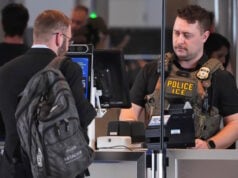
While finalizing the logistics, Merchant was observed conducting internet searches for political rally locations and reporting security protocols back to his IRGC handler in Iran. His stay in the U.S. ended abruptly on July 12, 2024. As he prepared to board a flight to leave the country, federal agents moved in and placed him under arrest.
Reax from Washington
The conviction drew sharp rebukes of Iranian state-sponsored terrorism from top U.S. officials.
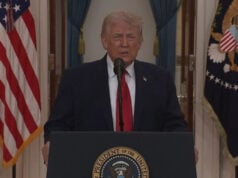
“This man landed on American soil hoping to kill President Trump — instead, he was met with the might of American law enforcement,” said Attorney General Pamela Bondi. She emphasized that the Department of Justice remains “ever-vigilant” in halting such acts before they can be realized.
FBI Director Kash Patel noted that this was not an isolated incident. “This was not the first attempt by Iran to harm our citizens on U.S. soil; the other efforts also failed,” Patel said. “Let this verdict serve as a reminder that the FBI is committed to detecting such threats and preventing acts of violence.”
Assistant Attorney General for National Security John A. Eisenberg added that Merchant’s plot “struck at the heart of our democracy,” while U.S. Attorney Nocella for the Eastern District of New York declared the failure of the IRGC’s scheme “complete.”
Legal Aftermath
The investigation was a massive multi-agency effort, involving FBI field offices from Dallas to Boston, the NYPD, and U.S. Customs and Border Protection. Merchant now faces a maximum sentence of life in prison.
The case serves as a stark reminder of the persistent threat posed by foreign adversaries seeking to interfere with the American democratic system through violence. As Merchant awaits sentencing, the Department of Justice continues to monitor the “pernicious threat” of the IRGC’s global operations.
Disclaimer
Artificial Intelligence Disclosure & Legal Disclaimer
AI Content Policy.
To provide our readers with timely and comprehensive coverage, South Florida Reporter uses artificial intelligence (AI) to assist in producing certain articles and visual content.
Articles: AI may be used to assist in research, structural drafting, or data analysis. All AI-assisted text is reviewed and edited by our team to ensure accuracy and adherence to our editorial standards.
Images: Any imagery generated or significantly altered by AI is clearly marked with a disclaimer or watermark to distinguish it from traditional photography or editorial illustrations.
General Disclaimer
The information contained in South Florida Reporter is for general information purposes only.
South Florida Reporter assumes no responsibility for errors or omissions in the contents of the Service. In no event shall South Florida Reporter be liable for any special, direct, indirect, consequential, or incidental damages or any damages whatsoever, whether in an action of contract, negligence or other tort, arising out of or in connection with the use of the Service or the contents of the Service.
The Company reserves the right to make additions, deletions, or modifications to the contents of the Service at any time without prior notice. The Company does not warrant that the Service is free of viruses or other harmful components.