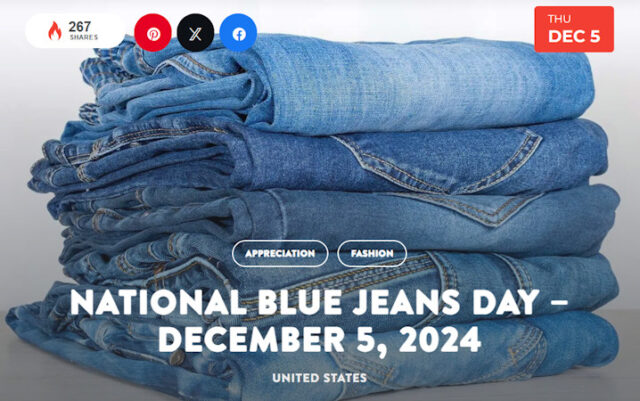
National Blue Jeans Day is on December 5. Jeans are one of the cornerstones of Western fashion. Every American is estimated to own seven pairs of jeans. Since its introduction in the 1800s, denim has proved to be one of the most versatile, durable, and iconic clothing items.
They’re worn by people of all ages and from all backgrounds. Jeans have undergone dozens of changes over the years — from long and baggy to short and tight, dark to light, colorful to faded. Few clothes have such a variety of aesthetic options than denim jeans.
- 1500s – Blue jeans originated from the harbor of Genoa during the Renaissance era, designed as part of the uniform for the Genoese navy, which needed durable pants for its sailors.
- 1874 – Tailor Jacob Davis and businessman Levi, the founder of Levi’s jeans, received patent #139,121 from the U.S. Patent and Trademark Office.
- This patent allowed them to place metal rivets in men’s work pants for the first time.
- 1930s – Jeans slowly went mainstream in the 1930s. Thanks to Western films with cowboys in jeans, ordinary Americans began to embrace this blue-collar outfit as part of their everyday fashion
- 1936 – a label was sewn onto an item of clothing for the first time. It was a red flag sewn next to the back pocket of a pair of Levi’s.
- 1940s – American soldiers during World War II wore jeans when off-duty, introducing them to other countries and boosting their global popularity.
- 1950 – The iconic but straightforward blue jeans and white shirt combination goes mainstream, popularized by stars like Marlon Brando, James Dean, and Brigitte Bardot.
- 1950s – blue jeans were banned in schools, theaters, and restaurants because they symbolized rebellion against conventional social norms.
- 1951 – popular singer Bing Crosby was refused a hotel room because he was wearing jeans. In response, Levi’s designed a denim jacket especially for him.
- 1957 – Actress Brigitte Bardot was one of the first women to wear jeans in 1957.
- 1960 – Baby Boomers adopt the term ‘jeans,’ changing the name of this clothing item formerly known as ‘waist overalls.’
- 1960s – Jeans shift to a more flared bottom look; once again, celebrities like Cher, Jimi Hendrix, and Mick Jagger play a significant role in making this style famous.
- 1990s – National Blue Jeans Day was established in the late 1990s by a company called Cotton Incorporated, to celebrate this iconic piece of clothing.
- 1990s – The 90s are characterized by baggy jeans, largely thanks to the influence of hip-hop artists who wear oversized clothes.
- 1998 – The oldest pair of jeans to be discovered was found in 1998 down an old mine. According to the date, they were 115 years old.
- 20th Century – In the early 20th century, women’s jeans had side zippers, distinguishing them from men’s jeans, which had front zippers.
- 2000s – Jeans take on a slimmer, body-hugging style with darker colors.
- 2001 – President George W. Bush decided that staff in the Oval Office could no longer wear jeans.
- Paintings from the 17th century depict peasants wearing blue fabric trousers, suggesting early versions of blue jeans existed long before Levi Strauss’s patent.
- Blue jeans symbolize informality, rugged individualism, and classless respect for hard work.
- Blue jeans originated from Genoa, Italy, and the term ‘blue jeans’ is a corrupted English version of the French ‘bleu de Gênes,’ which means the ‘blue of Genoa.’
- Each year in the U.S., 450 million pairs of jeans sell out.
- Despite their massive popularity in the U.S., over 50% of the denim used to make jeans comes from Asia, specifically China, Bangladesh, and India.
- The word “denim” comes from “serge de Nîmes,” a sturdy fabric made in Nîmes, France.
- Approximately 225 pairs of jeans can be produced from a single bale of cotton.
- We’re used to seeing blue jeans, but the color is created using indigo dye. Indigo was the best color to hide any dirt that got onto the clothing, and it was ideal for miners and sailors.
- If you’ve ever wondered why the inside of denim garments is white, it’s because only the outside (warp) is dyed indigo. The weft (interior) is not.
- Each person in America owns an average of 7 pairs of jeans.
- Levi Strauss, the creator of the famous brand Levi’s, never wore a pair of his own jeans. He was a wealthy businessman, and jeans were made for poor people.
- Jeans have been featured in several songs by popular artists over the years. Lana Del Rey released “Blue Jeans” in 2012, and Neil Diamond released “Forever in Blue Jeans” in 1979.
- One of the common features of Levi’s jeans is orange stitching, which is sometimes seen on them. This was first used to match the copper rivets that were first used on jeans.
Sources:

Disclaimer
Artificial Intelligence Disclosure & Legal Disclaimer
AI Content Policy.
To provide our readers with timely and comprehensive coverage, South Florida Reporter uses artificial intelligence (AI) to assist in producing certain articles and visual content.
Articles: AI may be used to assist in research, structural drafting, or data analysis. All AI-assisted text is reviewed and edited by our team to ensure accuracy and adherence to our editorial standards.
Images: Any imagery generated or significantly altered by AI is clearly marked with a disclaimer or watermark to distinguish it from traditional photography or editorial illustrations.
General Disclaimer
The information contained in South Florida Reporter is for general information purposes only.
South Florida Reporter assumes no responsibility for errors or omissions in the contents of the Service. In no event shall South Florida Reporter be liable for any special, direct, indirect, consequential, or incidental damages or any damages whatsoever, whether in an action of contract, negligence or other tort, arising out of or in connection with the use of the Service or the contents of the Service.
The Company reserves the right to make additions, deletions, or modifications to the contents of the Service at any time without prior notice. The Company does not warrant that the Service is free of viruses or other harmful components.