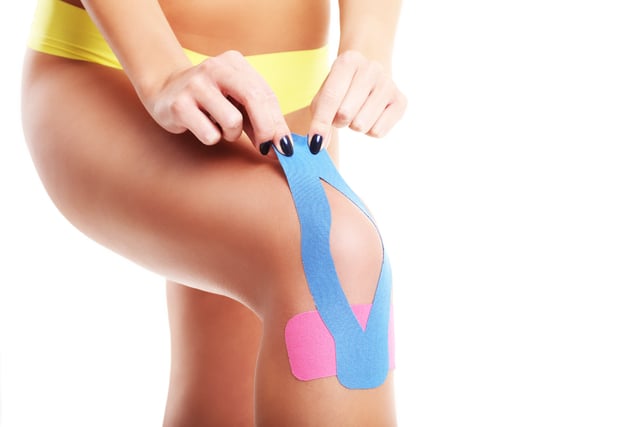
If you’ve ever played or watched sports, you’ve probably seen kinesiology therapeutic tape, also known as KT tape. The colorful, stretchy athletic tape is a popular remedy for muscle and joint pain, especially for areas like your shoulders, back, knees, and ankles. However, new research published in BMJ Evidence-Based Medicine has called its effectiveness into question.
How is KT Tape Supposed to Work?
KT tape is used to support muscles and joints while still allowing full movement, according to Shayan Ghadamabadi, DPT, a physical therapist with MSU Health Care. “It works by gently lifting the skin, which helps reduce pressure, improve blood and lymphatic flow, and decrease swelling and bruising,” he told Health. “The tape also provides sensory feedback that can reduce pain and improve muscle activation and body awareness during movement.”
It’s popular among professional and recreational athletes alike, because “it’s a low-cost, low-risk option for treating musculoskeletal injuries,” said Shane Davis, MD, a non-operative sports medicine physician at Tufts Medical Center. While it’s been around since the ’70s, KT tape surged in popularity after the 2008 Olympics, where it received a lot of high-profile exposure from athletes, Davis added.
What the Study Found
For muscle and joint issues, there’s no strong evidence that KT tape actually works for long-term recovery or significant physical improvement, the new research found. Additionally, KT tape can cause skin irritation and itching where the adhesive touches the skin.

There is a silver lining, however. The tape may provide a small reduction in pain and a slight improvement in movement right after it’s applied, and potentially for the next few days.
The researchers looked at 128 systematic reviews of randomized controlled trials (the gold standard in research) on the clinical effects of KT tape, including a total of 15,812 participants.
The main limitation of the new study is that the researchers used mathematical formulas to determine what counts as a “meaningful improvement” for patients, but these formulas don’t always match how people actually feel.
Additionally, the researchers looked at all the randomized controlled trials together, regardless of which body parts were taped or which taping technique was used, noted Brad R. Erler, PT, DPT, MS, ATC, a physical therapist at the Hospital for Special Surgery.
“I’d be interested to see if the results change if [the researchers] look at those groups individually or if they compare specific taping techniques,” he told Health. “But because they are looking at all body parts and all taping techniques as one large group, I think the results can get a little less defined and meld together.”
Why KT Tape Might Not Be Very Effective
This isn’t the first study to find the effectiveness of KT tape inconclusive. A 2012 systematic review, which examined 727 articles, reached a similar conclusion: insufficient evidence to support the use of KT tape, with a potential perceived benefit among patients.
So why might KT tape actually be less effective than people think? Even though it can provide helpful short-term effects like pain relief and support, it often doesn’t address the underlying cause of an injury, Ghadamabadi said. “Relying on it alone for a persistent issue can make it more of a temporary ‘band-aid’ rather than a true solution,” he said.
What’s more, if you’re applying KT tape yourself without the help of a trained professional, there’s a chance you’ll do it incorrectly, which can have a negative impact, or no effect at all, according to Martha Munsell, AT, ATC, an athletic trainer with the MSU Health Care Sports Medicine Community Athletic Training Program.
Should You Stop Using KT Tape?
Despite the study’s findings, experts still think there can be a use for KT tape, such as helping with swelling or low-grade muscle and tendon injuries.
“When combined with appropriate exercise and rehabilitation, KT tape can be beneficial by allowing individuals to move more comfortably and stay active during recovery,” Ghadamabadi said.
Aside from physical recovery, there’s also a potential mental benefit, Erler said. “As we saw in this study, it may only help in the short term, but maybe a person needs just a little help to get them over a hump or to get through their exercises. Maybe we can take advantage of that placebo effect,” he said. “If we tape someone and they feel better, perhaps they can be more confident in using their arm or leg when they’re playing in a game or doing their activity.”
KT tape won’t stabilize more severe injuries, like a dislocated shoulder or a newly sprained ankle, Erler said. In those cases, more rigid tape or a brace would be more beneficial—and always consult a healthcare provider to treat an injury. But Erler said he doesn’t see KT tape going anywhere.
Disclaimer
Artificial Intelligence Disclosure & Legal Disclaimer
AI Content Policy.
To provide our readers with timely and comprehensive coverage, South Florida Reporter uses artificial intelligence (AI) to assist in producing certain articles and visual content.
Articles: AI may be used to assist in research, structural drafting, or data analysis. All AI-assisted text is reviewed and edited by our team to ensure accuracy and adherence to our editorial standards.
Images: Any imagery generated or significantly altered by AI is clearly marked with a disclaimer or watermark to distinguish it from traditional photography or editorial illustrations.
General Disclaimer
The information contained in South Florida Reporter is for general information purposes only.
South Florida Reporter assumes no responsibility for errors or omissions in the contents of the Service. In no event shall South Florida Reporter be liable for any special, direct, indirect, consequential, or incidental damages or any damages whatsoever, whether in an action of contract, negligence or other tort, arising out of or in connection with the use of the Service or the contents of the Service.
The Company reserves the right to make additions, deletions, or modifications to the contents of the Service at any time without prior notice. The Company does not warrant that the Service is free of viruses or other harmful components.