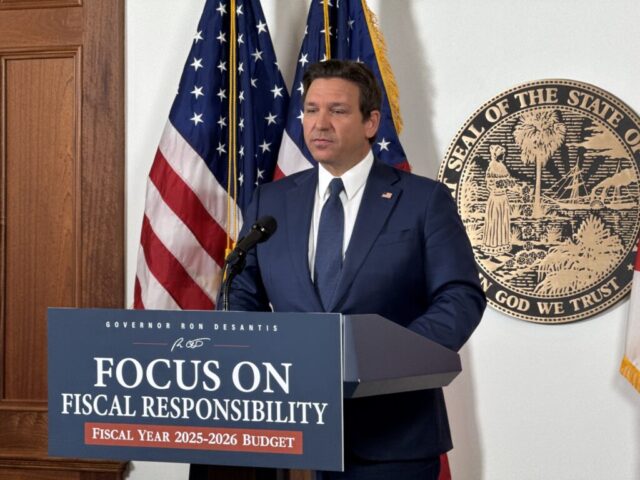
Gov. Ron DeSantis is directing Florida’s top higher education board to prevent state universities from hiring foreign specialty workers, he announced Wednesday.
At a Tampa press conference, DeSantis said the Board of Governors should fully “pull the plug” on the visas that allow foreigners in a specialty occupation to temporarily work in the United States, called H1-B visas. This comes a month after President Donald Trump announced a $100,000 fee for future H1-B visa applications amid his administration’s broader efforts to stop illegal immigration and roadblock non-Americans from working in the U.S.
“I’m directing today the Florida Board of Governors to pull the plug on the use of these H1-B visas in our universities,” DeSantis said, likening their usage to “indentured servitude” and deriding how “troubling” it is that Florida universities are relying on cheaper labor — especially as workers nationwide are experiencing increased layoffs due to artificial intelligence, a DOGE-style of thinking, and federal furloughs.

“We can do it with our residents in Florida or with Americans, and if we can’t do it, then man—we need to really look deeply about what is going on with this situation,” he continued.
He then rattled off a list of assistant professors, coaches, data analysts, coordinators, marketers, and more university workers on H1-B visas from areas like the United Kingdom, China, Spain, Canada, Trinidad and Tobago, Russia, Poland, Albania, Argentina, and the West Bank, appearing increasingly incredulous at how these various positions were deemed specialty occupations.
The Phoenix was unable to independently verify the list of professors and their countries of origin.
“Why aren’t we producing math and engineering folks who can do this?” DeSantis questioned, after claiming one college had a power systems researcher from Wuhan, China. “[There’s] a clinical assistant professor from supposed Palestine. Why are they—is that just social justice that they’re doing?”
As of June 30, 2025, there were more than 1,900 Florida employers sponsoring over 7,200 H1-B visa holders, according to the USCIS. There were a total of 78 employers and 677 beneficiaries in the education sphere, with the University of Florida boasting the most H1-B beneficiaries at 156, followed by the University of Miami with 90, and the University of South Florida with 72.
These schools also have the three largest medical programs in the state. Thousands of H1-B visas nationwide are used by foreign physicians, although the majority of H1-B recipients are in the tech industry.
H1-B visas have become a flashpoint in Republican circles, as party leaders like Trump and DeSantis urge less reliance on foreign labor while others insist that businesses need workers, NOTUS reported.
The conversation erupted as an offshoot from the larger discussion on illegal immigration and America-first businesses, two of Trump’s top priorities during his 2024 presidential campaign and the subject of many of his day one executive orders. In the immigration sphere, Trump has ordered mass deportations, increased ICE presence, and allocated federal dollars to states assisting in detention efforts of migrants illegally in the country — led by Florida under DeSantis.
This comes after Trump — in the early days of his term — stood alongside Elon Musk as they touted the new Department of Governmental Efficiency to cut down on alleged excesses in spending. This led to thousands of firings across federal agencies.
Just as Florida reflected the national model on immigration onto the state level, DeSantis also created a state-level DOGE to audit state universities and local governments to search for waste, fraud, and abuse. That torch has been taken up by Chief Financial Officer Blaise Ingoglia, who’s unofficially renamed the task force the Florida Agency for Fiscal Oversight, or FAFO.
Disclaimer
Artificial Intelligence Disclosure & Legal Disclaimer
AI Content Policy.
To provide our readers with timely and comprehensive coverage, South Florida Reporter uses artificial intelligence (AI) to assist in producing certain articles and visual content.
Articles: AI may be used to assist in research, structural drafting, or data analysis. All AI-assisted text is reviewed and edited by our team to ensure accuracy and adherence to our editorial standards.
Images: Any imagery generated or significantly altered by AI is clearly marked with a disclaimer or watermark to distinguish it from traditional photography or editorial illustrations.
General Disclaimer
The information contained in South Florida Reporter is for general information purposes only.
South Florida Reporter assumes no responsibility for errors or omissions in the contents of the Service. In no event shall South Florida Reporter be liable for any special, direct, indirect, consequential, or incidental damages or any damages whatsoever, whether in an action of contract, negligence or other tort, arising out of or in connection with the use of the Service or the contents of the Service.
The Company reserves the right to make additions, deletions, or modifications to the contents of the Service at any time without prior notice. The Company does not warrant that the Service is free of viruses or other harmful components.