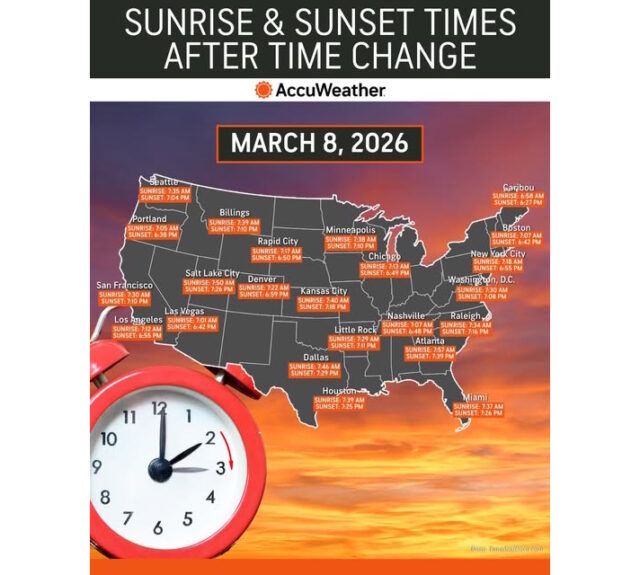
The biannual ritual of “springing forward” returns this weekend, as millions of Americans prepare to lose an hour of sleep in exchange for later sunsets and the promise of warmer days ahead. At 2:00 a.m. local time on Sunday, clocks across most of the United States will jump ahead to 3:00 a.m., marking the official start of Daylight Saving Time (DST). While the shift brings the welcome arrival of evening light, it also reignites a decades-old frustration for many who are weary of the disruption to their internal rhythms.
For the vast majority of the country, this shift is a routine part of the calendar, but the conversation surrounding its necessity has reached a fever pitch. In recent years, lawmakers and health experts have increasingly questioned whether the benefits of extra evening daylight outweigh the physiological and safety risks associated with the sudden change.
The AccuWeather Perspective: More Than Just a Clock Change
AccuWeather meteorologists have long tracked the impacts of these seasonal shifts, noting that the transition is about much more than just an hour on the wall. According to AccuWeather, the shift to Daylight Saving Time can have a profound impact on daily life, from energy consumption to home safety.

“When Daylight Saving Time ends and clocks fall back one hour, it’s the perfect reminder to tackle quick home maintenance tasks—from replacing batteries to reversing ceiling fans,” says Brian Lada, an AccuWeather meteorologist. This advice applies equally to the “spring forward” transition. AccuWeather recommends using the time change as a semi-annual cue to check smoke detector batteries, replace air filters, and ensure emergency kits are stocked.
Beyond home maintenance, AccuWeather highlights the dramatic change in the “feel” of the day. While the total amount of daylight increases as we approach the spring equinox, the one-hour jump creates an immediate and noticeable difference in our evening experience. In some northern states, the sun will now stay up well past 7:00 or even 8:00 p.m., providing a psychological boost and more opportunities for outdoor recreation.
The Health and Safety Toll
Despite the allure of evening sun, the “spring forward” transition is widely considered the more difficult of the two annual changes. Research has consistently shown a temporary spike in health and safety issues in the days immediately following the loss of that hour.
Studies have documented a measurable uptick in fatal car accidents, heart attacks, and workplace injuries during the first week of DST. The culprit is typically sleep deprivation. Even a single hour of lost rest can throw off the body’s circadian rhythm—the internal clock that regulates sleep, hormone release, and metabolism.
Health experts, including the American Academy of Sleep Medicine, have gone so far as to advocate for a permanent move to Standard Time. They argue that Standard Time more closely aligns with the human biological clock and the sun’s natural movement. However, public opinion remains split; while many hate the change itself, a significant portion of the population prefers the later sunsets of DST over the earlier sunrises of Standard Time.
The Legislative Battle: Will It Ever End?
The question of whether this could be the “last time” we change our clocks has been a topic of debate for several years. The Sunshine Protection Act, a federal bill that would make Daylight Saving Time permanent across the U.S., has seen various levels of success in Congress. In 2022, it famously passed the Senate by unanimous consent but stalled in the House of Representatives.
The debate is complicated by the fact that states have limited power. Under current federal law, states can opt out of Daylight Saving Time and remain on Standard Time year-round (as Hawaii and most of Arizona do), but they are not permitted to adopt permanent Daylight Saving Time without an act of Congress.
Dozens of states, including Florida, California, and various blocks in the Midwest, have already passed their own triggers or resolutions stating they will move to permanent DST as soon as federal law allows. Proponents argue that permanent DST would boost the economy by encouraging people to shop and eat out later, while also reducing energy use. Opponents, however, point to the “dark morning” problem—in the middle of winter, many northern regions wouldn’t see the sun rise until nearly 9:00 a.m., meaning children would be waiting for school buses in total darkness.
Preparing for the Shift
As we head into Sunday, experts suggest several ways to mitigate the “shock” of the hour loss:
- Incremental Adjustments: Go to bed 15 to 20 minutes earlier each night in the days leading up to the change.
- Morning Sunlight: Seek out natural light as soon as you wake up on Sunday morning to help reset your internal clock.
- Check Your Tech: While most smartphones and computers update automatically, don’t forget the “manual” clocks on ovens, microwaves, and older car dashboards.
As the sun sets an hour later this Sunday, many will celebrate the unofficial start of the “outdoor season.” Whether this becomes a permanent fixture of American life or remains a twice-yearly chore depends on the halls of Congress. For now, the nation prepares to lose an hour of sleep—and find a little more light at the end of the day.
Source: AccuWeather
Disclaimer
Artificial Intelligence Disclosure & Legal Disclaimer
AI Content Policy.
To provide our readers with timely and comprehensive coverage, South Florida Reporter uses artificial intelligence (AI) to assist in producing certain articles and visual content.
Articles: AI may be used to assist in research, structural drafting, or data analysis. All AI-assisted text is reviewed and edited by our team to ensure accuracy and adherence to our editorial standards.
Images: Any imagery generated or significantly altered by AI is clearly marked with a disclaimer or watermark to distinguish it from traditional photography or editorial illustrations.
General Disclaimer
The information contained in South Florida Reporter is for general information purposes only.
South Florida Reporter assumes no responsibility for errors or omissions in the contents of the Service. In no event shall South Florida Reporter be liable for any special, direct, indirect, consequential, or incidental damages or any damages whatsoever, whether in an action of contract, negligence or other tort, arising out of or in connection with the use of the Service or the contents of the Service.
The Company reserves the right to make additions, deletions, or modifications to the contents of the Service at any time without prior notice. The Company does not warrant that the Service is free of viruses or other harmful components.