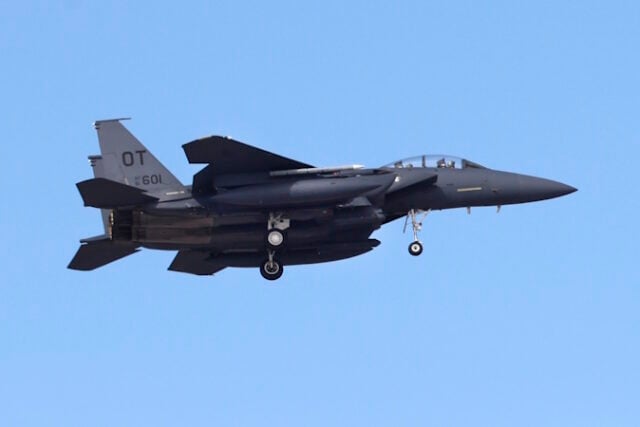
Tensions reached a breaking point this morning, April 3, 2026, when a U.S. F-15E Strike Eagle was confirmed shot down during a mission over the Khuzestan region of Iran. The sleek, dual-engine fighter vanished from radar shortly after reporting a missile lock, leaving a trail of wreckage and two empty ejection seats in its wake. In a race against both time and the elements, the U.S. military has scrambled a massive rescue task force, including HH-60G Pave Hawk helicopters and specialized Pararescue teams, to locate the two missing crew members who are currently evading capture in hostile territory.
For the first time since the war’s inception in early March, a manned U.S. combat aircraft has been confirmed shot down over Iranian territory. The aircraft, a Boeing F-15E Strike Eagle assigned to the 494th Fighter Squadron (the famed “Black Panthers” out of RAF Lakenheath), plummeted into a rural, mountainous region of southwestern Iran.
Within minutes, the digital fog of war began to lift. Iranian state media outlets, including channels affiliated with the Revolutionary Guard, began broadcasting shaky cell phone footage of a vertical tail fin emblazoned with the “LN” tail code—the unmistakable signature of the Lakenheath-based squadron. By 10:00 AM EDT, the Pentagon, though initially silent, was forced to acknowledge the reality: two American aircrew members were on the ground in hostile territory, and a massive, desperate Combat Search and Rescue (CSAR) operation was underway.
The “Golden Hour”: A Race Against Time and Tehran
In the world of CSAR, the first sixty minutes are known as the “Golden Hour.” If a pilot isn’t recovered within that window, the probability of capture or death increases exponentially. As of this writing, that window has long since closed, but the mission has only intensified.

Observers and OSINT (Open Source Intelligence) analysts have verified footage showing a specialized armada crossing into Iranian airspace from the west. The rescue package is a textbook “Personnel Recovery” task force:
- HC-130J Combat King II: The “quarterback” of the rescue mission, providing aerial refueling and command-and-control.
- HH-60G Pave Hawk Helicopters: The workhorses of the Air Force’s rescue wings, these helicopters are equipped with hoist systems, advanced sensors, and door gunners to extract personnel from “hot” zones.
- MC-130J Commando II: Specialized Special Operations aircraft likely inserting Ground Recovery Teams (GRT) or Pararescuemen (PJs).
Footage filmed from the ground near the Kohgiluyeh and Boyer-Ahmad province showed these helicopters flying at “treetop level”—a terrifyingly risky tactic intended to evade Iranian radar and surface-to-air missiles (SAMs). According to Mark Cancian, a senior adviser at the Center for Strategic and International Studies (CSIS), “The fact that they are flying so low and slow indicates a willingness to take immense risk. They aren’t just looking for wreckage; they are hunting for lives.”
The Crew: Two Empty Seats in the Desert
The F-15E is a tandem-seat fighter, meaning two souls were on board: the pilot in the front and the Weapon Systems Officer (WSO) in the back. While their identities have not been released pending family notification, their fate has become the focal point of a global standoff.
Iranian media has already published photos of an ACES II ejection seat found in a desert landscape. The seat was separated from the aircraft, a clear indicator that at least one, and likely both, of the crew members successfully “punched out.” For the families of these airmen, the image of that empty seat provides a sliver of hope—they survived the initial blast. But for the military planners in Washington, it marks the start of a nightmare.
Tehran has wasted no time in weaponizing the incident. Iranian state television has issued a scrolling crawl on the screen: “Shoot them if you see them.” Local anchors have urged residents to capture the “enemy pilots” and hand them over to the police, promising substantial financial rewards for their delivery. In a region as rugged and rural as southern Iran, the crew’s survival depends as much on their SERE (Survival, Evasion, Resistance, and Escape) training as it does on the speed of the Pave Hawks.
Technical Breakdown: How Did It Happen?
The F-15E Strike Eagle is a fourth-generation-plus powerhouse. It is designed to survive in high-threat environments, using its AN/APG-82 AESA radar and advanced Electronic Warfare (EW) suites to jam or evade enemy defenses. However, no aircraft is invincible.
Initial reports suggest the Strike Eagle was downed by a sophisticated Iranian air defense system. Whether it was the indigenous Bavar-373 (often compared to the Russian S-300) or a more mobile, tactical system like the Khordad-15, remains a matter of intense debate among aviation experts.
“The 494th has been flying high-tempo missions since Operation Epic Fury began,” says Justin Bronk of the Royal United Services Institute (RUSI). “This wasn’t a fluke. Iran has spent decades preparing for this exact scenario—denying the U.S. total air superiority through a layered, ‘picket fence’ of mobile SAM sites.”
The Context: A Month of Fire in Iran
To understand the weight of this shoot-down, one must look at the preceding four weeks of conflict. The war, which began in early March 2026, has been a brutal reminder that modern near-peer conflict is not the one-sided affair of the 1991 Gulf War.
Prior to today, the U.S. had suffered significant, albeit mostly robotic, losses:
- March 5-9: At least nine MQ-9 Reaper drones were shot down or lost over Iranian territory.
- March 12: A tragic mid-air collision between two KC-135 Stratotankers over Iraq claimed six lives.
- March 19: An F-35 Lightning II was forced to make an emergency landing after being peppered by ground fire.
Perhaps the most embarrassing incident occurred on March 1, when three U.S. F-15Es were mistakenly shot down by Kuwaiti air defenses in a “friendly fire” incident. While the crews in that instance were recovered safely, it shook the confidence of the coalition. Today’s event is different. This was not a mistake by an ally; it was a successful, hostile strike by the enemy.
The Political Fallout: Bargaining Chips or POWs?
The white-knuckle rescue mission currently unfolding is about more than just two airmen; it is about the narrative of the war. For the Trump administration, the capture of two American pilots would be a catastrophic PR blow, potentially turning the tide of domestic support for the conflict.
In Tehran, the mood is one of defiant celebration. After weeks of enduring U.S. and Israeli airstrikes on their infrastructure, the sight of a downed “Great Satan” warplane is a powerful morale booster. If the crew is captured, they will likely be paraded on state television—a violation of the Geneva Conventions that has, unfortunately, become a staple of modern asymmetric warfare.
“This is the moment every commander fears,” says an anonymous Pentagon official. “You have people on the ground in a country where every civilian is being told they are worth a bounty. We are throwing everything we have into that search area. We are not leaving them behind.”
Historical Parallels: Shadows of the Past
Military historians are already drawing parallels to the 1995 shoot-down of Captain Scott O’Grady in Bosnia. O’Grady survived for six days on grass and rainwater before being rescued by a daring Marine Corps mission. However, O’Grady was evading paramilitary forces in a fragmented state; the F-15E crew is evading a centralized, motivated military and a civilian population incentivized to find them.
The stakes are higher. In 1960, the shoot-down of Gary Powers and his U-2 spy plane derailed a superpower summit. In 2026, the fate of these two airmen could determine whether the current war escalates into a full-scale ground invasion or moves toward a tense, bloody stalemate.
The Current Situation: Friday, 10:30 AM
As of this hour, the status of the CSAR mission is “Ongoing.” Satellite imagery and social media reports indicate a “no-fly zone” has been effectively established by U.S. fighter caps (F-22s and F-15Cs) circling over the search area to protect the slow-moving rescue helicopters.
The terrain—steep ridges and deep valleys—is a double-edged sword. It provides cover for the pilots to hide, but it also creates “dead zones” for radio communication and makes the landing of a Pave Hawk nearly impossible. The crew likely has handheld radios, signaling mirrors, and infrared strobes, but they must use them sparingly to avoid alerting Iranian search parties.
Conclusion: The Human Cost of High-Tech War
The downing of the F-15E Strike Eagle is a sobering reminder that behind every billion-dollar weapon system and every geopolitical chess move, there are individuals—husbands, wives, sons, and daughters—strapped into ejection seats.
The next few hours will be the most critical of their lives. Whether they are extracted by the daring crews of the 494th and the rescue squadrons or fall into the hands of the Iranian Revolutionary Guard, this Friday will be remembered as the day the war in Iran truly “got real” for the American public.
We will continue to update this story as the Pentagon releases more information. For now, the world watches the grainy footage of helicopters over the Iranian desert, hoping for a miracle in the mountains of Khuzestan.
Sources and Links
- Military Times: US fighter jet shot down over Iran
- The Guardian: US F-15E jet confirmed shot down over Iran as Tehran releases wreckage images
- Washington Post: U.S. fighter jet crashes in Iran; search launched for 2 crew members
- New York Magazine (Intelligencer): U.S. F-15 Shot Down Over Iran, Search for Crew Underway
- Simple Flying: Breaking: US F-15 Shot Down In Iran
- Axios via UNN: US fighter jet shot down in Iran, crew search underway
- Defence Blog: U.S. Air Force launches F-15 rescue mission in Iran
- Wikipedia: List of aviation shootdowns and accidents during the 2026 Iran war
- U.S. Central Command (CENTCOM): Three U.S. F-15s Involved in Friendly Fire Incident in Kuwait
- CTV News / Associated Press: Affiliate of Iranian state TV claims a U.S. pilot ejected from their aircraft
Disclaimer
Artificial Intelligence Disclosure & Legal Disclaimer
AI Content Policy.
To provide our readers with timely and comprehensive coverage, South Florida Reporter uses artificial intelligence (AI) to assist in producing certain articles and visual content.
Articles: AI may be used to assist in research, structural drafting, or data analysis. All AI-assisted text is reviewed and edited by our team to ensure accuracy and adherence to our editorial standards.
Images: Any imagery generated or significantly altered by AI is clearly marked with a disclaimer or watermark to distinguish it from traditional photography or editorial illustrations.
General Disclaimer
The information contained in South Florida Reporter is for general information purposes only.
South Florida Reporter assumes no responsibility for errors or omissions in the contents of the Service. In no event shall South Florida Reporter be liable for any special, direct, indirect, consequential, or incidental damages or any damages whatsoever, whether in an action of contract, negligence or other tort, arising out of or in connection with the use of the Service or the contents of the Service.
The Company reserves the right to make additions, deletions, or modifications to the contents of the Service at any time without prior notice. The Company does not warrant that the Service is free of viruses or other harmful components.